For nearly a century, Mercedes-Benz and the Vatican have maintained a singular relationship, if not almost idyllic.
Mercedes-Benz and the Vatican: a Century of History
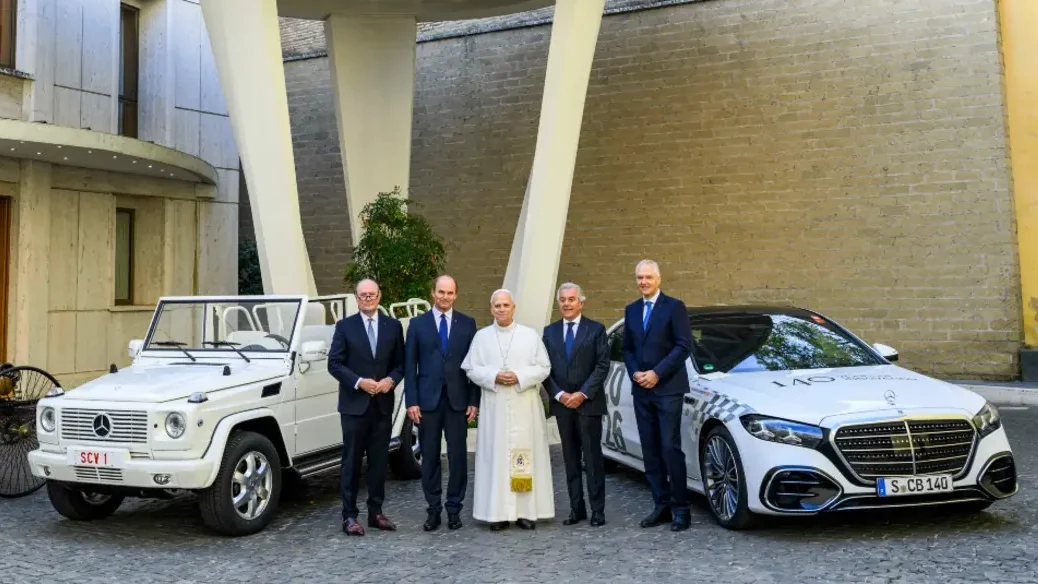
To honor these long-standing, close ties, the two institutions have joined forces around an exhibition installed in a glass pavilion near the Vatican’s Pinacotheca. Open through January 31, 2027, it traces the history of the famous “Papamobiles” from Mercedes-Benz, and even received the blessing of Pope Leo XIV himself! Titled Mercedes-Benz: A Century of Papamobiles, it brings together eight historical vehicles that tell how the German automaker imagined, decade by decade, the way the Pope is transported. The connection to current events is hardly hard to miss: during his trip to France last month, Leo XIV rode in a 100% electric G-Class. But let’s go back a little further. It all began in 1930, when Daimler-Benz presented Pope Pius XI with a Nürburg 460, a Pullman limousine driven by an eight-cylinder inline engine of 4.6 liters. It was the first car regularly used by a pope, and it already pushed personalization to a remarkable level: the pontiff’s seat was covered in silk, the panels were of wood and precious metals, and the ceiling was richly decorated with illuminated artwork.
Eight historical vehicles to discover
The following decades saw models that grew ever better suited to the papal function. In 1960, Pope John XXIII received a Landaulet 300 d with an extended wheelbase, whose rear glass fully retracts for public appearances, with steps that deploy when the doors are opened and a center seat that is electrically adjustable. In 1965, Paul VI received a 600 Pullman Landaulet with widened doors, an elevated roof, a cooling system, and an intercom to speak with the driver. Two years later arrived 300 SEL Pullman limousines, longer by 650 millimeters than the production version, intended primarily for Vatican VIP guests. But the real turning point came in 1980, when John Paul II visited Germany. Mercedes then created the first papamobile in the modern sense: a long-wheelbase Classe G, painted in mother-of-pearl with gold accents and a white interior, its rear crowned by a transparent dome. The pope is protected from the elements while remaining perfectly visible to the crowds, which changed the way a pontiff presents himself to the faithful. This concept was subsequently applied to the Classe M, with the ML 430 in 2002, used for World Youth Day in Toronto, then the ML 500 introduced in 2012 to Benedict XVI, whose expanded glass structure facilitated access. Since 2024, the Vatican has its first fully electric papamobile, a G 580, which symbolically closes this century of history… while ushering papamobiles into a new era.