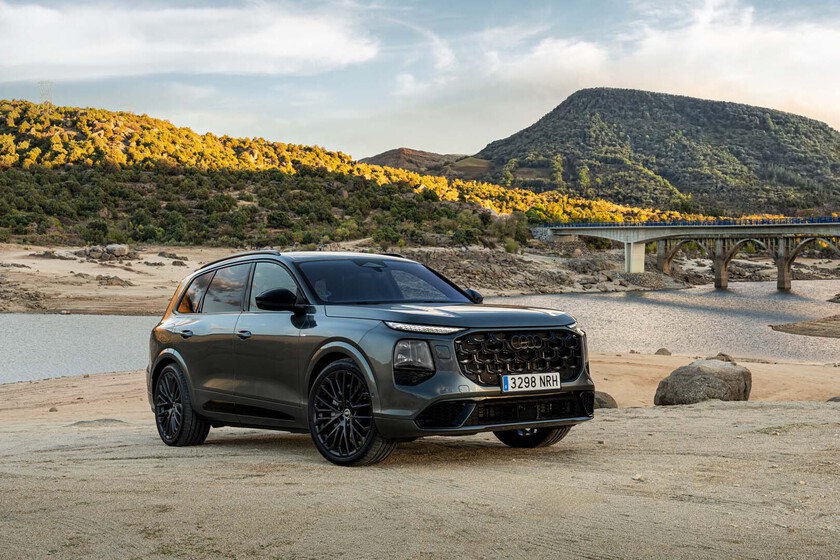
Two decades after the arrival of the first Audi Q7, the four-ring brand launches the third generation of this large, premium SUV.
It is now available with five, six or seven seats and with two engines, both diesel MHEV with the DGT ECO label: a 3.0-liter V6 TDI with 245 hp and the same block with 299 hp. Later, PHEV versions with the DGT ZERO label will arrive.
The biggest Audi you can buy. Until the Q9 arrives
Twenty years have passed since Audi launched the first Audi Q7 and, therefore, its first SUV. Since then, many things have changed: SUVs have come to dominate the market, the automotive industry has electrified in multiple ways, diesel engines have almost disappeared and Chinese brands have managed to push Western manufacturers to the limit, even in the high-end large-SUV segment of which the Q7 is a part.
As the second generation Q7 had been on sale for too long, Audi has decided to renew this SUV, not only to take on its increasingly dangerous Chinese rivals, but also to fight against traditional opponents, which are many: BMW X5, Mercedes-Benz GLE, Volvo XC90, Porsche Cayenne, Range Rover Sport and Lexus RX (the Volkswagen Touareg should also be on this list, but it has been discontinued without a successor).

With this new Q7, Audi launches its flagship, at least until the imminent Q9 arrives because the A8 is no longer marketed. That means that, if Audi has always treated the Q7 with care, it does so with even more reason because this SUV is one of the main showcases of its technology worldwide.
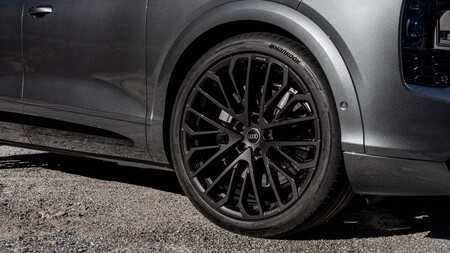
It leaps out at you as soon as you see it. In addition to adopting the design language of Audi’s latest releases, it introduces solutions that no other Audi has, such as the illuminated grille and the possibility of mounting up to 23” wheels with the top Black Line finish, and even features we have not seen on any other car, such as projecting the turn signals onto the ground.
As my colleague Irene Mendoza told you a few days ago, the indicators have been doing the same thing for more than 100 years, but Audi has reinvented them and the first model to incorporate this technology is the Q7, though the Q9 will soon arrive as well.
Ver esta publicación en Instagram
Through small projectors integrated into the front headlights and rear taillights, when the lights are on and the turn signals activate, the Q7 projects orange illuminated arrows onto the pavement. The aim is to give other road users more opportunities to see these cues.
Obviously, these arrows are only visible in low-light conditions, ideally at night, and they are useful both on the highway, for example to indicate that an overtaking maneuver or a lane change is about to occur, and in the city, whether to indicate that you are leaving a parking space or that you are about to exit a roundabout, among other things.
All technology that helps widen the chances of a warning being seen should be welcome. Note that traditional indicators remain in place; this projection simply adds to those signals.
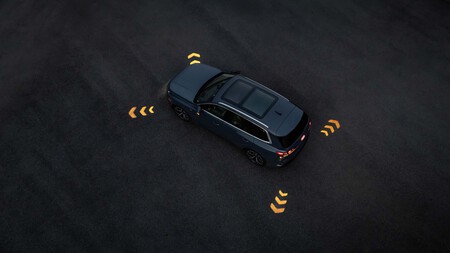
To these new turn signals, there are added other technologies we already knew, such as the digital Matrix LED headlights (which can also project things onto the ground or on the opposite wall, such as the four rings logo when the car is switched on) or the taillights that, like the headlights, allow changing the lighting signature.
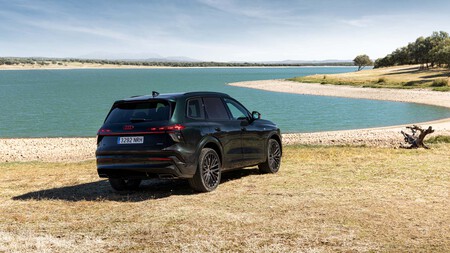
The size of the car is also new. Not so much its measurements, but that it does not follow the trend of almost every model to grow compared to its previous generation: it measures 5.05 meters in length, nearly one centimeter shorter than its predecessor.
It remains enormous, but it isn’t longer; in fact, when I saw it up close I thought it would be quite a bit shorter than the previous Q7, and this is due to a design with more SUV-like shapes than before, especially at the rear: the second generation of the Q7 had certain “wagon” traits, with a slanted rear window and a more inclined D-pillar, whereas the new Q7 has more squared-off shapes. Still, if anyone finds the Q7 small, bear in mind that the Q9 reaches 5.30 meters in length…
Continuing with the novelties, one of the things that draws the most attention of the new Q7 are its doors, or rather the way they open and close because they have electric opening and closing.
It is not the first time we see this system in a car; in fact, it is becoming fashionable among premium models, but, although it works well and is comfortable, it is hard to get used to because we all tend to open the door by pulling the handle and push it to close it, as we have always done, so it requires a mental adjustment to let the car perform these processes automatically.
It’s like when you move from a car with a conventional tailgate to one with an electric tailgate: the first openings and closings, by inertia, we do manually, until we get used to letting the system work.
With all this, it is not one of those ultra-useful technologies that changes our life; I already said it is convenient, but in other cases it is the opposite, for example when opening a rear door to leave a coat because what could be done in a blink ends up taking longer (the system needs its times to open and close).
That said, if any door detects an obstacle, such as a wall, another car or a person, the opening stops abruptly, so with this system there should be no chances of slamming into other vehicles. It is appreciated.
Audi Q7: interior
Of course, the tailgate is electric and provides access to a gigantic trunk, as has been the case since the first Q7. This time, capacity is 670 liters with the five-seat configuration and 581 liters with the seven-seat interior.
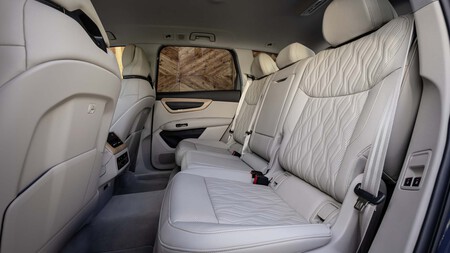
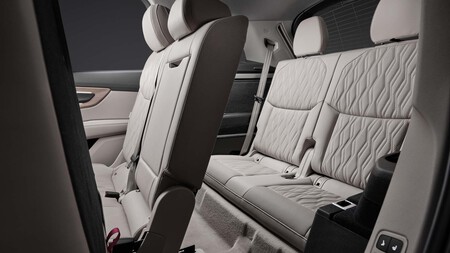
This latter option has also been a Q7 hallmark since it arrived 20 years ago, and in this third generation the possibility of having three rows of seats could not be missed; there is also the option to configure the interior with six seats, with two independent seats in the middle row.
And since we’re on the topic of electric functions, folding the two rear rows is also electric, and you just press another button to unfold them, also electrically. When folded, the boot capacity becomes 2,075 liters in the five-seat version and 1,980 liters in the seven-seat version: the Q7 becomes a “van.”
Staying inside, in the front, the electrically controlled functions reach the climate vents. To adjust the vanes, you must do it through the touchscreen.
Personally, I don’t see this as a positive feature because it takes longer than traditional physical controls, not to mention that the driver can get distracted if you do it while driving since you must look at the central touchscreen to direct the airflow to the desired position.
Sometimes brands get a little too modern, and this is one of those cases. The worst part is that this isn’t exclusive to Audi, because more and more cars feature these kinds of controls, both European and Chinese.
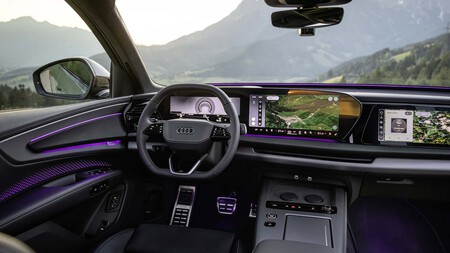
The upside is that the dashboard design is cleaner and on top of that there is the almost total absence of buttons: there aren’t even dedicated controls for the climate control temperature, something that must be adjusted from the central screen or via voice control.
As with the exterior, the new Q7 adopts the interior design language of the latest Audis, and the lack of physical buttons is one of the consequences, although, fortunately, there are physical buttons for key functions, such as volume up and down, mirror adjustments, adjusting the position of the front seats (and the rear seats if they are electric) and, of course, for operating the power windows.
Another consequence of this interior design is that the screens take center stage, including a third screen that can optionally sit in front of the passenger. Yes, more buttons would be welcome, but since Audi has bet (almost) everything on screens, it has done well, and both the instrument cluster and the Google-integrated multimedia system earn a solid pass.
It’s also worth noting that someone in Germany has thought of something practical like customizable shortcuts when lifting the central screen, to, among other things, be able to switch off the speed warning or disable some ADAS, such as the lane-keeping assist, without navigating through several menus.
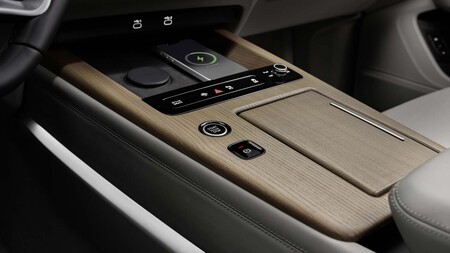
By the way, it’s also fair to say that the Ingolstadt engineers have nailed another issue: they have finally done away with piano black plastic interior. Or practically because there are hardly any surfaces finished in this finish that attracts dirt and scratches so easily. That kind of plastic doesn’t look good in any car, but less so in a high-end one like this, so nobody will miss it.
That absence of piano black, in my opinion, increases the perceived quality, both visually and to the touch, though overall this Q7 hasn’t really advanced in this respect compared to its predecessor. It’s well made, as one would expect in a car of this segment, but it isn’t better made than the previous Q7, neither in materials nor in fit and finish.
Yes, the interior insulation has improved. The work Audi has done in this area is frankly good. The quietness on the move is another of the things everyone expects in a car of this caliber, and the Q7 satisfies it to a large extent. The driving position is equally easy to get comfortable with, thanks to how good the seats are and the numerous adjustments they offer.
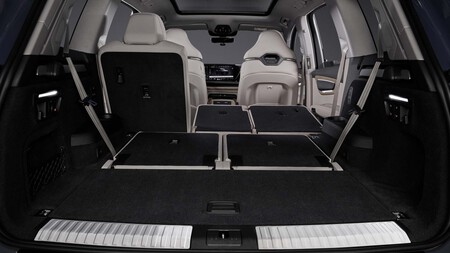
The test unit I drove for the media drive was equipped with the optional sporty front seats plus and I found them superb, in terms of comfort and support. They also come with two built-in speakers on either side of the headrest that form part of an optional Bang & Olufsen premium 4D sound system that sounds simply spectacular.
If you ask me, this sound system is a must-have for true music lovers, though it isn’t cheap since it costs 1,115 euros, but Audi requires also selecting the Premium Package (13,185 euros) to configure it and that mandatory combination, which includes the adaptive driving assistant plus or the panoramic sunroof with electric transparency control, among other things, increases the final price of the car by 14,300 euros.
Indeed, the configurability options for this car are immense, both outside and inside, and that’s while Audi assures us they have reduced options, such as the wheel catalog, which is no longer as extensive as before, or the engine range, which is limited to two options for now (more PHEV options will be added later).
Audi Q7: this is how it goes
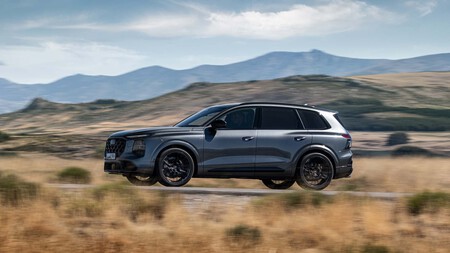
In reality, the new Q7 is offered with a single engine, but it is available with two power levels. It is the 3.0-liter V6 TDI, which can be chosen with 245 hp or 299 hp, always paired to quattro all-wheel drive and the eight-speed Tiptronic automatic with a torque converter.
Yes, you read that correctly: TDI. By late 2026, it’s odd to talk about launching a diesel car, and even more so about releasing a model that, for now, bets everything on diesel, with a fairly large block by current standards, a 3.0-liter six-cylinder, though it’s true that this V6 is electrified with a 48 V mild-hybrid system at both power levels, which earns it the DGT ECO label.
Behind (far behind) are the days when the Q7 could mount a 6.0-liter V12 TDI with 500 hp and 1,000 Nm of torque (what a madness), but that a SUV of such dimensions and weight (more than 2,400 kg) would offer diesel powertrains is, without a doubt, good news. Love it or hate it, this type of engine fits a car like this to a T.
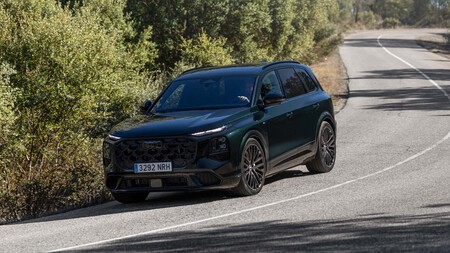
The unit I tested was equipped with the 299 hp V6 TDI and I found it engaging because it pushes and moves this “beast” with ease, yet it remains smooth, pleasant and relatively quiet. In this regard, TDIs have improved a lot compared to the 3.0-liter V6 TDI engines used in the first Q7, and also in terms of consumption because it’s easy to see averages around 8-8.5 L/100 km.
The MHEV system contributes to the enjoyment of use (and to keeping consumption in check) because it allows operating in fully electric mode at certain moments, such as during maneuvers or when driving at high throttle in certain situations.
But not everything is due to the engine (and how well the transmission shifts). The tuning plays a large part in why the Q7 feels agile. It’s an adjective that, at first glance, seems odd for such a large and heavy car, but the truth is that it is agile, especially with the optional air suspension S that the test unit had and with the four-wheel steering (also optional).
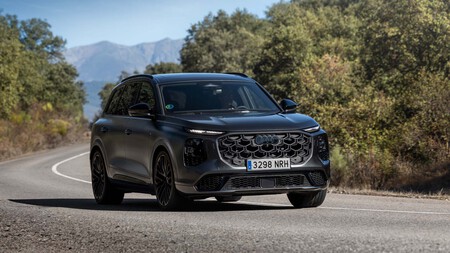
With this suspension, it’s a comfortable car, but the tuning is fairly firm, so it isn’t a “boat” that wallows in corners or during brakes, while the steering allows turning with far more ease than one would expect from such a “tank,” both on the highway and when maneuvering at low speed.
All this remains technology, like the turn signal projection or the electric doors, but applied to the dynamic plane. As you can see, the new Q7 is packed with technology, and you can still load it up even more by piling on the options available when configuring it.
Audi Q7 price
The risk is that the price can rise considerably, and that even without extras it isn’t exactly cheap because it starts from 95,630 euros in Spain with the Advanced base trim and the 245 hp TDI engine; with the same trim and the 299 hp TDI it starts at 98,500 euros.
The mid-range finish is the S line, with a starting price of 101,330 euros for the 245 hp version and 104,200 euros for the 299 hp version, while the top Black Line starts from 108,630 euros with 245 hp and 115,760 euros with 299 hp.
Images | Audi