The figure on the speedometer glowed almost unreal: about 130 mph on a road posted for 70 mph. At the wheel was a 20-year-old man who did not have a driver’s license. He was speeding along a Breton county road in a car launched at ultra-high speed. France’s road gendarmes are accustomed to chasing down speeding, but an excess of 100 km/h over the limit is a rarer sight. This dramatic check will not stay a mere anecdote. It illustrates, in a very tangible way, how serious speeding is now being treated in France.
The events date back to Saturday, September 19, 2026, on the RD 177 in Ille-et-Vilaine. On this departmental stretch, the maximum authorized speed is 110 km/h (about 68 mph). That day, the motorized patrol officers of the Redon Motorcycle Brigade spotted a car approaching far too fast. Their reading showed 210 km/h (about 130 mph). Beyond the shock of the numbers, the officers uncovered another element: the driver, aged 20, did not even hold a driver’s license. Since December 29, 2025, a criminal traffic offense has applied from the first infraction for a very great speed excess. Combined with the absence of a license, the case of this young man can therefore carry significant judicial consequences.
210 km/h without a license on RD 177: the facts and the gendarmerie’s message
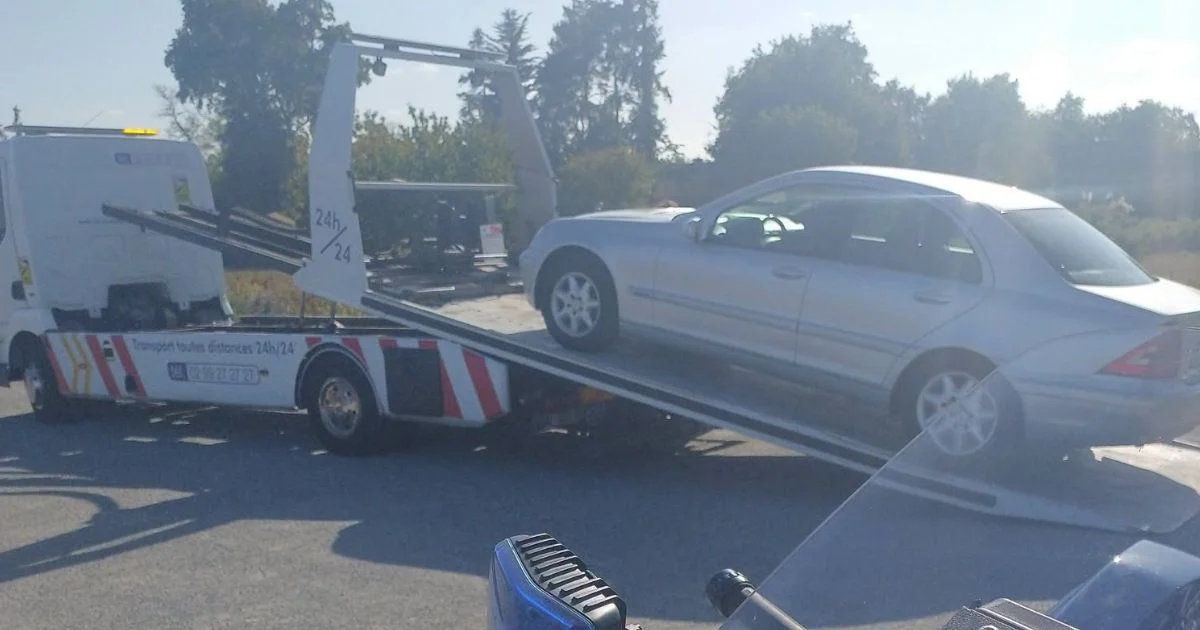
According to the information released, the stop occurred along this route that links Rennes to Redon. The car was immediately intercepted by the soldiers of the Redon Motorcycle Brigade, who proceeded with the standard checks. The measurement of 210 km/h in a 110 km/h zone equates to a 100 km/h overrun. In legal terms, the threshold for a serious speeding excess is set at 50 km/h above the posted limit. The vehicle was towed to the pound. A judicial procedure was opened against the 20-year-old driver, who was driving without a license. At this stage, no details have been provided about the young man’s motives or the subsequent steps in the case.
In the wake of the event, the Ille-et-Vilaine gendarmerie published a very explicit message to report the check. The post opens with a striking line: “110 km/h above the limits… recklessness in all its splendor.” The Ille-et-Vilaine gendarmerie published these words on Facebook. The authorities also recall the immediate response to this speeding: a blunt formula: “The sanction was as swift as his speed.” They specify that the car was towed and a judicial process launched. The same message underscores the legal framework strengthened since late 2025. It recalls the date of December 29, 2025—the entry into force of the new rule. From that threshold, any excess of more than 50 km/h above the limit falls under a criminal traffic offense. The gendarmerie ends with a direct appeal to road users: “We remind you that excessive speed destroys lives.” “You are not alone on the road.” “We urge you to double your caution and to scrupulously observe the speed limits.”
Serious speeding: a criminal traffic offense with heavy penalties
This control takes place within a recently revised legal framework. The July 9, 2025 law on road violence amended the regime governing serious speeding. A decree issued on December 22, 2025 clarified the application modalities. A speeding excess of at least 50 km/h over the posted limit is no longer a fifth-class contravention. It is now a criminal traffic offense from the first violation. In practical terms, this very great speed excess triggers a fixed criminal fine of €300 (roughly $330). The amount can be reduced to €250 for rapid payment or increased to €600 if payment is late. If the case is brought before the criminal court, the maximum penalty reaches €3,750 (about $4,000) in fines and up to three months in prison. Additional sanctions can be imposed that are notably punitive.
Among these additional sanctions, some directly affect the ability to get back behind the wheel. A serious speeding offense carries a 6-point deduction on the license, if the driver holds one. It can also result in suspension, or even cancellation, for several months. The judge may also prohibit the offender from applying for a new license for up to three years. The court may order the confiscation of the vehicle and entry of the offense on the criminal record. This strengthened framework comes as the number of serious speeding offenses climbs, with more than 63,000 excesses of at least 50 km/h recorded in 2024. Compared with 2017, this category of offenses has risen by about 70%. And speed remains the leading contributor to road deaths in France, involved in roughly one in three fatal crashes. This context helps explain the reaction to a 210 km/h, unlicensed drive on a road limited to 110 km/h.