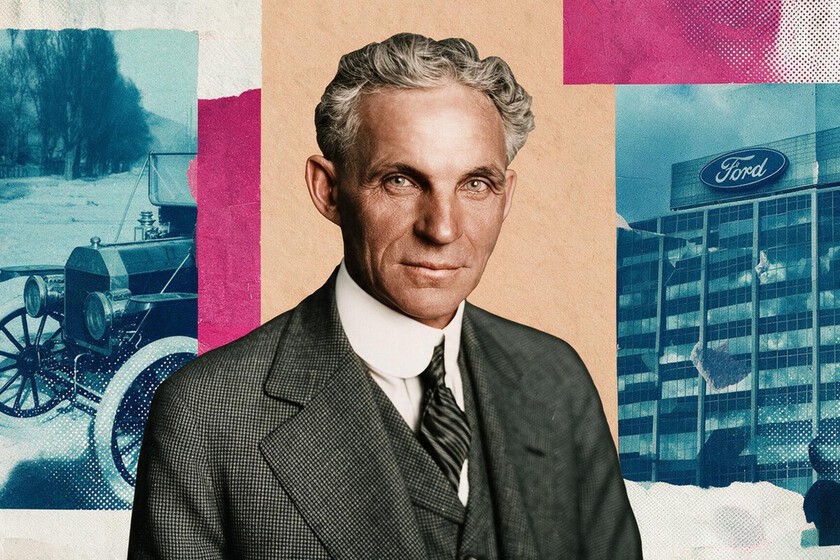
We know that Henry Ford didn’t start out with a managerial post in hand: he worked in a machine shop at 12, built his first steam engine at 15, and became an apprentice machinist at 16. But let’s not kid ourselves, Ford wasn’t some Samaritan; he simply understood that a happy worker is more productive than one who isn’t, and that directly affects profits.
But beyond applying this doctrine to the automotive industry, he was clear that nothing was guaranteed and that adaptability was the key to achieving the ultimate objective.
No method is sacred if it stops working
Henry Ford reportedly said in 1922 that none of his workers should consider themselves an expert, and if they did, they would have to be fired: “No one considers themselves an expert if they truly know their job.” For when you reach a level where nothing more can be improved, stagnation sets in.
For the entrepreneur who had to reinvent his business and learn to capitalize on commercial failures, such as his first two ventures (Detroit Automobile Company and Henry Ford Company), experimentation, observation, and learning from others formed the basis of success. And before revolutionizing the world with the Model T and the assembly line, he implemented business methods, car models, and sociological projects that failed spectacularly.
One of his failures was with the X-engine project: between 1920 and 1927 he became obsessed with developing an X-8 engine (eight cylinders arranged in an “X” around a single crankshaft) to replace conventional engines, but it had a defective mechanical design.

That is why he warned: “Be prepared to review any system, abandon any method, discard any theory, if the success of the job requires it“. Essentially, this means that no method is “sacred” if it stops working, so traditions should be taken with a grain of salt and never stop learning: absolute knowledge doesn’t exist in the end anyway.
So he applied this mindset to the production line, identifying what caused him to lose money or time and changing course. He decided that his workers should have decent working conditions to prevent uprisings, absenteeism and to increase productivity, and also give them leisure time—which would be supervised—for them to keep consuming and thus close the cycle.
Imagen | Magnific, Wikimedia