The mood at Maserati isn’t exactly festive these days. Sales are at a record low, with only 7,800 registrations in 2025, versus 11,300 in 2024 and more than 51,000 in 2017. These struggles have fueled rumors of a possible sale to a Chinese automaker. Those rumors were dismissed by Antonio Filosa, head of Stellantis, Maserati’s parent company: “Maserati is not for sale!” he told Italian lawmakers in June last year. However, a partnership with a collaborator (potentially Chinese) remains among the preferred options. This route would allow the development of two future premium models, meant to replace the Quattroporte sedan and the Levante SUV, both pulled from the lineup in 2023 and 2024.
Maserati Grancabrio Trofeo 590 hp: a light facelift
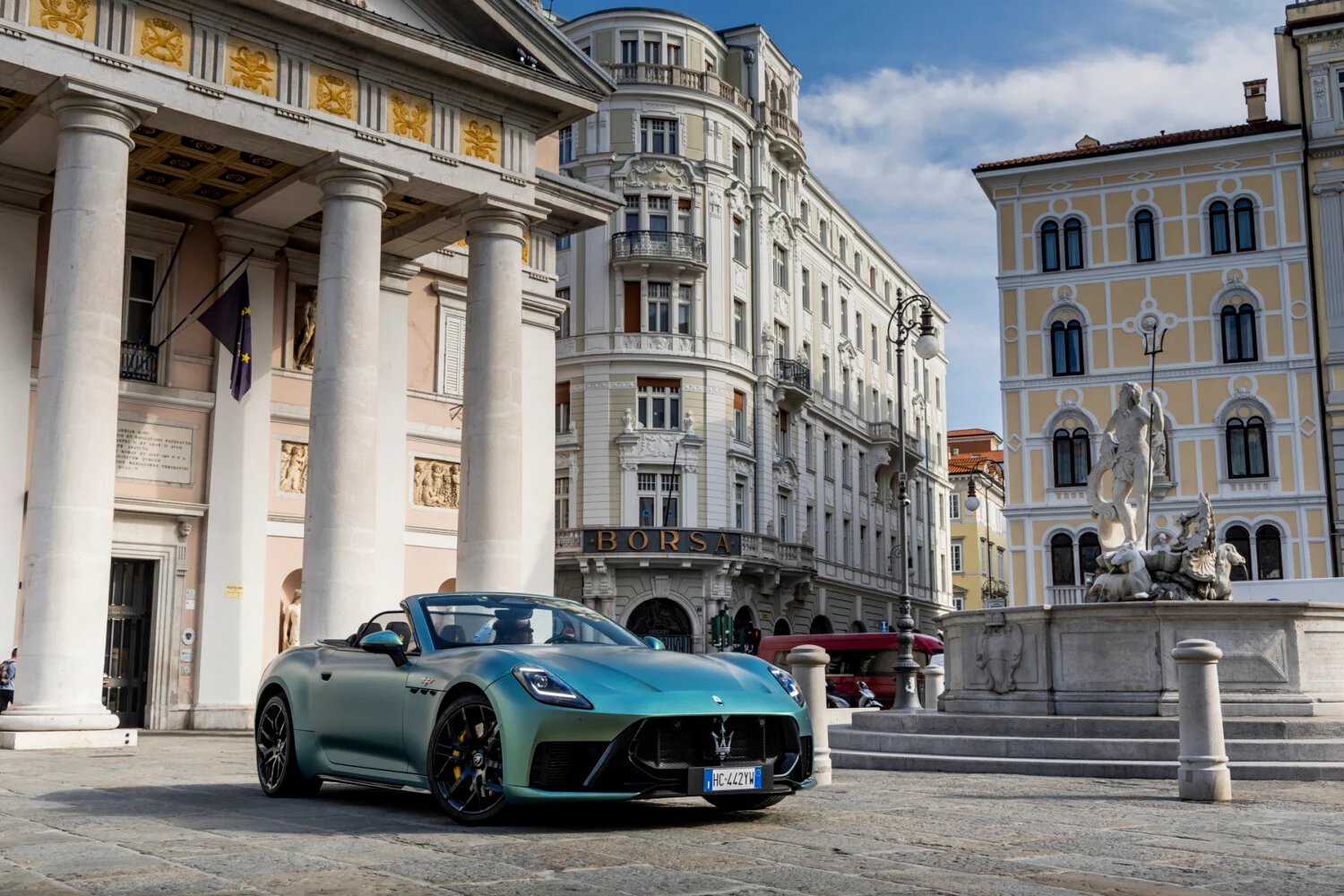
In the meantime, Maserati will have to manage with a pared-down lineup, consisting of the entry-level Grecale SUV, the GranTurismo and GranCabrio, as well as MCPura and GT2 Stradale for the sportier side. To stay above water, the GranTurismo and GranCabrio receive a mild refresh. The designers preserved the essence of the lines, which keep their curves and correct proportions. The main changes concern the nose, with the oval grille from the previous model giving way to more geometric shapes that sharpen the aggression. At the rear, the taillights are now housed under a transparent panel. New alloy wheels are added, and the color palette remains notably expansive, with no fewer than 45 body colors available, at a price that can be dizzying (€19,200 for matte Vert Jupiter on our test car). Inside, enthusiasts will notice a new almost hexagonal steering wheel and a redesigned digital gauge, while the gear-shift controls are now metal buttons with haptic feedback, making operation more convenient. Wrapped in leather, the cabin feels premium—the driver particularly appreciates the large aluminum shift paddles on the wheel—though some fit-and-finish details still leave room for improvement. The two rear seats, though narrow and not easy to access, can come in handy. The trunk, which ranges from 131 to 172 liters depending on whether the top is up or down, should be sufficient for a short lovers’ weekend. The fully electric soft top deploys and retracts in roughly 15 seconds up to 50 km/h (31 mph), but the operation can only be commanded from the touchscreen, which proves somewhat inconvenient.
Maserati Grancabrio Trofeo 590 hp: a 40-horsepower boost
Its 3.0-liter twin-turbo Nettuno V6 now delivers 590 horsepower, allowing it to stay ahead of the Porsche 911 Carrera 4 GTS Cabriolet (541 hp) and to close the gap with the Aston Martin Vantage (665 hp, or 680 hp in the S) and Bentley Continental GTC (680 hp). Maserati has also tweaked the management logic of the eight-speed ZF automatic transmission. Beyond that, the GranCabrio remains essentially unchanged, with a body that’s predominantly aluminum (65%), a front-mid engine layout, and all-wheel drive. The V6 retains its unique pre-chamber combustion system, with a combination of direct and indirect injection intended to reduce fuel consumption and emissions.
On the other hand, acoustic work was performed to enhance its sonic signature. It’s audible from startup! The exhaust emits a rasping, bass-rich note, and while one might still lament the glorious acoustics of the previous generation’s natural V8, the improvements are evident. There are still a few rough notes, mainly at low load, when the V6 runs on only half of its cylinders to save fuel. In terms of performance, the 40 hp increase does not translate into quicker runs, the 0–60 mph time hovering around 3.6 seconds.
Maserati Grancabrio Trofeo 590 hp: a kick in the pants, a velvet glove
When you push hard, the drivetrain delivers a firm shove, but the responses remain very linear, and there’s a certain lack of punch below 2,000 rpm. The gearbox prioritizes smoothness, even if shifts lack a touch of speed. The GranCabrio fully leans into its grand touring role: those seeking thrills should turn to the MCPura. In fact, the aerodynamic work minimizes buffeting, and the front occupants are well protected even with the windows down and without a wind deflector. With the deflector installed and the windows up, your hair will stay neatly in place at highway speeds. Finally, the double-lined roof provides excellent sound insulation. This grand-tourer vibe is matched by the suspension setup: in Corsa mode, comfort remains intact, and only the smallest road imperfections at low speed seep through the suspension. In the same vein, the steering is soft and very pleasant in city driving.
Unfortunately, these settings turn against the GranCabrio when you push the pace: the steering loses a bit of precision, the front axle reveals its limits, and the suspension struggles to control body movement (even in Corsa) and you can even lose pedal feel on rough roads. This Maserati isn’t one to press to the edge. It’s best to adopt a more relaxed tempo, even with an elbow on the door, to enjoy the GranCabrio’s comfort and the pleasing growl of its mechanicals. After all, that’s part of the dolce vita…
Maserati Grancabrio Trofeo 590 hp: its pros
- Overall comfort
- Look and presentation
- Rear seats usable
Maserati Grancabrio Trofeo 590 hp: its cons
- Sport-driving suspension
- Performance plateau
- Interface ergonomics
The Auto-Journal verdict: 4/5
The GranCabrio evolves only marginally: styling, ergonomics and sound. The comfort is remarkable, but Maserati hasn’t taken the opportunity to revisit the suspension tuning, which shows its limits on rough roads tackled at a brisk pace.
Maserati Grancabrio Trofeo 590 hp: in measurements
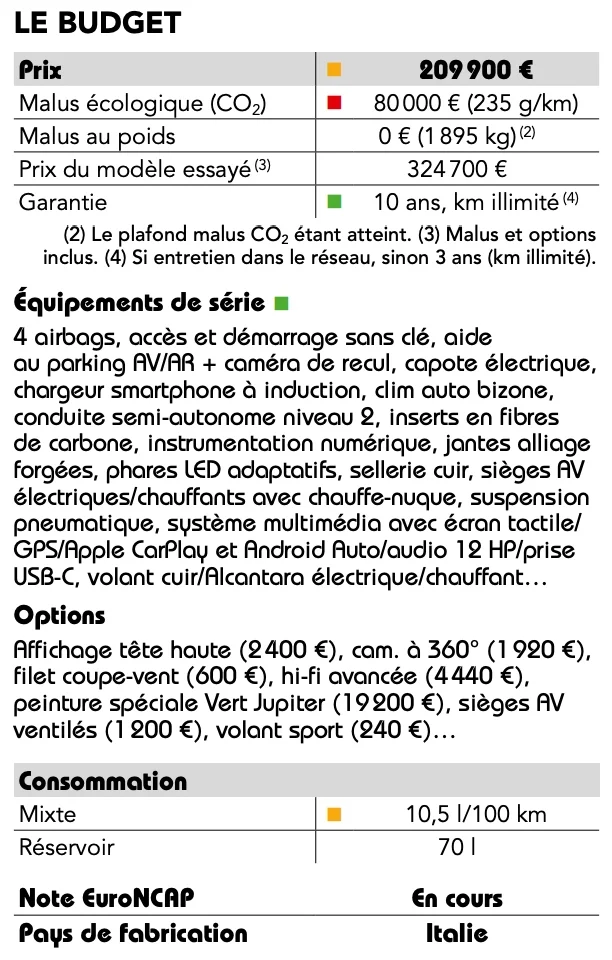
Find our first test of the Maserati Grancabrio Trofeo 590 hp in Auto-Journal issue 1216 dated September 3, 2026.