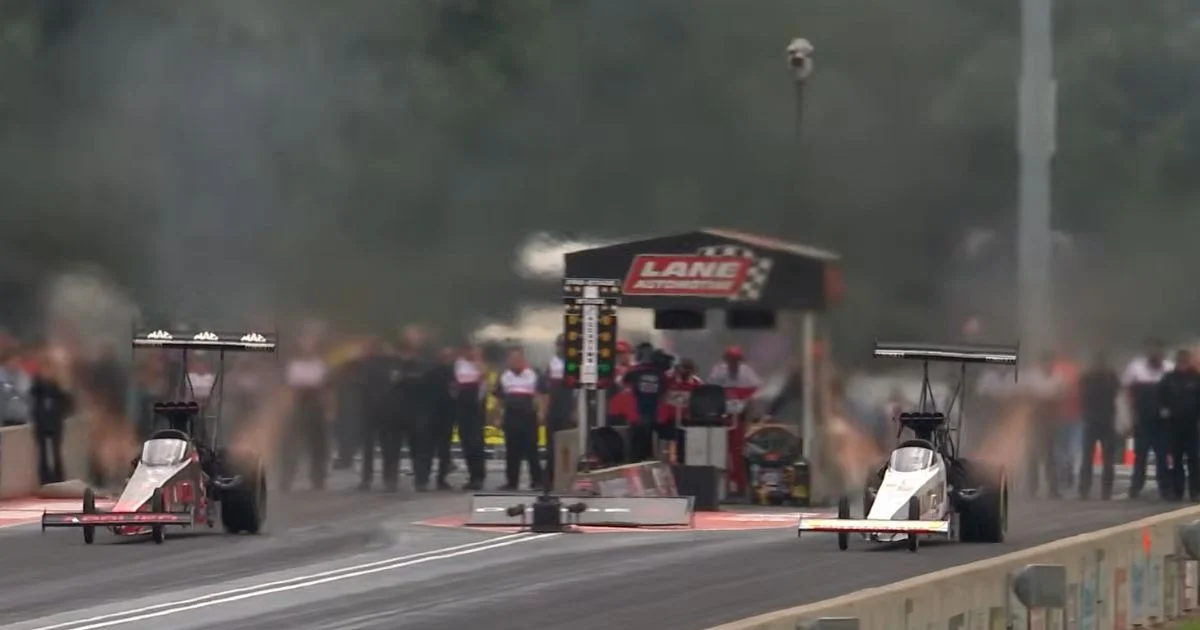
Nearly 560 km/h in only 305 meters: the figure is jaw‑dropping. And yet, it’s bona fide speed, recorded during an official race on the National Hot Rod Association circuit. In Top Fuel, a single run carved out a new NHRA speed record with a peak at 558 km/h. In this category, outright speed records rarely fall, which makes the feat even more remarkable.
This record‑setting run took place on the U.S. 131 Motorsports Park strip in Michigan. The championship event was finally contested on a Monday, after a weather‑caused postponement. In the semifinals, Shawn Langdon’s dragster covered the 1,000 feet sanctioned distance, i.e. 305 meters, in 3.663 seconds. The speed at the end of the strip topped out just under 560 km/h. Langdon already held the previous national mark at a little over 555 km/h. He went on to win the final with another pass exceeding 556 km/h on the same day.
NHRA Top Fuel Speed Record for Shawn Langdon
In Top Fuel, shattering the absolute speed record is a rare achievement. Before this run, the benchmark stood at 555 km/h, also held by Langdon. On this track, he bettered that mark in the semifinal against Doug Kalitta, posting a 3.663-second run over 305 meters. The speed at the finish line approached 560 km/h, the fastest ever recorded in NHRA history.
That Monday, Langdon didn’t merely break the record; he also captured the event title. In the final of the NHRA Great Lakes Nationals, he prevailed with a run around 560 km/h. The victory marked his sixth win of the 2026 season and the 28th of his career. It also put him atop the Top Fuel standings. The day unfolded on a track located roughly 230 meters above sea level. By comparison, many speed records were set at Pacific Raceways in Kent, a venue at about 94 meters altitude.
How a Top Fuel car reaches nearly 560 km/h
To hit such speed on only 305 meters, Top Fuel dragsters rely on extraordinary machinery. A supercharged V8 Hemi engine delivers around 12,000 horsepower with nitromethane. It’s the equivalent of roughly eight Bugatti Chiron hypercars. This brute force is transferred to the track through two giant rear tires standing about 36 inches tall and 17 inches wide. That translates to roughly 91 cm in diameter and 43 cm in width. They survive for only about 2.4 kilometers before needing a change. In front, by contrast, the much narrower front tires cut aerodynamic drag and help clinch those final kilometers per hour.
All that power must be channeled within a framework that NHRA keeps increasingly tight for safety. As safety measures, the race distance was shortened from 400 meters to 300 meters. On this shorter course, reaching close to 550 km/h becomes even more spectacular. In April 2025, Brittany Force became the first to surpass 547 km/h. This record continues a progression that began in 1964 at 320 km/h and reached 482 km/h by 1992.