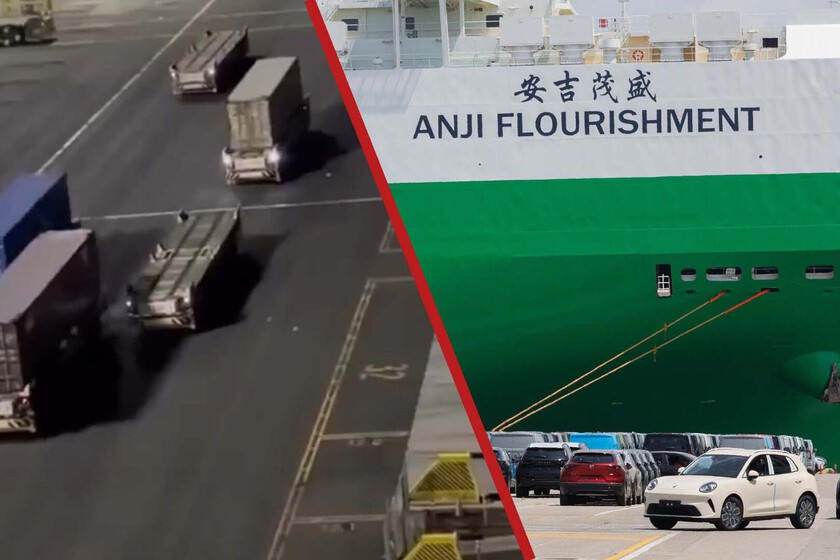
China is already the world’s “factory” and now it has set out to also control logistics. How? Through software, robots, 5G networks and artificial intelligence, as it is already doing in its factories.
There are already several Chinese seaports where almost the entire logistics process has been automated to unload, transport, and reload all goods.
More agile and with fewer errors, but human supervision remains essential
For your new car to reach the dealership where you bought it and be able to take it home, a few things have to happen first. Beyond the design and development phase, on one hand is the manufacturing process and on the other the transportation process to make the vehicle travel from the factory where it “comes to life” to the dealership.
This last part is very involved because logistics is no easy task, and even more so now that many of the cars sold in Spain come from the other side of the world: from China.
Chinese manufacturers are managing to streamline everything a lot thanks to the enormous Ro-Ro ships they are buying to carry thousands of units to European ports in a single voyage.

But those cars don’t load themselves onto those ships. Or at least that used to be the case until now, because technology has evolved so much that, in certain ports, those cars do load onto ships by themselves. And not only are cars moved from one place to another in the port without a worker or crane operator doing anything, but all goods.
In China, more and more port terminals are automated. The drivers, the trucks, the cranes and the dock workers who are part of any seaport in the world are giving way to a central system controlled by artificial intelligence, autonomous vehicles and automatic cranes in certain ports of the country, such as Yangshan (Shanghai), Qingdao, Tianjin or Xiamen.
Thousands of containers arrive at the major ports every day. Each one must be unloaded, identified, moved and stored to be reloaded onto trucks, trains or other ships and sent to its final destination.
View this post on Instagram
Nolan Kessler
I focus on performance-driven cars, emerging technologies, and the business forces shaping the automotive industry. My work aims to deliver clear, relevant insights without unnecessary noise, with a strong attention to detail and accuracy. I follow the evolution of mobility daily, with a particular interest in what defines the next generation of driving.