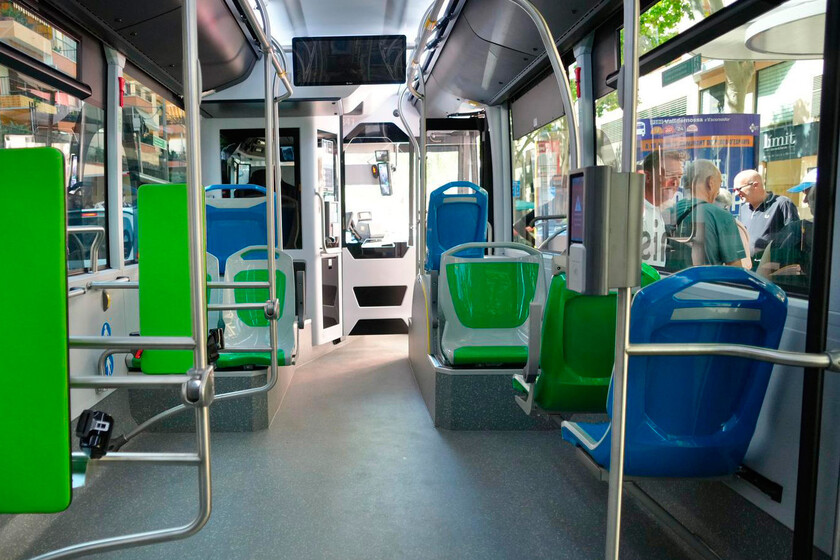
The influx of tourists is a problem in some Spanish cities, and moving around them becomes a nightmare for residents: traffic jams, crowded buses, subways, and trains. In the Balearic Islands, measures have already been taken: they limit the number of people who are not registered as residents who can circulate each day in Mallorca and Ibiza. Now there is also a push to give preference to residents for boarding municipal buses.
This is a Palma PSOE electoral proposal: that at EMT bus stops, boarding be differentiated between residents and tourists. Thus, if the bus is close to filling up, Palma residents will have priority and tourists will have to wait for the next one.
Residents in one queue, tourists in another
“Tourists must be able to access the public service, but we believe that residents should board first,” argues Iago Negueruela, candidate for the mayoralty of Palma de Mallorca. He presented this initiative on Wednesday, during the European Mobility Week. The municipal elections will be held in May 2027, and he asserts it is a measure he will implement once in office.
The socialist candidate’s proposal is to implement at the municipal bus stops a two-queue system: one for those who hold the Unique Card and another for those who do not. This is the way to differentiate tourists from residents: this transport pass, which allows travel across Mallorca’s public transport network (train, metro, EMT buses, and TIB), is exclusive to residents registered in the Balearic Islands.
Thus, in the event of high occupancy, residents would get on the bus first, prioritizing their daily commutes. “If a worker arrives late for work, they have a problem. If a tourist arrives later to stroll through Palma, it’s not a problem,” Negueruela defended, according to eldiario.es. He cites Mallorcans who work at the airport and who often encounter stops crowded with tourists.
Residents first: Venice already does it and the PP criticizes it

Negueruela notes that this measure has precedents in ultra-tourist cities like Venice. In this city, residents who hold the Venezia Unica card have priority boarding on the ACTV network’s vessels (boats and vaporetto boats). Access is organized into two lines: a priority line for these users and another for the rest of the passengers.
It should be noted that in the Balearic Islands, throughout 2026, public transportation is completely free for holders of the new Unique Card, as well as for those still using the Intermodal card, for both buses (urban and interurban), metros, and trains. This means that a large portion of Balearic residents will have this pass, enabling free travel. The initiative was introduced to encourage the use of public transport as well as to assist households with transport costs.
From the Popular Party, which leads the Balearic Government, they consider the measure would be difficult to implement and would also harm the service. The Mobility Minister, José Luis Mateo, argues that establishing two differentiated queues would require checks at the stops, which could slow the service. Mateo also labels the measure as electoralist.
Images | EMT Palma