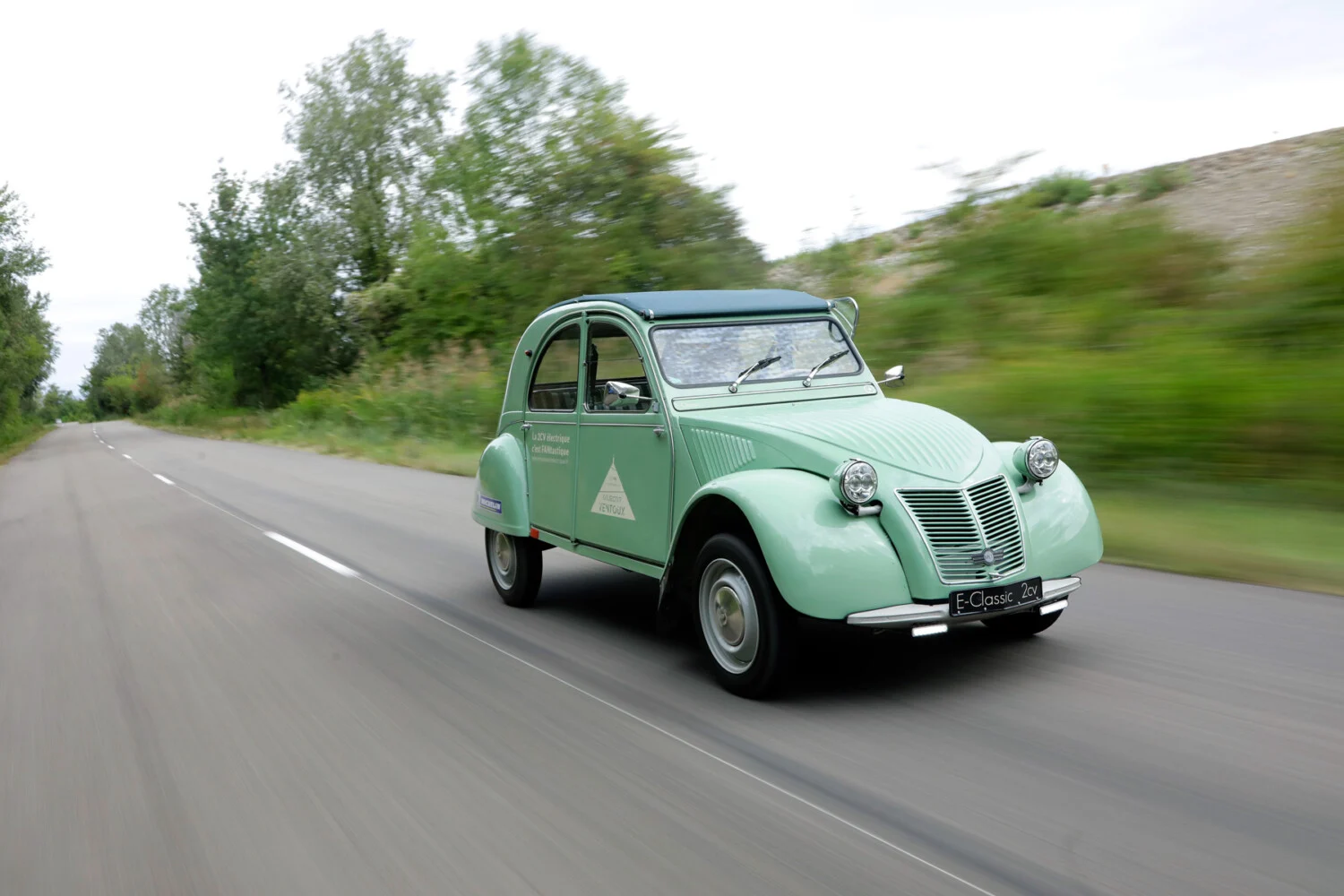
Since the announcement of the 2CV’s comeback, a lot has been said. It isn’t the first time Citroën has contemplated reviving the name of one of its most emblematic models.
The Grand Return of the New Citroën 2CV
Over the last two decades, the French automaker has regularly rekindled the flame with concept cars. There was first the “essential car” C-Cactus in 2007, then the very explicit Revolte (2009), the Cactus in 2013, all the way to the Oli concept (2022), each reinterpreting the values of simplicity, accessibility, and ingenuity that once fueled the success of the “Deuche.” It’s easy to cheer as a model that could resemble the car that brought happiness to so many households finds its way into production in about two years. Yet its 100% electric character and the new regulations bring as many questions as they do constraints. First up, in terms of styling. For that, Citroën chief Xavier Chardon may have dialed up a friend by calling Luca de Meo. The former head of Renault, Seat, and Fiat is a neo-retro marketing pro. He successfully relaunched the Fiat 500 in the mid-2000s, and more recently the Renault 5 and 4. He seems well placed to advise his former colleague at Volkswagen France. However, this major return, formalized during a meeting with investors last May in Detroit (United States), will not unfold in the same context.
The Grand Return: Priced at 15,000 Euros
The Fiat 500 appeared at a time when the market was not electrified, and it could push its prices downward to attract buyers (starting at €11,750 in 2007). Regarding the Renault 5 and Renault 4 E-Tech, both 100% electric, only their lease terms—hence a rental—can make them appealing, because the price tag can exceed €30,000 for the right version. Promised at €15,000, the future 2CV will thus have to invent a neo-retro, low-cost formula, while even Dacia is struggling to sell cars at attractive prices under the new rules. In this tightening context, the European Commission—guilty in large part for the automotive industry’s ills—wants to show leniency. Its plan is to define, with manufacturers (at least in a consultative manner), a new vehicle category. Called M1E, with still-fluid outlines, it could curb designers’ ambitions but allow brands to put simpler and cheaper vehicles on the road. Those who meet this new regulation would, in principle, be four-seaters, likely under 4 meters in length where the target had been 4.20 m, and their top speed would be limited to 120 or 130 km/h. In a sense, that’s good news, because it means we shouldn’t expect long-distance travel or highway poise, given limited autonomy or modest performance.
The Grand Return: Things Are Heating Up at Vélizy
At Citroën’s design center in Vélizy (near Paris), doors open to questions. A 2CV, the one that stopped production in July 1990 after 41 years on the line, was brought in so it could be examined in minute detail. How do you reinterpret a model that history has elevated to myth, yet whose lines were never considered a reference? It carries a strong goodwill and its simple mechanicals make it a joy for tinkerers, but let’s not forget its fragility. The Bourvil 2CV and De Funès’ Rolls-Royce in the film Le Corniaud (1965) is an exaggerated scene but carries a kernel of truth. Today, even with laxer rules, the new interpretation will need to be sturdier and thus heavier. Consequently, for economic reasons as well, Citroën could lean on an existing, well-regarded chassis—the Leapmotor T03 from China. This modern platform makes it possible to integrate contemporary systems. The decision isn’t final, but it’s hard to imagine Stellantis developing an entirely different base. The brand with the double chevron is meanwhile crafting a showroom-ready mock-up that will birth the concept to be unveiled at the Paris Motor Show in October. It will be a moment not to miss, given the astonishing number of debuts. The various brands have so many things to show that the suppliers capable of building mock-ups or concepts are overwhelmed. Citroën will even have its salon 2CV built in Germany, as no French company has the time to tackle the job. It’s worth noting that the final model will be assembled in Italy, alongside a small Fiat, at the Pomigliano d’Arco plant.
New Citroën 2CV: What Versions Should We Expect?
Citroën is seizing the opportunity to revive the 2CV name with a model that adheres to the same philosophy as the original: a low-cost car for everyday use. However, don’t expect to be driving far from home. If the car offers 150 km of range for €15,000, we should count ourselves lucky. The good news is that its small battery will recharge fairly quickly. But what made the 2CV famous was also its breezy character, its long-travel suspension that kept it from tipping, and a light weight that let it tackle almost any terrain. Will the new one also be able to handle fieldwork without worrying about its underbody? Several versions, notably the two-tone Charleston or a van, have attracted strong marketing interest. But in such conditions, prices will rise noticeably and every euro will matter more than ever. When you see that the electric C3’s “Urban Autonomy” version has the badge replaced by a sticker on the body, you can expect some explicit cost savings. Finally, Citroën may also develop a four-seat Ami for the L7e category (a heavy quadricycle, with a B1 license), as Fiat plans with its provisional Multiplia, inspired by the old 600 Multipla. In any case, we’re eager to see the brand’s future unfold!
The Auto-Journal’s Take?
More than the 2CV itself, it’s the sociological revival of a vehicle that played a significant role that’s taking shape. Budgets are tightening, cutting-edge technology costs are rising, and we must find paths to restore automotive purchasing power to those hungry for novelty and in urgent need of personal mobility. That will be the mission of this future model.
Find our exclusive piece on the future Citroën 2CV in Auto-Journal issue no. 1216, dated September 3, 2026.