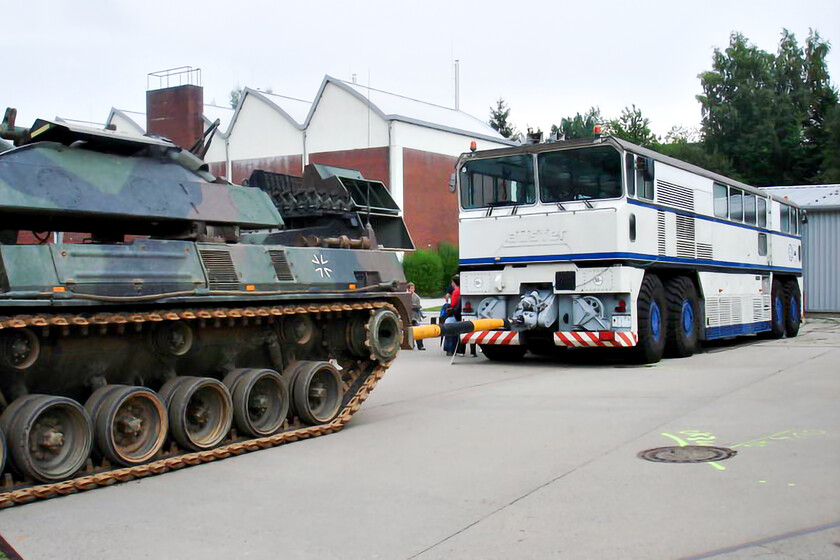
This truck-wheel locomotive is not a dystopian dream; it is very real. In the midst of the Cold War, West Germany needed a vehicle capable of testing the Leopard II’s technology, which would become Western Europe’s deadliest tank.
To achieve this, they created the Lauster MF60, a beast able to haul a Leopard tank as it tried to back off.
The Lauster MF60, the Hidden Beast of the Cold War
The Cold War pushed West Germany into an ever-escalating race. Always more armament, vehicles ever more powerful, heavier, faster. Each new generation of battle tanks gained weight and complexity, and this drift posed a problem: validating the running gear and propulsion before the final tank existed. A testing bench capable of withstanding loads of such magnitude was needed, but there was nothing on the market that could do it.
Classical methods, instrumented prototypes, or fixed laboratory benches showed their limits against masses and forces of such scale. A mobile test bench, capable of truly traveling on roads and off-road while recording data, offered a much closer alternative to real-use conditions.

The Bundeswehr thus turned to Lauster, a German company founded by Erhard Lauster and renowned for its large off-road vehicles, famous for their drum-axle designs dating back to the 1940s. In the mid-1970s, the firm delivered a prototype designated MF60, Messfahrzeug (measuring vehicle), a name that announced its vocation from the outset.
The result resembled more a road train than a conventional military vehicle. With 15.5 meters long, 3.6 meters wide, and 4.5 meters tall, this leviathan weighed about 80 tons. A standard Leopard 2, by contrast, weighs just over half of that.
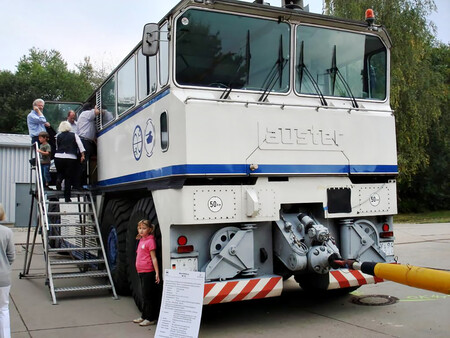
The propulsion was equally impressive to its dimensions. Two supercharged MTU (Maybach) MB838 Ca-M500 V10 diesel engines, identical to those used in the Leopard, powered each a 600 kVA (480 kW) generator.
The electricity produced drove four electric motors of 240 kW (326 hp), one per axle, for a combined output of 1,850 hp. The vehicle featured eight-wheel steering and two driving positions, one at each end. These allowed steering this asphalt locomotive in both directions without needing to turn around.
Its generous interior volume allowed an unusual number of measuring instruments and technicians aboard. Most notably, its hybrid propulsion and braking enabled reproducing slopes, loads, and traction forces under controlled conditions (for example, on a base away from prying eyes), preventing the need to multiply real tests across different terrains. It was thus capable of simulating towing and braking forces up to 600 kN (kiloNewtons) within a continuous speed range of 0 to 70 km/h.
The MF60 served as a platform for evaluating several heavy Bundeswehr programs during this period, complementing the theoretical calculations from design offices about the running gear of the future Leopard 2.
The MF60 always remained a unique model. Unlike the Lauster FM of 1969 — the precursor of this enormous laboratory —, preserved today at the Technik Museum in Sinsheim, the exact whereabouts of the MF60 remain uncertain after being recovered by the German army.
Imágenes | The Volkswagen factory that produced coupes and convertibles in Osnabrück for 125 years will now manufacture armament for Israel’s Iron Dome