It didn’t take me long to say yes to Dacia’s offer: “Am I up for climbing aboard alongside Sébastien Loeb? Of course I am!”
In Brief
The article recounts the unique experience of a shakedown ride as a co-driver aboard the Dacia Sandrider piloted by Sébastien Loeb. It highlights the intensity and technical nature of rally-raid, the profound transformation of the co-driver’s role, and the evolution of navigation thanks to digital tablets and shortened pre-race prep. The co-driver testimonies illustrate the necessity for extreme mental lucidity and specific physical conditioning, given the new constraints and the high pace demanded by the discipline. The adrenaline and professionalism of the teams are strongly emphasized, revealing a world where humans and technology intertwine in an ultra-demanding environment.
In the car with Sébastien Loeb
The rendezvous is set for early June, about 50 miles (80 km) north‑west of Barcelona, at the Nasser Racing Camp—the hacienda that serves as Nasser al‑Attiyah’s European residence, the five‑time Dakar winner (and Olympic trap medalist!).
If some folks build tennis courts or pools on their property, Al‑Attiyah has laid down a rally-raid testing track on his grounds. You can tell the surrounding roads—roughly as rough as you’d expect—were made for it.
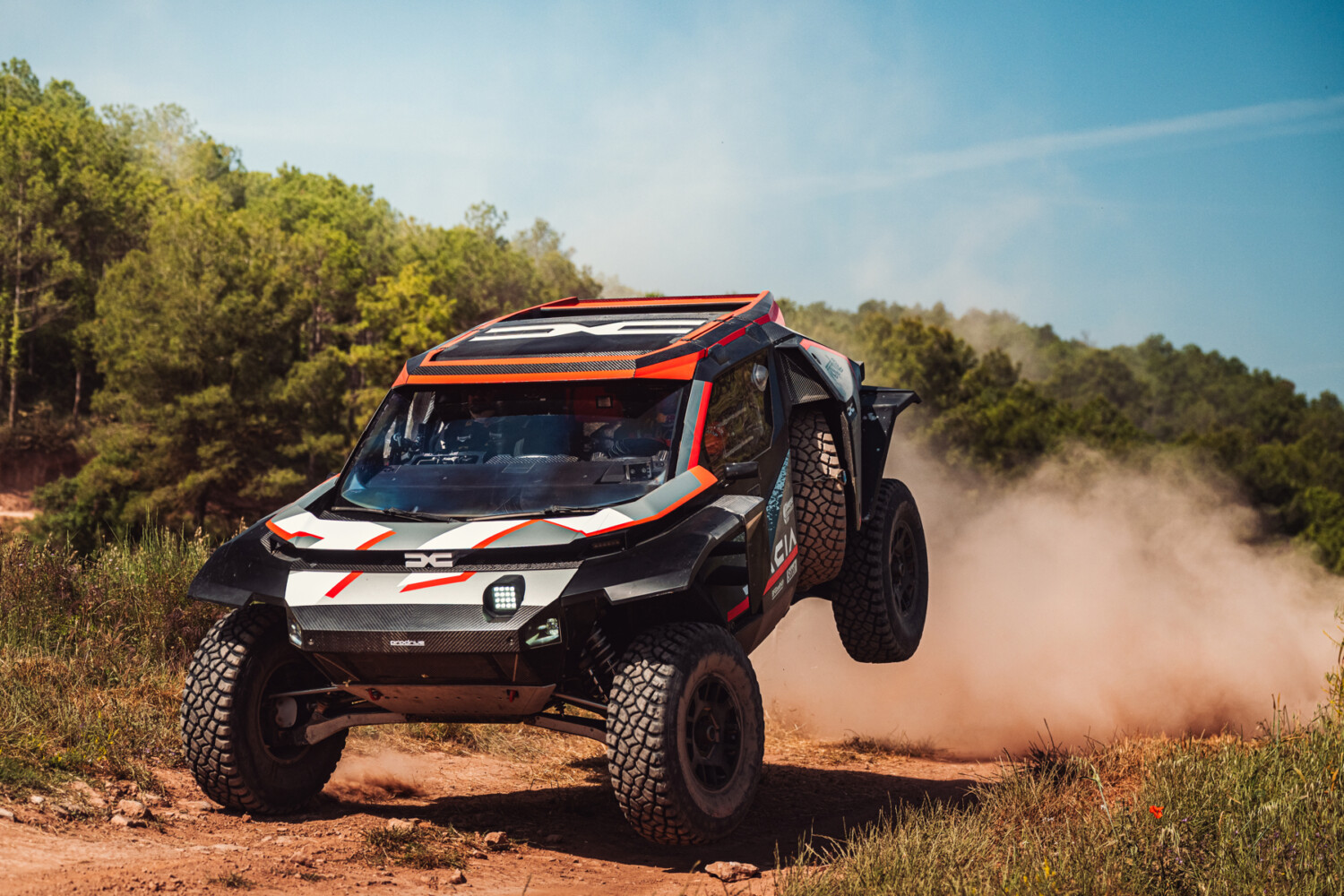
When I arrive on site, the Dakar Rally‑Raid team is already at work for days. Confirmation: I’ll be aboard the Sandrider with which Nasser al‑Attiyah, Sébastien Loeb, and Cristina Gutiérrez are contesting the World Rally‑Raid Championship.
“Sit down for a meal and fuel up. The session will begin after lunch…” A brief hesitation: is it sensible to gorge before being jolted aboard a fully fledged off‑road race car? I sit down nonetheless.
There’s no time to digest, because the moment to don a helmet and fireproof suit arrives. “Okay, you can get in…” A mechanic helps me settle into the Sandrider, avoiding accidentally pressing one of the many cockpit buttons.
First observation: the interior is truly tight. Claustrophobic types, beware! Once my six‑point harness is fastened, Sébastien Loeb starts the engine. “How’s it been since the last time?” asks the nine‑time world champion over the radio linking our helmets.
Our previous co‑drive together happened inside a WRC’s cabin on a tarmac mountain road. “You’ll see; this exercise will be very different. Grab your harness tight…” As we head toward the start of the stage, Loeb clarifies: “The power curve is capped by the regulations. We’re allowed a maximum of 360 hp. In fast sections, we’d like a bit more, but given the stage profile, we won’t feel this limitation…” At the inflatable arch painted in Red Bull colors, he floors it. He knows the course by heart and doesn’t need me to read him the notes. The dirt track under the Sandrider’s wheels is rough, narrow, and twisty.
Full throttle among the trees!
As kilometers fall away, the Sandrider handles the terrain’s irregularities as if it’s perfectly smooth. A bump gives us a jaw‑dropping demonstration. As the car soars into the air, I brace for the spine‑crushing impact I’d expect on landing. “The engineers did a substantial job on the suspension and damping,” Loeb notes. A few more turns and the seventh and final kilometer looms. Much too soon, I’d gladly go back for another round!
Unfortunately, it’s time to step out of the cockpit and hand my seat to true professionals, whose roles are far more crucial here than in the WRC. Edouard Boulanger, Fabian Lurquin, and Pablo Moreno—the three Dacia co‑drivers—are on site, ready to share insights into this still‑mysterious profession in motion.
It’s a perfect moment to delve deeper into this vocation that’s rapidly changing. “Our job has seriously changed in the last five years,” confirms Edouard Boulanger, winner of the 2024 Rallye du Maroc and the 2025 Abu Dhabi Desert Challenge with Nasser al‑Attiyah under the Dacia banner. “In my view, it’s a new era of navigation. It isn’t merely an evolution of what existed; it’s a real new chapter.” Fabian Lurquin, with whom I briefly swapped places, adds: “The biggest revolution is that now the course is provided only five minutes before the start of the stage. Before, you got it the day before, which allowed thorough preparation.” Edouard Boulanger goes even further: “A few years ago, in top teams, navigation was almost a team effort, with the co‑driver as just the final link. There were mappers and a whole logistics behind it. Crews weren’t on equal footing at the starting line. Today, that’s no longer true. There’s now perfect parity among all competitors.”
Co‑driver: a profession in flux
Another evolution has also altered the way co‑drivers work: “From here on, the course information is delivered to us on digital tablets rather than as paper roadbooks,” Fabian Lurquin explains.
Adapting to this new approach wasn’t easy. With a paper roadbook, it was simple to peek ahead, then back to what’s behind. It’s a different mental workout now.
The start ceremony for a stage has changed: “When we approach the start line, our tablet unlocks five minutes from our departure time and the information appears. We just have time to verify that it’s loaded correctly and functioning before we go.” Then it’s a continuous discovery. You must stay extraordinarily lucid because with the tablet the organizers tend to multiply the cues. When I began rally‑raid, there could be dozens of kilometers between two notes. Now, it’s very rare to have more than a kilometer between notes. At the speed we travel, that means roughly one second to read the note, understand it, synthesize it, and relay it to the driver. We can’t tell him everything, or there would be too much. We must selectively convey only the essential information—precisely timed. This demands razor‑sharp mental clarity under all conditions, even when you’re bounced around all day in the car and your head keeps slamming into the seat. The brain has to keep functioning so the cues reach the driver at the right moment. I think it’s essential to follow a dedicated training regimen. For instance, to acclimate to the cabin heat, I train by cycling in full kit with a helmet in a climate chamber at 95°F (35°C)…
Ah yes, even that!
Even if I don’t personally undertake such drills, it seems my potential as a co‑driver hasn’t escaped Sébastien Loeb… Before climbing into his helicopter to head home, he signs off: “Hi, co‑driver!” with a conspiratorial wink. Who knows what his plan might be? Since then, I’ve made sure my cell phone is always charged. You never know: he might call to invite me to join him on the next Dakar…
Read our feature as a rally‑raid co‑driver beside Sébastien Loeb in Auto Journal issue no. 1192, dated September 18, 2025.
Comparison Table
| Criterion | Before (old method) | Now (current method) |
|---|---|---|
| Course publication | The night before the stage | Five minutes before the start |
| Navigation medium | Paper roadbook | Digital tablet |
| Distance between notes | Up to dozens of kilometers | Extremely rare to exceed one kilometer |
| Time to convey a note | Several seconds | About one second |
| Specific physical preparation | Not specified | Examples: cycling in a 35°C suit |
| Vehicle power (Sandrider) | – | Maximum 360 hp |
| Sandrider width vs WRC | – | About 40 cm wider |
| Sandrider weight vs WRC | – | Approximately +800 kg |
Key Takeaways
- The experience of co‑driving aboard the Dacia Sandrider piloted by Loeb is intense and sheds light on the evolution of rally‑raid.
- The co‑driver’s job is undergoing a radical transformation: the roadbook is delivered five minutes before the start, now on a digital tablet.
- The Dacia Sandrider delivers up to 360 hp, is about 40 cm wider, and weighs roughly 800 kg more than a WRC car.
- Navigational demands require ultra-fast reaction times, with only about one second to relay each note.
- The preparation of co‑drivers includes targeted training to withstand the discipline’s extreme conditions.
FAQ
What is the main recent change in the rally‑raid co‑driver’s job?
The course is no longer shared the day before the stage but only five minutes before the start, which changes preparation and navigation.
How has navigation evolved with technology?
Navigation is now carried out on a digital tablet, replacing the traditional paper roadbook and altering how information is accessed.
How much time does a co‑driver have to read and relay a note during a special stage?
Typically, about one second to read, understand, synthesize, and relay the note to the driver.
What kind of specific preparations do some co‑drivers follow?
Some co‑drivers train by cycling in a suit with a helmet in a climate chamber at 35°C to build cabin heat tolerance.
What is the maximum power of the Dacia Sandrider used by Loeb?
The Sandrider is limited by the regulations to a maximum of 360 horsepower.
What size difference exists between the Sandrider and a WRC car?
The Sandrider is roughly 40 cm wider and about 800 kg heavier than a WRC car.