
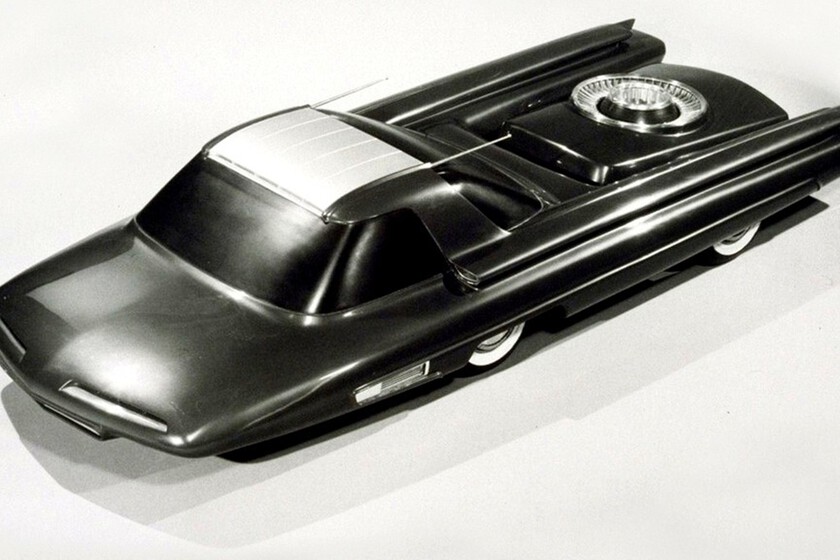
There was a time when nuclear energy eclipsed humanity to such a degree that the idea of putting reactors into cars seemed plausible. What could possibly go wrong? The automotive world has always been a cradle for innovative, avant-garde, or simply crazy ideas. Cars are a mundane, everyday element of our society, so many of the concepts meant to propel us toward the future have been tried or imagined within them.
From flying or jet-powered cars that mid‑century designers imagined we would have in the year 2000 to the autonomous cars that are on the horizon, there have been countless ideas that never made it into actual automobiles. There was even a period when brands flirted with nuclear power by proposing atomic cars.
The Nuclear Fever of the 1950s Spilled Into Cars

To set the scene, let’s cast our gaze back. The first half of the 20th century had not yet finished, and humanity—driven, as is often the case, by its urge for military dominance—managed to master atomic energy and ended World War II with the infamous atomic bombs of 1945.
From that point onward, fission reactors appeared to offer a relatively simple, cheap, and durable way to generate electricity. In reality, and looking at it with the perspective time has granted us, it wasn’t exactly like that, but in the 1950s and 1960s an exciting new world of possibilities opened up, a world that engineers and designers could not stop fantasizing about.
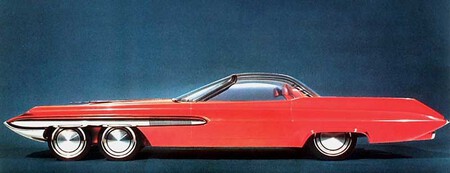
It was the era of the space race between the United States and the Soviet Union, the early years of the Cold War, and a highly volatile period across all fields of science. Cars, of course, were influenced as well, and some American brands (and European ones too) chose to present ideas for vehicles powered by nuclear energy in prototype form.
And no, none of them reached production as hoped, but they did inspirе the imagery of the video game Fallout 3, for instance, in a dystopian future ravaged by nuclear war. What did exist were some means of transport that embraced this technology to varying degrees.
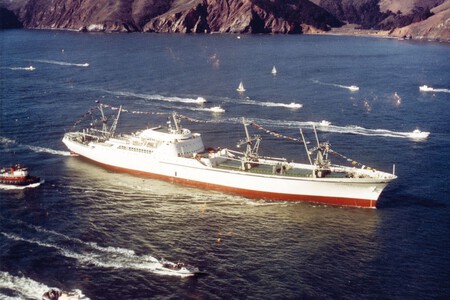
NS Savannah (1959)
Submarines were among the few (if not the only) means of transport to adopt nuclear energy—and they remain so today—began with the launch of the USS Nautilus (SSN-571) on January 21, 1954.
In the motherland, Lenin, an icebreaker, began service in 1957 as the first surface nuclear vessel and the first civil use of this kind. Two years later, the ship NS Savannah (July 21, 1959) became the first American mixed vessel (goods and passengers) to rely on nuclear power for propulsion. For its creation, President Dwight D. Eisenhower allocated a budget of 46.9 million dollars.
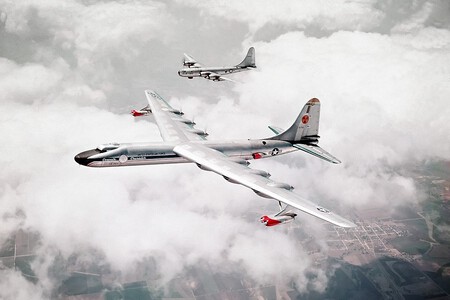
Convair NB-36H (1958)
The Convair NB-36H bomber (1958) was, for its part, the only bomber to carry a nuclear reactor. But it was not used as an energy source; it only carried the reactor as an experimental payload to determine whether the weight of the reactor plus its shielding could be accommodated on an aircraft of this type.
But let’s return to cars, which is what concerns us here. The first idea of a nuclear car dates back to 1941, when Dr. R.M. Langer, a physicist at Caltech, announced the creation of a nuclear car using uranium-235 in Popular Mechanics. In 1945 William Bushnell Stout (designer of the Stout Scarab) did the same in the New York Times, presenting the same problem: reactor insulation.
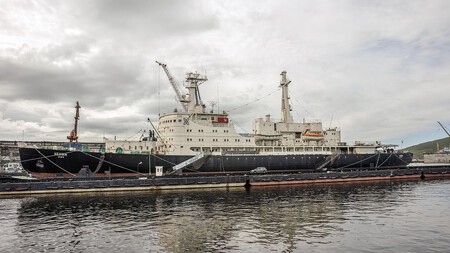
Rompehielos nuclear Lenin (1957)
At the end of 1945, from London, John Wilson made a similar announcement; a stir ensued and many personalities were summoned to witness the car’s presentation. The British Minister of Fuel and Energy of the era, along with a large press corps, attended a presentation that never materialized.
Wilson announced that his nuclear-car project had been sabotaged. Later, the British judiciary declared Wilson guilty of fraud and revealed the nonexistence of any atomic vehicle.
Studebaker-Packard Astral (1958)
Founded in 1899 and definitively ceasing operations in 1958, Packard was an American luxury carmaker that acquired Studebaker in 1953 in an effort to amplify its prestige. Naturally, with Detroit as its cradle.
In the final stretch of its existence, the corporation sought to dazzle the world by hopping on the nuclear-car bandwagon with the Studebaker-Packard Astral, whose design by Edward E. Herrmann was unveiled at the Geneva Motor Show in 1958.
Looking to dazzle the world from the old continent, the Astral was anything but a typical car. For starters, it did not have four wheels, not even three, or two… it had only one central wheel on which it could move, stabilized by gyroscopes.
Inside its space-age body from a science-fiction cartoon, there was an engine that relied on nuclear energy to produce the electricity needed to move. The company labeled this motor as “ionic,” though the reason remains unclear. Studebaker-Packard also claimed some form of energy shield for protection and that it could glide over water.
Ford Nucleon (1958)
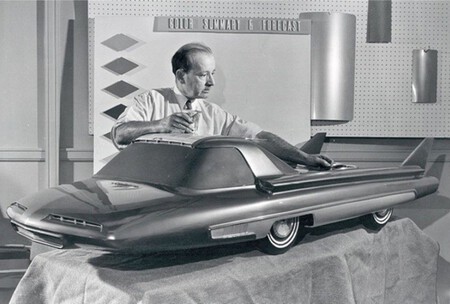
Perhaps the most famous of all nuclear cars was the Ford Nucleon. Its futuristic shapes (in keeping with the era’s fashion) with a cabin placed behind the front axle and a pickup-like silhouette reflected a configuration designed to keep people as far from their energy source as possible.
The Nucleon mounted, at the rear behind the rear axle, a pair of turbines. A miniature uranium nuclear reactor boiled water, and the resulting steam turned each turbine: one to drive the wheels, the other to generate power for the rest of the devices.
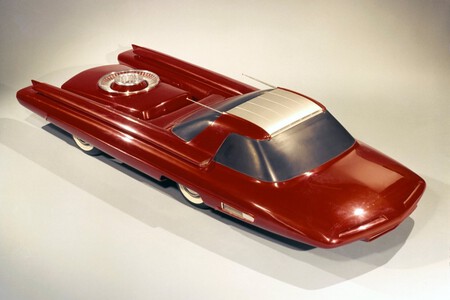
According to the company, the Nucleon could travel about 8,000 kilometers between each uranium reload, and Ford had imagined service stations that would replace gas stations and would sell nuclear material instead of petroleum derivatives. All very normal.
Despite being the most powerful company and viewing it as a viable option, Ford never took the Nucleon beyond the prototype stage. There was no reactor small enough, and more importantly, there were no guarantees about the safety of the vehicle’s occupants (or the rest of the world).
Simca Fulgur (1959)
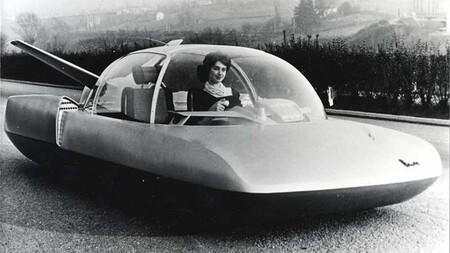
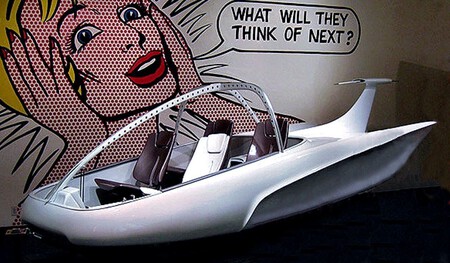
As if it came straight out of a science-fiction film like Star Trek, the Simca Fulgur sketched by Robert Opron (designer and architect responsible for the Renault Fuego or the Citroën SM among others) was unveiled at the Geneva Motor Show in 1959 and subsequently traveled to the United States (New York and Chicago) to conquer America’s fever for nuclear energy.
On the outside it could fit the late-1950s futuristic looks: a plain, nearly flat body, a bubble cockpit entirely made of transparent plastic, and a rear featuring an aviation-style wing.
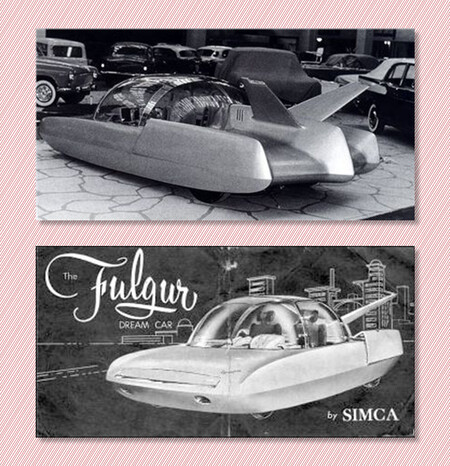
Curiously, the Fulgur was a car never intended for production, since most of its ideas came from a children’s magazine of the era. Of course, in its rear there was a reactor to produce electricity, but that was not the only extravagant feature of the model.
Among other things, it did not have steering: the wheels were fixed and ran on rails embedded in the road, and at speeds above 150 km/h the front section would rise, resting only on the rear via gyroscopes. It also used voice control for the controls and a radar to detect obstacles on the road.
Ford Seattle-ite XXI (1962)
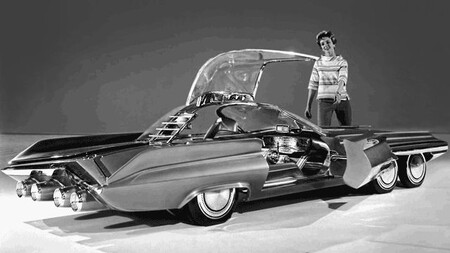
Long after the Nucleon, Ford introduced the Ford Seattle-ite XXI on April 20, 1962 at the Seattle World’s Fair. What was shown, in reality, was a 3/8-scale model designed by Alex Tremullis.
The Seattle-ite XXI encapsulated all the ideas that early 60s imaginations had about the future of automotive design, many of which were little more than optimistic decoration. Others, however, carried real potential.
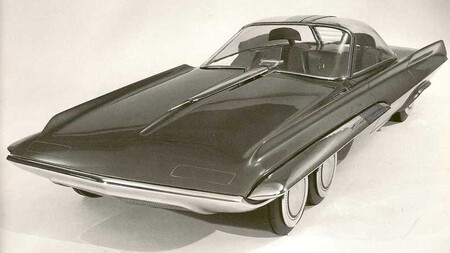
The bubble cockpit combined conventional automatic doors with a vertical element acting as a window-roof. The idea of a modular, replaceable nuclear-cell reactor could not be missing. Yes, a notion that had been discarded after the Nucleon, yet it remained striking.
Additionally, it used a dual front axle like the Tyrrell P34 in Formula 1, a modular, divisible concept, and proposed a navigation computer with an interactive interface—an embryonic form of the tech we have today, albeit in an early stage.
Arbel-Symétric (1958)
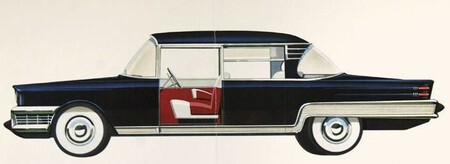
Yes, the Americans and Russians were the most active in the nuclear race, but they were not the only ones. The French company also developed, mainly as prototypes and experiments, some peculiar hybrids powered by gasoline and electricity.
Designed by Casimir André Loubière and supported by his brother Maurice, who owned COSARA (Société Transatlantique Aérienne en Extrême Orient), the first version of Arbel appeared in 1951, combining a Simca four-cylinder engine of 1,100 cc and 45 horsepower that powered four electric motors mounted on each wheel.
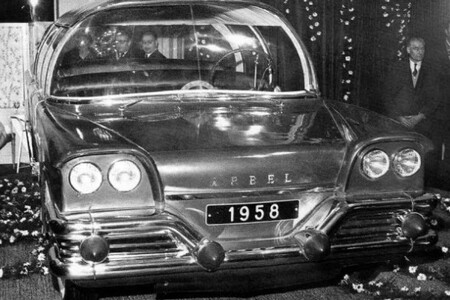
But not content with that, at the 1958 Geneva Motor Show Arbel unveiled the Arbel-Symétric, a much more ambitious and alternative proposition. Instead of equipping an internal-combustion engine, the French imagined a car that could generate electricity through alternative means.
First they considered a gas-powered generator, but inspired by the Ford Nucleon they contemplated a much more viable idea: a 40 kW nuclear generator (Genestatom), fed by interchangeable cartridges of nuclear waste. Unfortunately for the Loubière brothers, the French government never approved the project, and in 1959 Arbel closed its doors.