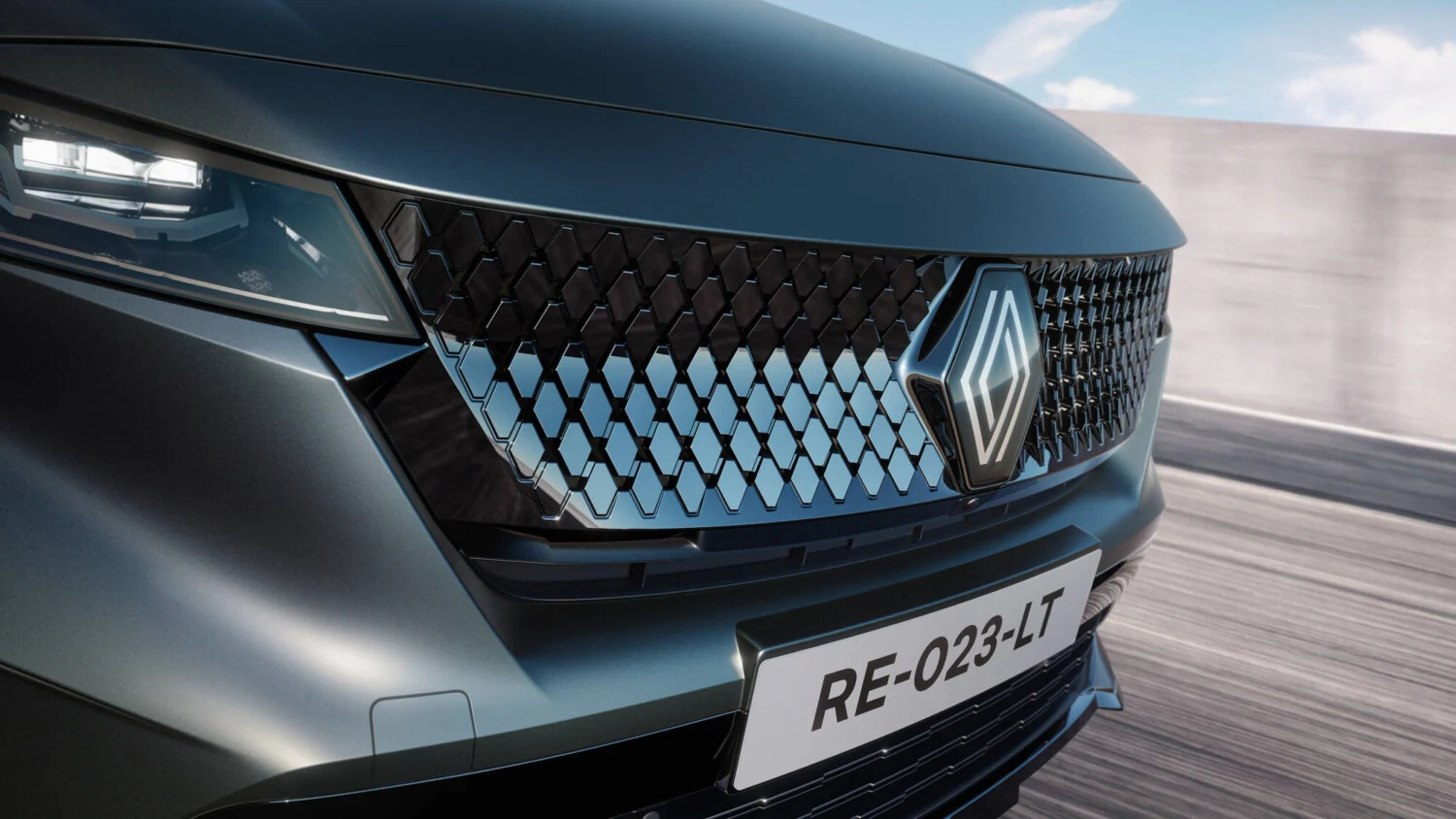
In Renault’s lineup, the Rafale is the brand’s coupe-SUV. In the design offices, they’re already thinking about its successor. Scheduled for late 2028, its successor will switch to 100% electric. And above all, it will open a new era for the way Renault designs its cars. A detail that matters more than a mere change of engine.
The manufacturer has decided to overhaul its engineering from the ground up. Objective: to develop a complete model in two years, for less money, and without sacrificing quality. This new engineering organization, inspired by Chinese methods, begins this month on new projects. The Rafale’s successor will be the first to benefit, ahead of the next Scenic and a future updated R5. And suddenly, the next Renault Rafale 100% electric becomes much more than just an emission-free version.
The Renault Rafale successor, first test of the new method
At the heart of this transformation, Renault is simplifying how a project is broken down. A future model will count for fewer than 30 modules, compared with 45 until now. The idea is simple: fewer interfaces, faster decisions, and shorter timelines. Philippe Brunet sums up this shift without beating around the bush. “Not everything is 100% in place yet, but enough to start,” he told Reuters. “All projects entering development from November will begin in this configuration.”
Until now, a Renault vehicle was managed through 45 distinct modules, with as many teams and arbitrations. “Previously there were 45 modules, the product of an organization that belongs to the past,” Brunet continued. “I think 30 is very good. If you consider that the Chinese are among the most efficient, that’s roughly what we’ve seen there.” The automaker studied these methods in China during the development of the electric Twingo and now aims to transplant them. It targets a two-year development time for the Rafale’s successor, with better cost control. In parallel, up to 20% of the engineering workforce could disappear by the end of 2027. A major training plan is set to shift staff toward electrification and software specialties.
Electric platform, Chinese partners and software: what the future Rafale hides
This reorganization comes with a new technical foundation, designed from the outset for the future electric Rafale. The SUV will debut a modular electric platform, internally dubbed RGEV Medium 2.0, with an 800-volt architecture. The next-generation Rafale will also be conceived as a Software Defined Vehicle, a car largely defined by software. Its electronics will rely on a central computer capable of receiving over-the-air updates. The battery will be integrated into the structure, in a cell-to-body arrangement, which would cut parts by about 20%. Renault also cites a roughly 40% reduction in production costs for the electric versions. The target for the Rafale’s successor is to approach about 750 miles of range (WLTP) in 100% electric. An extended-range version would target up to 1,400 km (about 870 miles). The brand also announces a 10% to 80% charging time of around fifteen minutes. All of this for a size near 4.75 meters (roughly 15.6 feet) in length and a curb weight under two metric tons (about 4,400 pounds).
Under the hood, the future Rafale is expected to receive a new third-generation electric motor, the EESM, without rare-earths. The power range would run from roughly 275 hp to nearly 500 hp, with rear-wheel drive as the standard configuration. Two-motor versions would offer all-wheel drive for the higher-performance variants. An EREV variant is also planned, with a small 1.5-liter gasoline engine—C15—signed Horse Powertrain, used solely as a generator. To develop these configurations, Renault will continue to work with its Chinese entity ACDC on both the vehicles and the onboard intelligence. The manufacturer also intends to select at least one Chinese company in every supplier basket, module by module. The industrialization of the Rafale’s successor is planned in Europe, at the Palencia plant in Spain. In the face of rivals’ flashy demos, Philippe Brunet sets a clear line not to cross. “We won’t build a car that does loop-the-loops. We’re aiming for technological innovations that are useful, not just for show,” Brunet replied. To illustrate this path, the executive cites the example of the compact electric Renault 5. “A Renault 5 is a car that carries a technological image with customers; it sells. We took the first step, the second step, and we’re taking the next step for the 2028 generation.”