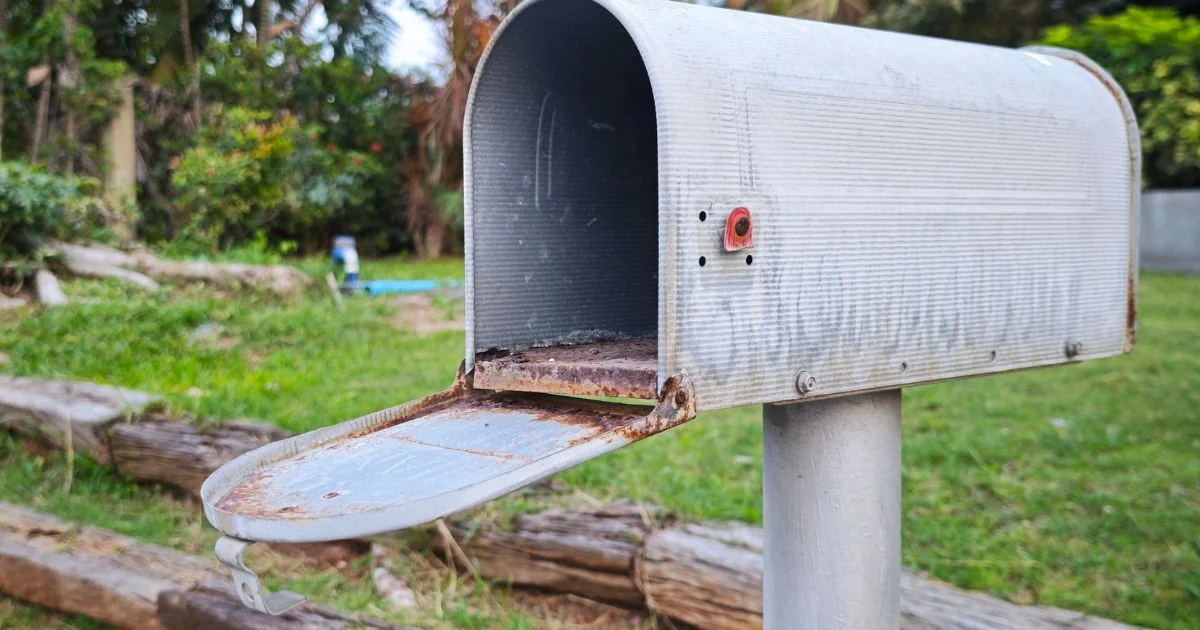
When your mailbox keeps ending up toppled into the ditch, the temptation to armor it up becomes real. That’s exactly what happened to an American carpenter. His mailbox, perched beside a country road, has been struck again and again by distracted or unlucky drivers.
In a year, this installation was hit eight times, to the point that the owner resorted to a radical fix. On TikTok, where his video has logged more than 4 million views, Travis Howard, aka @builtbytravis, details his project. He shows how he turned his modest box into a concrete mailbox mounted on a massive concrete pedestal. The question extends far beyond his yard. Is this ultra‑sturdy remedy merely a venting of frustration, or a potential headache for road safety and insurers?
A Concrete Mailbox to Stop Repeated Impacts
In his video, Travis Howard explains that his mailbox was struck eight times in a single year. “Please, don’t hit my mailbox anymore, because you’re the one who will end up hurt,” he says. The scene is captured on TikTok and picked up by Motor1. A carpenter by trade, he rebuilt the post with 6×6 wooden posts, thicker than standard. “Every time I got hit last year, I had to make it bigger and bigger, because the hole kept getting bigger,” he explains.
The new setup no longer rests on a simple post pounded into the ground. “There are two and a half yards of concrete here. The thing extends down about four feet. That’s something like 4,000 pounds,” he explains. In concrete terms, that’s almost 2.5 cubic yards, or about 1.9 cubic meters of concrete. The block sinks about 1.2 meters deep, for a mass approaching 1.8 tons. He says he hadn’t planned for such a volume at the outset. But every repair had widened the hole, pushing him to add even more material.
Concrete Mailbox: Safety Rules and Fiery Reactions
For American road authorities, a setup this massive raises eyebrows about safety. The United States Postal Service notes that “the Federal Highway Administration (FHWA) has determined that wooden mailbox supports not exceeding 4 inches by 4 inches, or a standard steel or aluminum post 2 inches in diameter, buried up to 24 inches, should be able to break safely if struck by a vehicle.” In plain terms, the supports are meant to bend or snap during a collision and should not transfer all the energy back into the driver’s car. For the Department of Transportation, brick or concrete boxes can become “fixed obstacles” hazards. Several states ban brick models, including Texas, Florida, and Illinois. Some guides for these devices warn that a homeowner can be sued if a nonconforming mailbox causes damage. In one case in Ohio, a driver was paralyzed after hitting a reinforced mailbox; the owner wasn’t charged.
On TikTok, this concrete mailbox instantly split viewers. Some see a deadly trap at the roadside. “Now you’re going to kill someone instead of losing a mailbox. If someone hits it hard enough during a rollover, or something, they’ll die,” wrote one user. “So, instead of replacing a mailbox, someone’s going to die?” protested another. “This should be illegal. Nothing so close to a road should be this solid. Put a ‘paint bomb’ on it or raise it like a sidewalk, but there it’s just a road hazard through and through. Even more so if it snows a lot,” chipped in a third. Others, instead, expressed sympathy for the homeowner and applauded his ingenuity. “I drive past your mailbox every day. I was really sorry; it seemed every time you fixed it, it disappeared within two days, then I watched you pour the concrete and I laughed so hard,” said one. “Reminds me of the guy who builds a snowman around tree stumps, so people crash into them and wreck their cars,” added another, referencing a viral meme.