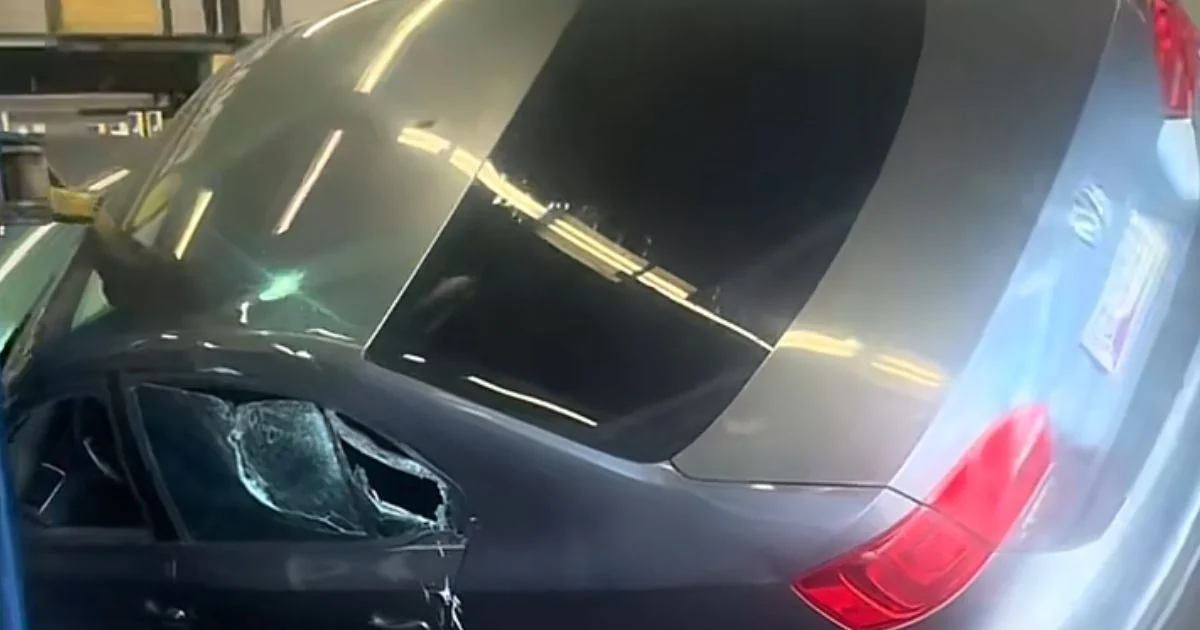
A routine oil change spirals into a nightmare. In the United States, a motorist handed his Volkswagen over to a Midas shop for a simple oil change, only to find the car on the shop floor, having fallen off the car lift, with shattered windows and a side panel completely deformed. It’s a scenario many drivers fear, tucked away in the back of their minds, not fully imagining that it could actually happen.
The fall was filmed and shared on TikTok, where the video has already racked up more than 4.1 million views. It shows the Volkswagen crushed on its side, the glass in shards, beneath the workshop’s fluorescent lights. The video’s creator, Chris (@chrisblaze520), notes that it isn’t his car; he’s simply showing. And behind the string of jokes from viewers, a question keeps resurfacing: how can a car fall off a lift in a garage, and what happens to the customer when it ends like this?
A Volkswagen wrecked on the lift after an oil change at Midas
In the TikTok clip, the on-screen text sets the tone: “This time I took my car to Midas for an oil change”. The next image shows the result of this routine stop: the left side of the car appears crushed, the windows shattered, and the bodywork bearing the marks of a violent impact with the shop floor.
Under the clip, the comments pour in. “You’ll end up with a 2027, whatever you want,” writes one. “Midas is going to buy me another car,” adds another. “That’s the Midas touch,” counters a third. A fourth chimes in: “Well, at least they owe you a new car. I’d be grinning from ear to ear,” another user says, while yet another posts: “Congrats on your new car, honey.” One voice, though, takes a more serious tone and reminds viewers of a basic shop rule: “First rule for lifting a car. Bounce test.”
Car falling off a lift at a garage: possible causes and recourse
In shops, there are procedures already in place to prevent a car from ending up like this Volkswagen. Specialists in lifting equipment explain that a fall can stem from a low-quality lift, a makeshift installation, or a concrete floor that’s too old, cracked, or no longer able to hold anchors properly. Yet in most accident cases, human error is the culprit: mispositioned lift arms, misidentified lifting points, or the absence of that crucial “bounce test” that confirms the car is stable before it’s hoisted. Safety and prevention organizations have documented cases where a minivan dropped because the arm locking devices were worn, or a Honda fell twice off a lift in a small Swedish shop, also filmed and widely shared. All of this serves as a reminder that these accidents are not as rare as people think.
Legally, in the United States, consumer-advice sites remind that a mechanic can be sued for defective workmanship, breach of warranty, fraud or deceptive estimates, and that a car falling off a lift typically lands in these categories. In France, the guidance from the French National Institute for Consumer Affairs goes similarly: when a vehicle is damaged while under the care of a professional, that professional is generally responsible and must compensate the customer. The liability of the garage is even presumed in cases of damage tied to its intervention, leaving it to prove otherwise. For a French motorist facing a comparable scene, a few steps are advisable:
- Photograph and video the car, the lift, and the workshop environment before moving anything.
- Request a written record detailing the facts: the work order, a description of the incident, and contact information for the person in charge and the professional insurer.
- Notify your own insurer promptly, and seek an independent appraisal if needed.
- If there’s a dispute over compensation, send a formal notice, then consult a consumer mediator, or pursue legal action.
Because at heart, an oil change is a simple service, but only if the professional strictly follows the safety rules governing the use of a car lift.