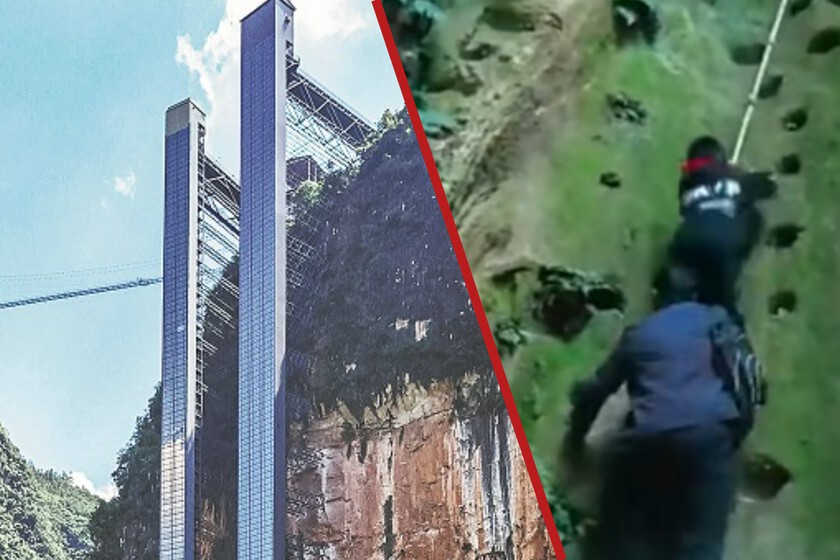
Going to school every morning by climbing up the vertical wall of a mountain nearly 300 meters tall in an elevator. This is what the children of a small village at the bottom of a remote and lush canyon in Yunnan Province, in China, do. Previously they took up to four hours to reach their school, along a steep path and having to scale the mountain via dangerous steps. Now they barely need half an hour, on a journey that combines this elevator with a cable car.
The photo speaks for itself: two colossal glass columns rise up the wall of a deep canyon to connect to its summit. The latest of these elevators, larger than the previous one, has just started operating. They were born as a tourist project, but today they are essential for the daily lives of the residents of the area. Welcome to the “celestial school bus”.
Two Glass Giants on a Remote Cliff
The Fuyao elevator began operating on July 31, 2026, after two years of construction and testing. And they call it thus, “celestial school bus”. It stands 288 m tall and is completely glass-walled, so the ascent offers splendid views of the Grand Canyon of the Nizhu River. It is precisely the immense drop it spans.
At a speed of 5 m per second, the elevator reaches the top in less than a minute: exactly 57 seconds. It can accommodate up to 81 people. This newly inaugurated Fuyao surpasses in every way its elder sister, which stands to its left.
And Fuyao accompanies a first elevator: the Qingyun, operating since 2022. This first vertical stair of the canyon rises about 260 m, is somewhat slower, and its capacity is around 40 people. In any case, both are impressive and have notably improved the communications of the residents of the village of Nizhuhe: their combined capacity is 1,200 users per hour. Since these two giants have been in operation, around 15,000 people go up and down each day.
Constructing a 288 m Elevator on a Narrow Ledge, Amid Wind and Fog
The project for this second elevator of the Nizhu River Grand Canyon began in 2024, with an investment of 68 million yuan, about 8.8 million euros at the current exchange rate. Although in reality the entire infrastructure, including the other elevator, the cable car, the footbridges and other systems, has amounted to 360 million yuan, nearly 47 million euros.
As with other Chinese infrastructures raised in impossible locations, it has posed a notable technical and logistical challenge. According to Ningbo Hongda Elevator, designers of this Fuyao elevator, the cliff where it rises is karst rock and in an active seismic zone. An extremely limited work space is added on a ledge, and they must face changing conditions: strong gusts of wind inside the canyon combined with fog or humidity.

The project’s leaders conducted exhaustive on-site analyses and had to adjust the elevator’s design several times to ensure the stability of the structure, its protection against corrosion and humidity, or to perfect elements such as the braking system. The elevator also features redundant power sources and multiple backup units, to guarantee the safety and operation of the system. Although construction finished in 2025, inspections and tests have been carried out for more than a year before opening to the public.
From Climbing the Wall with Ropes to Riding in an Elevator
In the depths of this Nizhuhe Grand Canyon, on the border between Yunnan and Guizhou, and extending about 10 km with vertical cliffs that can exceed 500 m, lies the village of Nizhuhe. It is part of the prefecture-level city of Qujing, being a settlement within the county of Puli. This small and remote mountain village has no school: the primary school sits on the plateau above the canyon.
That meant that the children previously faced a round-trip walking route of up to four hours, climbing the mountain. Literally: there were sections where they had to ascend with ropes and handholds carved into the wall, in addition to completely vertical stairs or footbridges hundreds of meters high. It could rain, blow wind, or the sun could beat down.
Thanks to this “celestial school bus” their daily path is much easier and gentler: they only have to walk 1 km from their home to catch one of these two elevators, and then the cable car. A journey that they now complete in about 30 minutes.
Before the inauguration of the new Fuyao elevator, the system’s capacity was about 4,000 users per day. Now it has been expanded to the 15,000 passengers mentioned. Most are tourists, but the children and residents have priority in using the elevators, with differentiated access. Moreover, for them the service is completely free, including the cable car.
Images | Shanghai Eye on YouTube, Tidenews