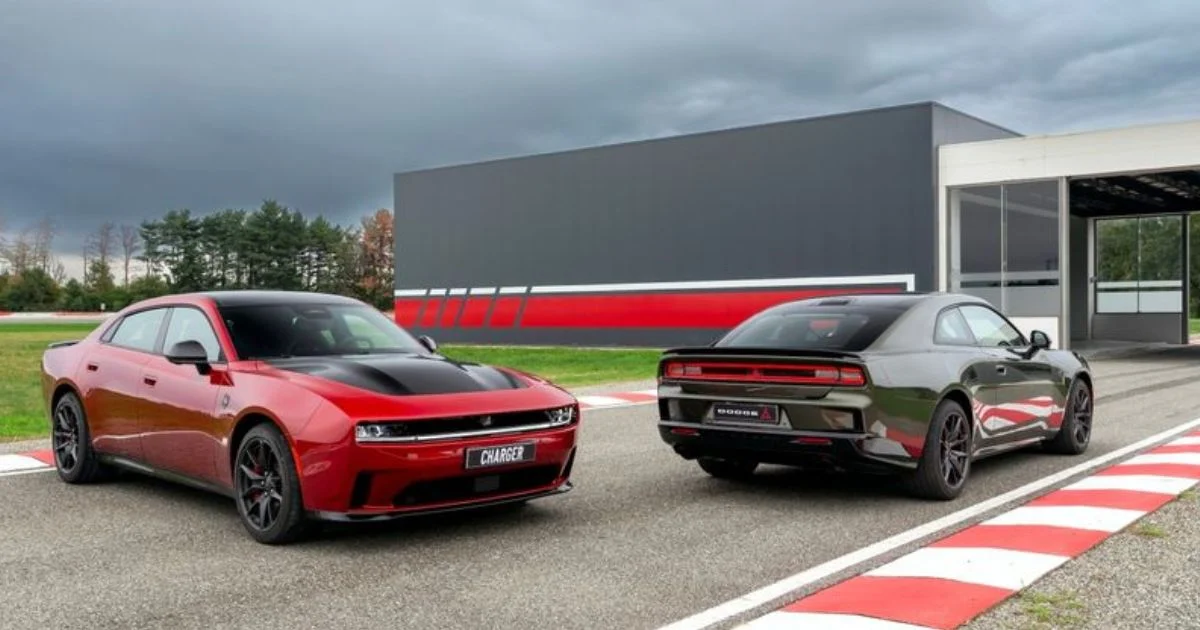
Seeing a real American muscle car arrive officially in European showrooms had many doubting it would ever happen. Yet a new Dodge Charger with 550 hp is indeed crossing the Atlantic. It also puts to rest the legendary V8 HEMI myth. For this eighth generation, Dodge has reinvented its large coupe-sedan on Stellantis’s STLA Large platform. The chassis, electronics, and the dual gasoline/electric drivetrain have been heavily redesigned. Initial orders for Europe have just opened through the importer KW Automotive. Deliveries are slated to begin in September 2026.
On the menu, a full lineup. The gasoline-powered Dodge Charger Sixpack variants receive a new 3.0-liter inline-six turbocharged engine delivering 420 or 550 hp. The Dodge Charger Daytona electric models can climb to 670 hp with a sizable 100.5 kWh battery. All will be offered in either two- or four-door body styles, only in left-hand drive, through a dedicated European network. The star for enthusiasts remains the Dodge Charger Sixpack Scat Pack 550 hp, which replaces the old Scat Pack V8. It raises one simple question: can a Charger without a V8 still make dreams come true on our roads?
Dodge Charger Sixpack 550 hp: A Six-Cylinder to Replace the HEMI V8
The new Hurricane 3.0 inline-six has the heavy task of succeeding the HEMI blocks. In the Sixpack R/T spec, it develops 420 hp and 634 Nm. That enables the Charger to sprint from 0 to 60 mph in 4.6 seconds. It covers the quarter-mile from a standing start in 12.9 seconds. The Sixpack Scat Pack rises to 550 hp for roughly 720 Nm. It posts a 0–60 mph time of 3.9 seconds and a quarter-mile time of 12.2 seconds. The 0–60 mph benchmark remains under 4 seconds. Facing the 370-hp 5.7 HEMI and 535 Nm, the R/T gains about 50 hp and nearly 100 Nm. The new Scat Pack also outpaces the 485-hp 6.4-liter V8 with 644 Nm, picking up several tenths in the quarter mile.
And it’s not just about big numbers. Its aluminum block hides forged internals, direct injection at 350 bars, and two turbochargers spinning in opposite directions. Torque remains available at 88% from as low as 2,500 rpm. All of this is paired with standard all-wheel drive. In the gasoline variants, the front axle can be decoupled to send 100% of the torque to the rear wheels. This setup enables features like Line Lock or Drag mode. The chassis uses multi-link suspension with adaptive dampers. Braking is handled by Brembo with ventilated rotors up to 16 inches and six-piston calipers up front. An arsenal that prepares it for both drag starts and intense circuit braking.
Dodge Charger Daytona Electric and Europe Arrival: Power, Tech and Distribution
Alongside these Sixpack variants, the Dodge Charger Daytona Electric carves out zero-emission performance. The figures are equally impressive. The Daytona R/T delivers 536 hp. The Daytona Scat Pack climbs to 670 hp at peak. Both versions rely on a 100.5 kWh battery and a 400-volt architecture. DC fast charging reaches up to 183 kW. Reaching from 20% to 80% is expected in about 27 minutes. Two electric propulsion modules handle the traction. At the front, a disengagement system minimizes losses, while at the rear a locking differential keeps the drive engaged. To preserve the muscle-car DNA, Dodge has developed the Fratzonic Chambered system. It’s a virtual exhaust based on passive radiators. Features like Race Prep complete the package. The PowerShot mode adds 40 hp for ten seconds during the most vigorous launches.
For Europe, this 550 hp Dodge Charger lineup will go through importer KW Automotive and its network of approved centers. Amencars Madrid will, for instance, cover the entire Iberian Peninsula. The models will be offered in two- or four-door body styles, only left-hand drive. The starting price is communicated at around €66,000 on the European market. A France-homologated two-door R/T version would top roughly €83,990. Inside, the muscle car gets a modern cockpit with a 16-inch digital gauge cluster. It also features an augmented-reality head-up display. A Drive Experience Recorder, developed with Cosworth, is also present. It can synchronize 1080p video at 60 frames per second with full telemetry data. All of this is complemented by Level 2 driving-assistance aids. Making this XXL American a bit easier to live with on European roads.