
In Brief
Mercedes-AMG has officially ruled out bringing back the V8 in the current C-Class, primarily for economic reasons rather than environmental regulations alone. Adapting this engine would require investments too large to amortize over the short remaining life of the current model. The V8 remains in the AMG lineup, but the modern C63 favors a plug-in hybrid four-cylinder, while the upcoming sporty C-Class is expected to switch to an inline six. If a V8 return on the next generation isn’t ruled out in the long term, nothing has been decided yet.
Mercedes-AMG enthusiasts hoping to see the C-Class receive a facelift that signals the massive return of the V8 will be disappointed. Despite extending the lifespan of its eight-cylinder engines, Mercedes does not intend to reinstall that engine under the hood of the current C-Class. The decision isn’t driven solely by environmental standards. The automaker cites mainly an economic reason.
The Mercedes-AMG V8 Will Live On Through 2035
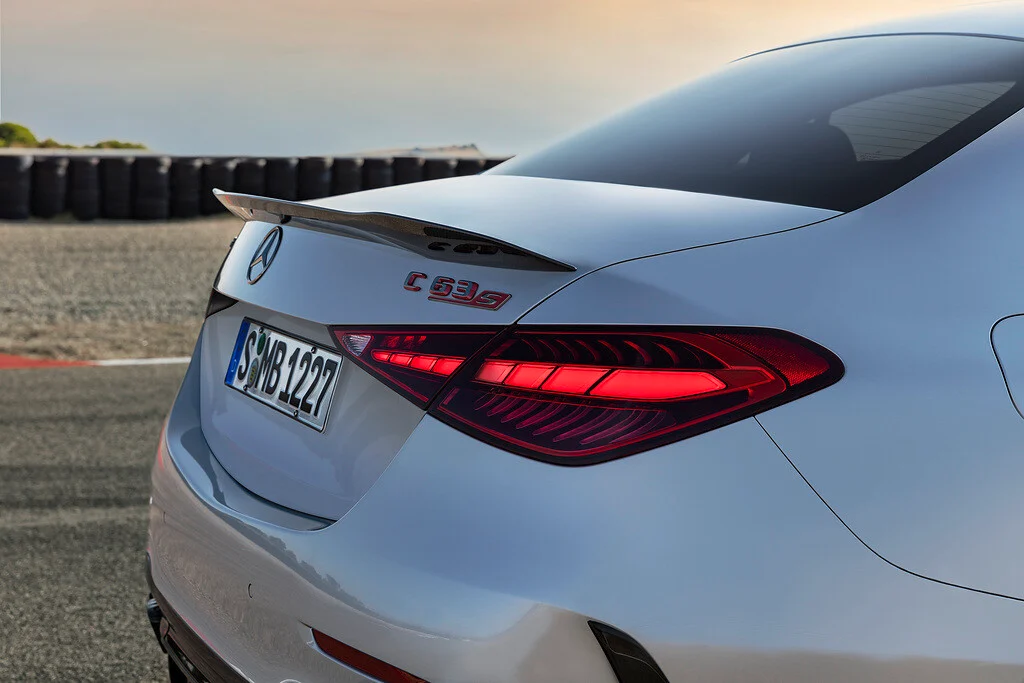
Since the debut of the current Mercedes-AMG C 63 S E Performance, the choice to replace the traditional V8 with a plug-in hybrid four-cylinder has generated plenty of chatter. Yet, Mercedes-AMG hasn’t definitively closed the book on big-displacement engines.
Klaus Rehkugler, head of product management and global training at Mercedes-Benz, told CarExpert, an Australian media outlet, that the V8 will remain in production at least through 2035. A bit of good news for enthusiasts. And Mercedes-AMG is also working on a new generation of its eight-cylinder engine.
But this extension won’t benefit the current C-Class. And Mercedes has now explained why.
The issue is primarily about profitability. The current generation of the Mercedes C-Class just received its mid-cycle refresh, and it would have only about three to four years left before its replacement.
Adapting a new V8 to this platform would require significant investment. Mechanical integration would need to be developed, various tests would have to be conducted, and all the necessary homologations would have to be obtained. With a shortened commercial lifespan, Mercedes-AMG estimates it would probably be impossible to recoup those costs.
The C63 Built Its Reputation Around the V8
That’s why the V8 won’t return in this generation, even though this engine will continue to exist elsewhere in the Mercedes-AMG lineup.
The decision is especially symbolic because the eight-cylinder engine was an integral part of the C63’s identity. The W204 generation wowed with its 6.2-liter naturally aspirated V8. Before that, the W205 switched to a 4.0-liter twin-turbo V8.
The current C63 has drastically shifted its philosophy. It pairs a 2.0-liter turbocharged four with a plug-in hybrid system. The combination produces 680 horsepower and 1,020 Nm of torque. Performance is therefore impressive. Yet this architecture also brings more weight and greater complexity. More notably, it has profoundly altered the character of the performance model.
Mercedes-AMG seems ready to rethink its strategy, anyway. The current C63 S E Performance is expected to gradually leave the scene. While a C53 is expected to take over the role of the sporty C-Class.
Never Again a V8 in the C-Class?
That future variant could drop the plug-in hybrid four-cylinder in favor of a 3.0-liter inline-six. An evolution that would echo the strategy used with the GLC, where the GLC 63 gave way to the GLC 53.
To bring back a V8, you would have to look higher up in the Mercedes-AMG lineup. The maker continues to believe in this architecture and has also eased its stance on switching to full electrification… Demand for gasoline-powered vehicles remains stronger than expected.
Could the V8 reappear on the next C-Class? For the current generation, the file seems closed. Mercedes-AMG will not develop a new C63 V8. Primarily because the investment would be difficult to recoup before the end of its lifecycle.
However, Mercedes-AMG does not officially close the door on the next generation of the C-Class. It’s still far too early to know its mechanical lineup. The V8 surviving at least through 2035 keeps hope alive for enthusiasts—perhaps a long-term return, even if only for special editions.
Comparison Table
| Model | Engine Type | Displacement | Power | Torque |
|---|---|---|---|---|
| C63 (W204) | Naturally aspirated V8 | 6.2 L | Not specified | Not specified |
| C63 (W205) | Twin-turbo V8 | 4.0 L | Not specified | Not specified |
| C63 S E Performance (current) | 4‑cylinder plug-in hybrid | 2.0 L turbo | 680 hp | 1,020 Nm |
Key Takeaways
- The V8 will not rejoin the current Mercedes C-Class, particularly for economic reasons.
- The current generation of the C-Class would not have enough time to amortize the costs of integrating a new V8.
- The Mercedes-AMG V8 remains in production through 2035 and powers other models in the lineup.
- The current C63 S E Performance offers a 680-hp, 1,020 Nm turbocharged plug-in hybrid four-cylinder.
- A future C53, equipped with a 3.0-liter inline-six, should replace the C63 S E Performance.
- The return of a V8 in the C-Class for a later generation isn’t definitively ruled out, but nothing is decided yet.
FAQ
Why isn’t Mercedes-AMG installing a V8 in the current C-Class anymore?
Mainly for economic reasons, as adapting the V8 would require substantial investments that would be impossible to amortize over the remaining market life.
Until when will the Mercedes-AMG V8 engine be produced?
Mercedes-AMG has confirmed the V8 will remain in production at least through 2035.
What powertrain powers the current Mercedes-AMG C63?
The current C63 S E Performance uses a turbocharged 4-cylinder with plug-in hybrid, delivering 680 hp and 1,020 Nm.
Will the next C-Class performance model have a V8?
No official information has been released for the next generation, but the V8 will not return to the current C-Class.
What’s the future for the C63 S E Performance?
The C63 S E Performance will gradually disappear, making way for a C53 powered by a 3.0-liter inline-six.