
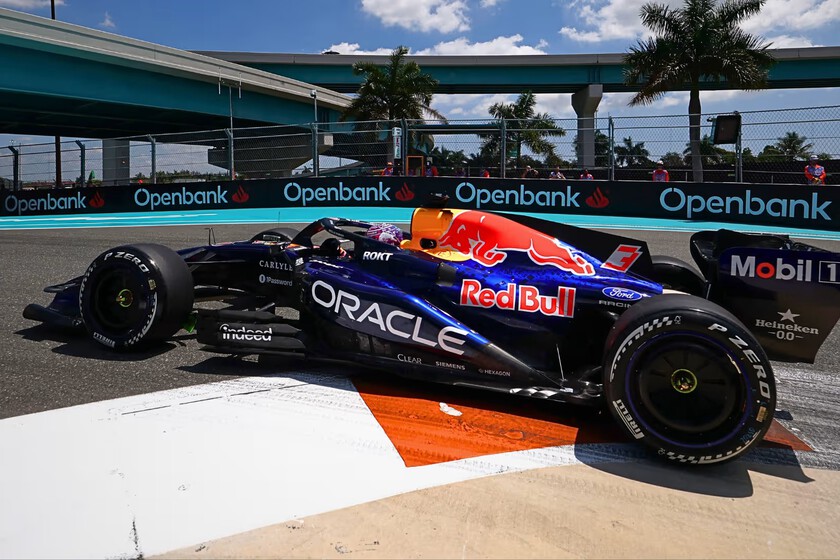
It happened again. Red Bull has used its second team in Formula 1 to gain a debatable advantage. It occurred at the Miami Grand Prix, when after a chaotic first lap by Max Verstappen, from the Red Bull pit wall they issued an order… to a driver from another team. Specifically, to Liam Lawson to let himself be overtaken.
In a context where the world of global sport fights against multi-ownership, Formula 1 maintains an archaic model in which two of its eleven teams belong to the same owner. More than a few are starting to get fed up, but what is even more worrying is that we could soon see another such case with Mercedes.
Red Bull ordered Lawson to let Verstappen pass despite having pushed him off
When Red Bull bought the Minardi team back in 2006 the sport was very different from today. Few could have expected that multi-ownership would end up turning into a blight that would afflict many sports, and almost always with Red Bull involved as a common factor. The problem is that while others have rolled up their sleeves, Formula 1 looks the other way.
Just look at what happened in Miami. After a wild first lap, Verstappen, a Red Bull driver, pushed Lawson, the Racing Bulls driver, the energy drinks company’s junior team, off the track. Verstappen dove to the inside, left the circuit, and shoved the New Zealander off it. A maneuver that was undeniably the fault of the number ’33’.
Lawson, following his instinct as a driver, held his position. But then came the radio message: he had to return the position to Verstappen because from the wall they interpreted that he was the one at fault. In reality, obviously, they did not think so. It was simply an excuse to let Verstappen pass and facilitate his comeback.

For years, several rivals have complained about Red Bull’s multi-ownership, which has driven them to actions such as Daniel Ricciardo meddling in the world title fight to help Verstappen by depriving Lando Norris of a fast lap. Precisely, McLaren has led the charge, and calls for Red Bull to be forced to sell its second team.
The problem is not only that Formula 1 does not move a finger, but that the situation goes further. In recent weeks there have been rumors that Mercedes could buy Alpine to turn it into its filial team, in the manner of Red Bull. If in football, with hundreds of teams and leagues, what Red Bull does is already dangerous, in Formula 1, with only eleven teams, it is lethal.
We will see whether Formula 1 finally decides to take the reins of its business or continues to leave it adrift, a drift that is increasingly worrying.
Images | Formula 1