An electric car needs a large battery to achieve a meaningful range. A big battery costs a fortune, which drives up the car’s price. The opposite extreme isn’t appealing either. Small electric vehicles are more affordable precisely because they carry less battery, and that translates into a range that remains lacking. The Dacia Spring illustrates this well. It costs under 18,000 euros, yet promises only about 225 km of range.
The solution to avoid choosing between price and range is to add a gasoline engine that doesn’t move the wheels, but acts as a generator of electricity.
An EREV Is Not a PHEV
This approach, dubbed a Extended-Range Electric Vehicle, has been sweeping China for years while Western manufacturers watched from the sidelines. Now it is already boosting BYD’s sales in Europe, as BMW and Hyundai develop their own EREV (Extended Range Electric Vehicle). The technology that’s succeeding in China is starting to take hold elsewhere.
The capacity of a battery in an electric car directly affects its price and its range. The bigger the battery, the more expensive the car and the longer the range. How can an electric car have substantial range without costing as much as a luxury car? China has the answer, and it’s ready to be applied now. The solution isn’t about experimental solid-state or sodium batteries. The answer is EREVs.

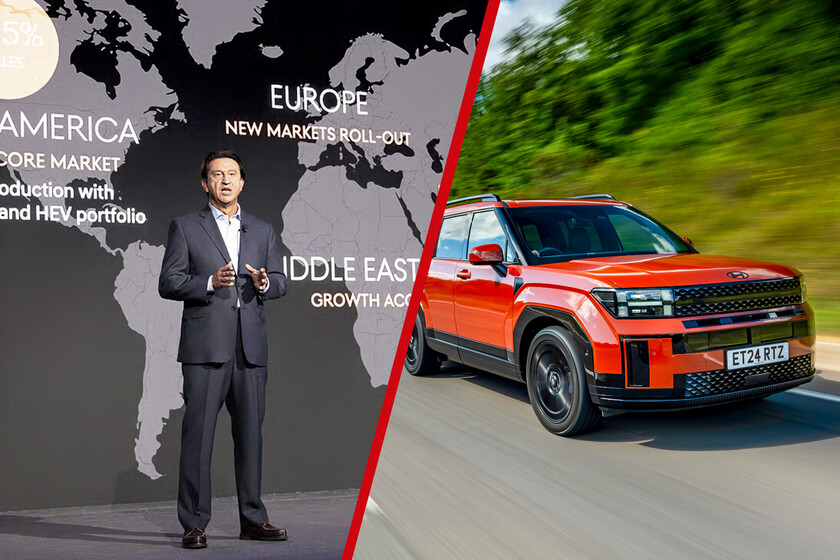
The Hyundai Santa Fe will be the first to become an EREV.
The trick is to place a gasoline engine inside an electric car, but that engine never touches the wheels—and thus it remains electric and not a PHEV. It only acts as a generator when the battery starts to run low.
The result is a vehicle that drives exactly like an electric (silent, with instant torque, no vibrations), but that can refuel in 5 or 10 minutes at any gas station if the occasion requires it. And to cap it, it has very low consumption because it only generates electricity; there’s no need to start the car or push it to 120 km/h on the highway.
Hyundai Two Motor System
At its first Investor Day for CEOs held outside South Korea, in New York, Hyundai confirmed it would launch its first EREVs in 2027. The promise was ambitious: over 960 kilometers of combined range with batteries of less than half the capacity of its current EVs, which have 88 kWh (Ioniq 5) to 110 kWh (Ioniq 9).
The stated objective is to reduce costs and eliminate in one stroke the range anxiety, which is nothing more than the fear of not knowing where to recharge and for how long.
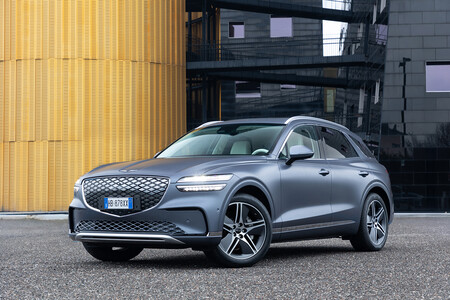
Genesis GV70
Nine months later, we already know which model will be the first to debut this drivetrain. Prototypes of the Hyundai Santa Fe have been seen testing in South Korea with badges confirming its EREV status. This 4.83-meter SUV, available in Spain with a 240 hp hybrid, is one of the brand’s best sellers in North America, and will be the vehicle chosen to inaugurate Hyundai’s new era of range-extender technology.
It is known that the system will use a turbocharged 2.5-liter gasoline engine as a generator, combined with two electric motors, one on each axle. Reports speak of a range well over 900 km with a 44 kWh battery. Hyundai named this configuration the Two Motor System in its investor presentation.
Hyundai will not be the only Korean group brand to use this drivetrain. The Kia Telluride, a seven-seater SUV about five meters long exclusive to North America, will also feature it. Genesis, the luxury arm of Hyundai, will also incorporate EREV technology into its lineup. The GV70, one of its best-selling models in the North American market, stands as the strongest candidate to receive the system in 2027.
Could Hyundai’s EREV system reach Europe?
Nothing is confirmed yet, but since it is initially aimed at a model already available in Europe, there is a possibility of seeing the Two Motor System on this side of the Atlantic, both in Hyundai and Genesis. And Hyundai aims to bolster its luxury brand across the continent, previously confined to a showroom presence. The Two Motor System would then be a strong calling card.
Hyundai isn’t alone in moving toward EREVs. BMW, which experimented with the technology in the i3 REx from the previous decade, is planning a return. The next generation of the X5 could feature an iX5 REx variant with an extended-range, delivering a combined range of around 1,000 kilometers. Importantly, unlike Hyundai’s North America–focused announcement, BMW has explicitly targeted Europe and North America as markets for this technology.
The irony is that the solution that major Western and Korean manufacturers are adopting is one that General Motors tried to push at the start of the century without success and that has been China’s everyday reality for years. In 2024, EREVs grew by almost 80% in the country, with 1.2 million deliveries.
Brands such as Li Auto, Aito, Leapmotor, or Changan have spent years refining this approach and have made it the preferred choice for Chinese buyers living in areas with less dense charging infrastructure. In Europe, PHEVs with EREV-like technology (hardly driving the wheels) account for nearly 40% of BYD’s sales.
Find your ideal electric car
If you have considered buying an electric car, this will interest you. We have created the personalized Electric Car Recommender, where in addition to seeing models that fit your needs you’ll also get answers to the questions that worry you most, such as price, range, or nearby charging points.

Looking for your next electric car and feeling overwhelmed by the options? That’s normal.
More than 45,000 readers have already tried it. And you?
Advice offered by the brand