
In Brief
The restyled Opel Astra Plug‑in Hybrid keeps exterior updates to a discreet minimum, featuring a refreshed lighting signature and a more contemporary look, with few other visual changes. Inside, only a handful of ergonomic and technology-focused tweaks stand out. The main advancement lies in the hybrid powertrain, which has been revised to offer more electric range and lower overall consumption. Yet, drawbacks persist in terms of interior space and ride comfort. Against a backdrop of strong competition, the Astra makes progress but still lags in some key areas for a compact, rechargeable hybrid.
Opel’s compact-car lineage runs deep, tracing back to 1936 and the launch of the first Kadett. Revived in 1962, the name became a staple of the Opel lineup before giving way to the Astra in 1991. That model enjoyed solid success—over 4 million units sold in six years—though its on-road behavior was never a class-leading highlight. Subsequent generations, despite a narrative of German engineering and reasonable pricing, bore the marks of cost-cutting quality issues, marring Opel’s image. To complicate matters, Asian competitors moved into the same market territory.
Opel Astra Plug-in Hybrid 195 hp Ultimate: a Curse for the Astra?
Today the stakes are high: in France, the Astra no longer sits in the Top 10 among compact cars. It has fallen behind fully electric rivals like the Renault Mégane E‑Tech and the Volkswagen ID.4. Yet this generation has not spared itself the modern touches, offering sharper styling than ever and a multi-motored lineup (gasoline, diesel, hybrid, plug-in hybrid, and even pure electric).
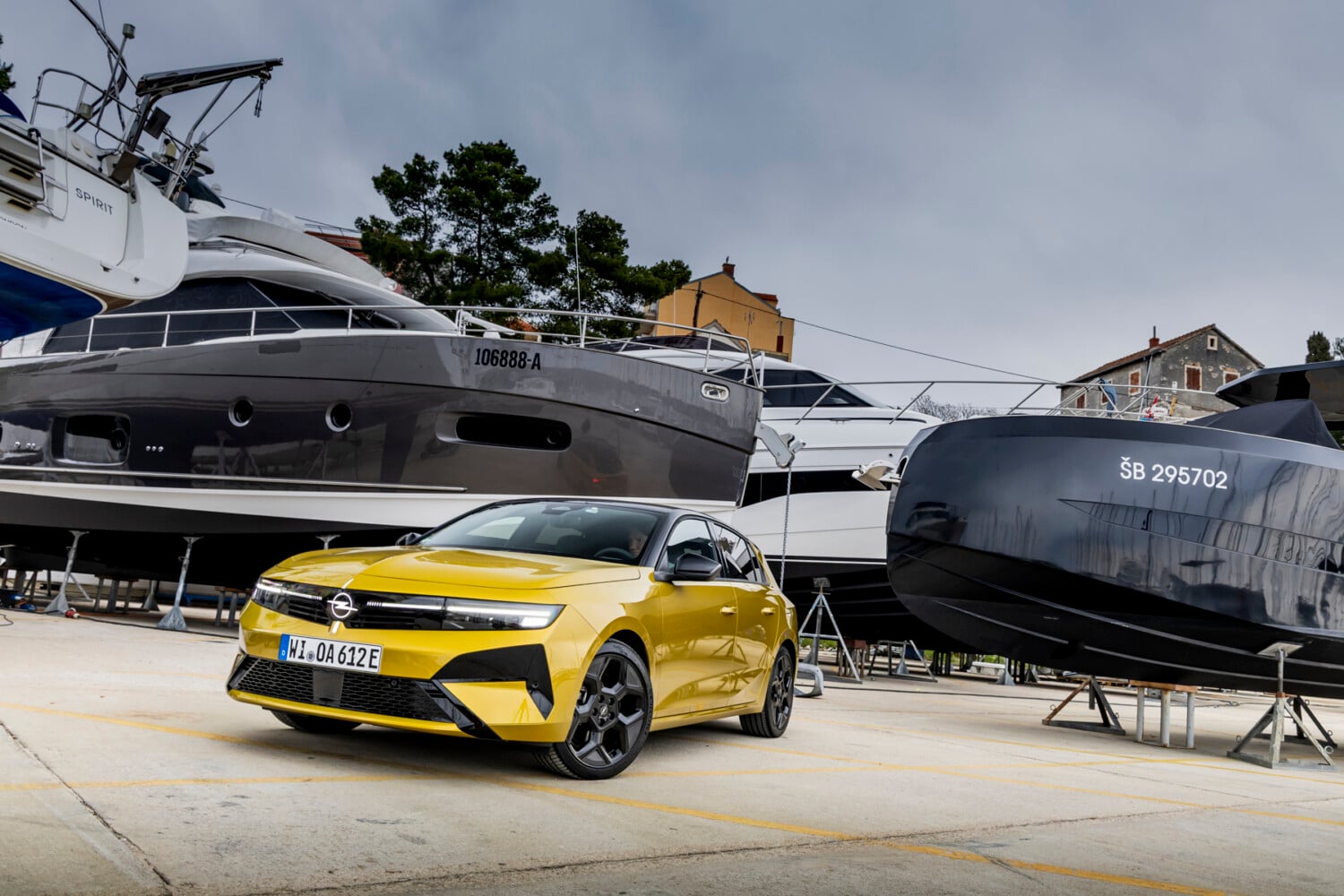
Is there a so‑called Astra curse? Five years, already, after its launch, the Astra L remains visually fresh, and the Kult Yellow metallic paint (790 €) on our test unit highlights its taut lines that haven’t evolved with this facelift. The exterior restyling is, in fact, mostly about the lighting signature.
At the front, the Vizor grille is now glow‑drafted as a permanent feature, just like the taillights. The Astra can also be fitted (standard on Ultimate trim, optional on GS) with next‑gen LED matrix headlights featuring more than 50,000 pixels—an equipment level still relatively uncommon in this class. More so, there are also new 17- and 18-inch alloy wheel designs. So, exterior changes are modest, but noticeable.
Opel Astra Plug-in Hybrid 195 hp Ultimate: inside, no revolution
Inside, there’s likewise no radical upheaval. A driver-monitoring camera appears in the windshield pillar to satisfy the latest European regulations, and the interfaces have been redesigned with revised materials. Despite these efforts, the interior ambiance remains sober and not particularly exuberant—dark tones, a dashboard carved with sharp angles, and finish details (joints, materials) that leave something to be desired.
The driver, however, benefits from a comfortable seat, reasonably clear menus, and solid all‑round visibility. In the rear, passengers lose a bit of width and legroom, and the narrow door openings make ingress a tad cumbersome. Techwise, the plug‑in hybrid variant is where most of the notable changes reside. It inherits the Grandland’s powertrain architecture, featuring a reshaped 1.6 PureTech engine refined at Opel’s Rüsselsheim design studios, a more powerful electric motor (125 hp instead of 110), a larger battery (14.2 kWh net versus 11.3), and a higher combined output (195 hp instead of 180).
Opel Astra Plug-in Hybrid 195 hp Ultimate: how much does it cost?
The bigger batteries translate to better electric-range capability. In our test, the petrol engine woke up after about 65 km, a figure that matches the Montlhéry-measured range for the Peugeot 308 Plugin Hybrid—an apparent close cousin of this Astra—and represents about 23 km more than the old model. As for electric energy available on board, it should help bring down average consumption significantly once the batteries are depleted, something the previous Astra Plug‑in Hybrid struggled with: the older version averaged around 7.2 L/100 km. The new package should hover near 6.8 L/100 km when the batteries are drained, as seen with the Peugeot 308.
Compared with the Golf eHybrid, the Astra gains some ground in price, but the VW model still outperforms it in electric range (exceeding 100 km) and overall efficiency, at around 6.2 L/100 km once the batteries are depleted. The Golf, however, carries a roughly €4,000 premium.
Opel Astra Plug-in Hybrid 195 hp Ultimate: willing but not particularly spirited
The Astra demonstrates a willing demeanor rather than a truly punchy personality with its new powertrain, though it remains pleasant to drive. In electric mode, the cabin is notably quiet, aided by features like a windscreen and front side windows treated with acoustic glazing. The B-mode (one-pedal driving) enhances energy recuperation, offering extra comfort in urban driving. The driver will, however, notice that the automatic transmission can be rather noisy and sometimes not as smooth as desired, and the brake pedal can be a bit hard to dose at very low speeds. When the gasoline engine joins the mix, engine noise rises perceptibly but doesn’t become bothersome. If the transmission sometimes lacks perfectly timely responses, with less-than-ideal downshifts and a hint of lag, the overall driving experience remains largely undisturbed. The chassis, meanwhile, proves capable, delivering a balanced feel and solid grip. The steering is precise—though one might want it a touch more incisive—and the Astra tracks through bends with good vigor. The dampers, on the other hand, do not earn the same praise: they tend to ride harshly on rough surfaces at low speeds and feel a touch too permissive with body motions. The Peugeot 308 (the French cousin) benefits from crisper, more direct steering and a better balance of damping. It is also about €1,700 more expensive with equivalent equipment.
Opel Astra Plug-in Hybrid 195 hp Ultimate: the pros
- Electric range
- Lower consumption
- Overall driving enjoyment
Opel Astra Plug-in Hybrid 195 hp Ultimate: the cons
- Firm suspension
- Imperfect transmission
- Rear-seat space
The Auto-Journal assessment: 3.5/5
The powertrain is where the Opel Astra makes its most significant progress, delivering extended electric range and lower consumption. It still lags behind the best in class in some respects, chiefly due to a transmission that can feel uneven and an interior space that doesn’t quite meet expectations.
Opel Astra Plug-in Hybrid 195 hp Ultimate: in numbers
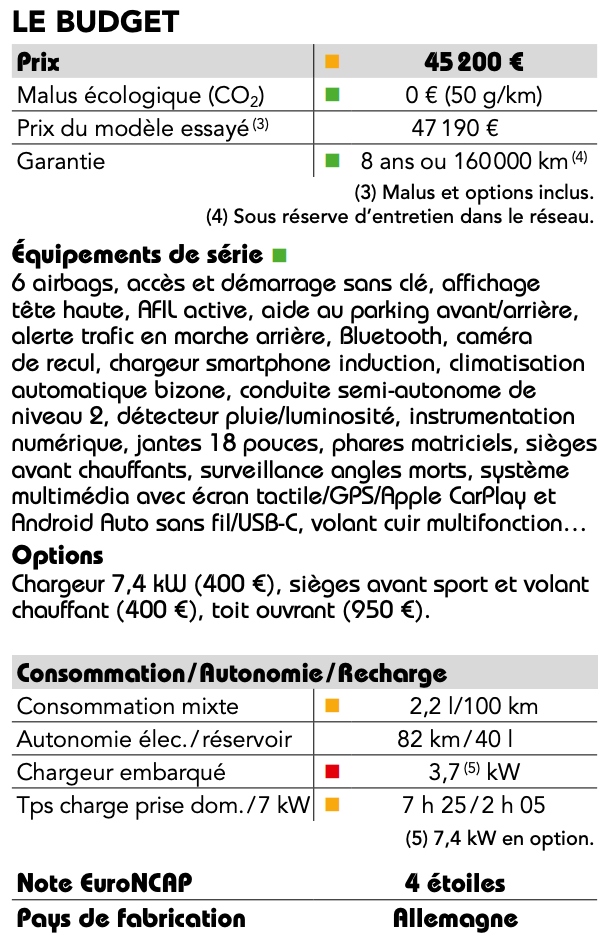
Find our test of the Opel Astra Plug-in Hybrid 195 hp Ultimate in Auto-Journal issue 1206, dated 04/02/2026.
Comparison Table
| Model | Combined Power (hp) | Electric Range (mi) | Average consumption with battery depleted (mpg) | Price (comparison) |
|---|---|---|---|---|
| Opel Astra Plug-in Hybrid (old) | 180 | 26 | 32.7 | – |
| Opel Astra Plug-in Hybrid (new) | 195 | 40 | 34.6 | – |
| Peugeot 308 Plugin Hybrid | – | 40 | 34.6 | €1,700 more expensive |
| Volkswagen Golf eHybrid | – | >60 | 38 | €4,000 more expensive |
Key Takeaways
- The Opel Astra Plug-in Hybrid gets a subtle facelift, mainly focused on the lighting signature and lighting technology.
- The model gains electric range, reaching about 40 miles (65 km) in our test, and lowers consumption to roughly 6.8 L/100 km when the battery is depleted (roughly 34–35 mpg).
- The hybrid powertrain is more capable (195 hp combined) thanks to a more powerful electric motor and a new battery.
- The Astra offers solid overall driving pleasure but still suffers from middling rear-seat space and firmer suspension.
- It remains competitively priced against better-equipped rivals, such as the Peugeot 308 and the Volkswagen Golf eHybrid.
- The verdict is positive, but the Astra still lags behind the top-tier compact plug-in hybrids on range and interior space.
FAQ
What are the main changes of the Astra Plug-in Hybrid restyle?
The restyle mainly brings a new lighting signature, next-generation LED matrix headlights, and new wheels, while the overall design changes are limited.
What is the electric range of the new Opel Astra Plug-in Hybrid?
During the test, the Astra Plug-in Hybrid covered 65 km in electric mode before the petrol engine engaged.
What are the strong points of the Opel Astra Plug-in Hybrid 195 hp Ultimate?
Its main strengths are electric range, reduced consumption, and overall driving enjoyment in daily use.
What drawbacks persist on this model?
Firm suspension, a gearbox that can feel imperfect, and limited rear passenger space remain the main weaknesses.
How does the Opel Astra Plug-in Hybrid stack up against the competition?
It trails some rivals in electric range and efficiency, but it stays more affordable than the Volkswagen Golf eHybrid or Peugeot 308 Plugin Hybrid with similar equipment.