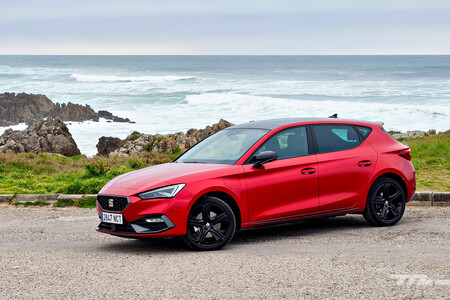
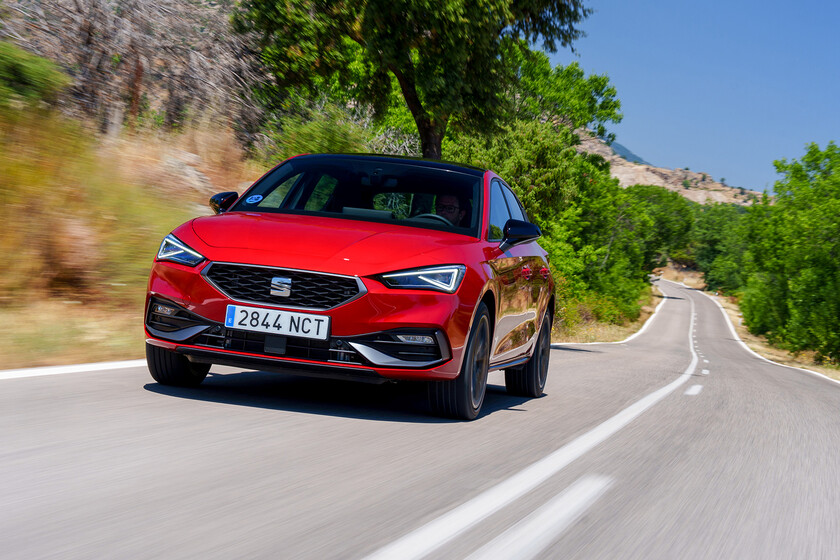
The battery of this plug-in SEAT León hybrid delivers its energy for more than 500 km. It’s not a mistake or a trick, it’s a misalignment in focus. We have been poorly sold on plug-in hybrids (PHEVs), as if they were a transitional model toward electric cars or as if they would truly consume an average of 1.3 l/100 km. What they really are, in fact, are substitutes for diesel. This is especially true in the case of the SEAT León eHybrid.
After testing it for 2,000 km and finishing with an average consumption of only 5.3 l/100 km, it becomes clear that PHEVs have their place in the market, replacing diesels for those who have to cover a lot of daily kilometres each week.
SEAT León eHybrid: the important changes are the ones you notice, not the ones you see
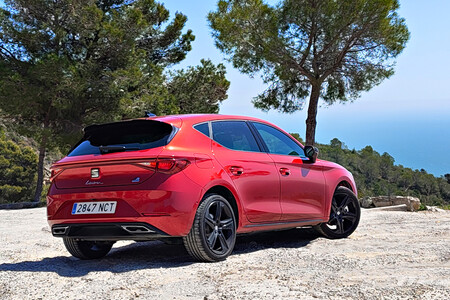
At first glance, the SEAT León eHybrid looks familiar, but appearances can be misleading. Compared with the original León eHybrid, the 2026 model keeps the 1.5-litre gasoline engine with 150 HP, but it is now paired with an electric motor of 85 kW (115 HP), instead of 75 kW (102 HP). The lithium‑ion battery expands significantly, going from 12.8 kWh to 25.7 kWh gross capacity and 19.7 kWh usable capacity. It also adds the option of fast charging with a 50 kW CCS port.
It is the front axle that drives everything through a six-speed automatic dual-clutch transmission. The combined power remains unchanged compared with the first version, still 204 HP and delivering 350 Nm. Compared to the CUPRA León eHybrid VZ, it delivers 68 HP less because the petrol engine in the sporty variant is 177 HP.

That said, this SEAT León is by no means a slow car. With both motors working, it clocks a 0-100 km/h time of 7.5 seconds. The most important thing is that SEAT promises up to 133 km of electric autonomy and more than 500 km in hybrid mode, enabling the consumption to drop to diesel-levels and offering a hybrid range of nearly 600 km.
Comfortable and dynamic, but not outstanding
It is an exceptionally smooth car in electric mode, which it uses by default whenever there is enough battery charge (and in many markets it is required by law to start in electric mode) there to prevent the engine from cutting in. There are no unpleasant jitters in the transmission when shifting gears. In electric mode, while not particularly quick, it is perfectly adequate for moving up to 120 km/h on the highway. Obviously, the faster you go, the sooner the battery will deplete and the 1.5-litre petrol engine will come to life.
Keeping the engine off in electric mode is straightforward: it will not activate unless you truly push the accelerator or floor it. In that case, the shift from electric power to petrol (with electric assistance) is smooth, though it takes about a second to take effect and push you with more force.
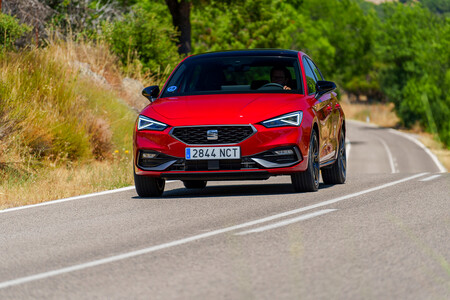
In hybrid mode, the León alternates between petrol and electricity as it sees fit. Again, the transition is smooth. The same happens when you run out of electricity: the car will keep shutting off the engine whenever possible, as you lift off or brake.
At low or steady revs, the combustion engine is quiet enough, but if you floor the accelerator to overtake, for example, the engine noise becomes noticeable above 3,000 rpm and starts to sound strained. Curiously, it doesn’t feel as fast as it actually is: it accelerates from 80 to 120 km/h in 4.5 seconds.
There are steering-wheel paddles to manually shift gears, but the gearbox does not respond quickly, so it is better to let it operate on its own. Overall, it does a good job, though sometimes it stays too long in one gear if you floor it. The brake feel is…different. It seems to lack bite and then, suddenly, it has it. The transition between regenerative braking — adjustable on the central touchscreen — and mechanical braking could be improved.
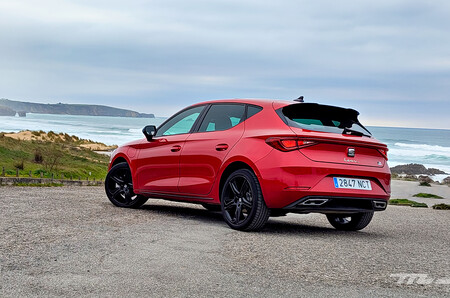
Where it really doesn’t disappoint is in that combination, habitual in SEAT and Cupra, of comfort and dynamism. Not sporty, the car is lively and relatively agile. Both in city driving and on faster roads, this León exudes composure and stability, but with a premium placed on ride comfort. The suspension filters almost everything, and the cabin remains quiet to a remarkable degree. It is a car that can cover long distances without flinching.
The same great interior space as ever
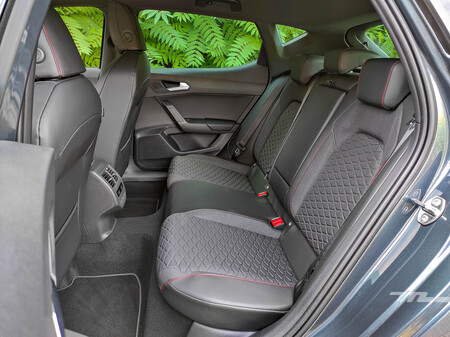
The León’s interior space remains one of the best in its class. The rear passengers’ legroom is one of the strong points of this car, thanks to a generous wheelbase.
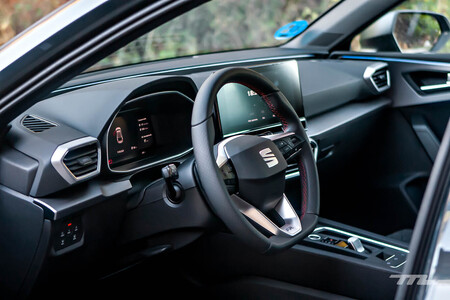
The only point where the e-Hybrid differs from the rest of the range is its trunk capacity. The boot has been reduced by 110 litres and stands at 270 litres. This is because the petrol tank takes up what, in the rest of the range, would be the double floor of the boot, since the battery sits beneath the rear seat (where the petrol tank is usually located).

Aquí, incluye de serie un nuevo cargador inalámbrico para smartphones y la pantalla táctil central más grande de la gama León, de 12,9”, con navegador de serie, con un sistema de infoentretenimiento más capaz (funciona con muchísima más fluidez) y con una barra táctil para controlar la temperatura del climatizador y el volumen de audio que, por fin, está retroiluminada.
Tiene un consumo realmente bajo. No han sabido vendernos los PHEV
The new León e-Hybrid lives up to the premise of being spacious, comfortable, precise (without being sporty), and quick when needed. For all intents, it is the León we know. And now it has markedly improved in terms of efficiency. On the one hand, it adds a 50 kW CCS fast charging option to be able to use fast-charge points on the road, and on the other hand it manages to lower its consumption to diesel-like levels.
The car truly shines in hybrid mode. From the EU authorities and from the manufacturers themselves, there is a strong emphasis on the electric range of PHEVs. In practice, it makes sense for daily trips under 46 km, according to statistics, to operate in electric mode. However, little is said about the low highway and hybrid-mode consumption that this car is capable of.
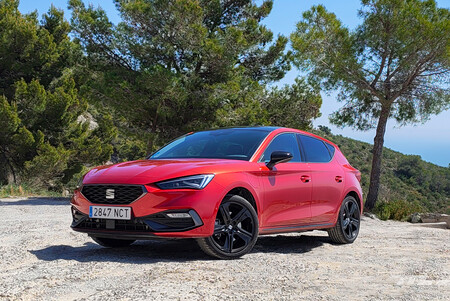
On one of my usual routes, a Barcelona-to-Santander trip, the battery did not fully discharge until after more than 600 km. During that stretch, the consumption was truly low: 5.3 l/100 km on the highway. Once the battery was depleted, consumption rose, as expected, to 6.4 l/100 km. Thus, instead of using up the battery in the first 80 km of the journey by running in electric mode, the energy was used to assist the petrol engine for most of the trip.
Moreover, the distance covered with a full tank and the battery—670 km—is even more impressive given the León’s small petrol tank, which is under 40 litres. In a moment when petrol and diesel prices are sky-high and likely to stay elevated, this León eHybrid stands out as a very efficient—and thus affordable—option for those who must cover long distances and cannot take long breaks to recharge an electric vehicle.
And what about the price? How does it stack up against rivals?
The SEAT León eHybrid currently starts at €36,800 and comes with a fairly well-equipped standard package, although rear side airbags (only head airbags as standard) and the front knee airbag are offered in an optional pack (€350) and the adaptive DCC suspension is optional (€790).
It’s hard not to think of the BYD Seal 6 DM-i when discussing plug-in hybrids. The Chinese model is much larger (4.86 m), with a huge boot (491 litres), and cheaper (up to €4,000 cheaper depending on versions). And then there’s its claimed autonomy of more than 1,000 km.
However, the BYD manages to exceed 1,000 km thanks to a 65-litre petrol tank, while the León’s tank is only 40 litres. The León also boasts a superior electric range: 133 km WLTP versus 105 km WLTP in the top-version of the Seal 6. It’s significant when both batteries sit in similar gross-capacity ranges. On top of that, the León offers higher overall build quality, especially inside, and a more up-to-date, clearer, faster, and much more intuitive infotainment system.
SEAT Leon eHybrid: our rating
7.7
8
9
8
8
6
8
8
7
7
8
Pros
- Very low consumption
- Price-performance ratio
- Habitability
- CCS fast charging at 50 kW
Cons
- Reduced boot space
- Rear side airbags optional
The SEAT León eHybrid is a stylish, modern compact, whose driving experience won’t surprise you, but it won’t disappoint you either. Its Main strength lies in its low consumption, provided you recharge the battery. And with fuel prices high, it’s a strong incentive to do so. For fuel and tax savings (zero vehicle tax in many markets, available purchasing incentives), for the composed and smooth way it moves on the road, and for its fairly spacious interior, this car covers many fronts and does so well. It’s the ideal compact.