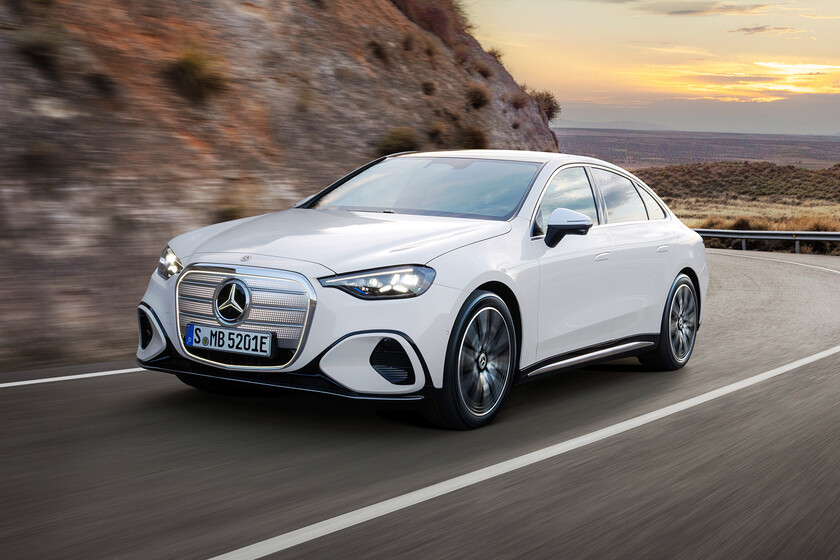
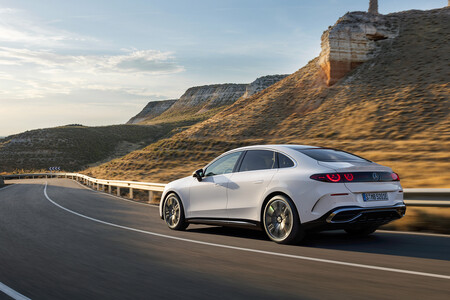
Just like BMW with its new i3, Mercedes also enters the segment of electric sedans with its new Classe C. This model breaks with the past by reviving many of the technological solutions from the Mercedes GLC and featuring dimensions never before seen in a Classe C.
And just a few days after its unveiling, the 100% electric Mercedes Classe C, a direct rival to the new BMW i3, is already available to order in Spain. The C 400 4MATIC variant starts from a price of €69,800.
Giant touchscreen and cloud-connected suspension
Most cars grow when moving to a new generation—it’s a fact across all segments. But in this case, Mercedes hasn’t made any effort to rein in, even a little, the dimensions of the new electric Classe C.
It measures 4.88 meters in length, i.e., 13 cm longer than the current Classe C and only 7 cm shorter than a higher-segment Classe E. It also stands out for its 2.96 m wheelbase, which undoubtedly improves interior space. The boot offers 470 liters (20 liters more than the i3) and a 101-liter frunk (front trunk).

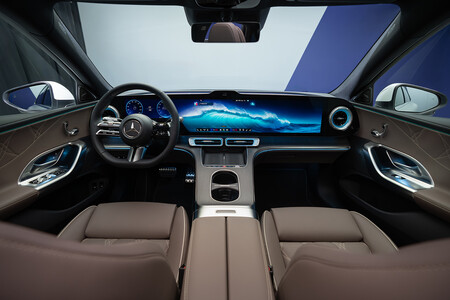
In the interior, the MBUX Hyperscreen (optional) dominates completely. Essentially because it is enormous. No less than a 39.1-inch high-resolution display that spans the full width of the cabin, with backlighting and more than 1,000 LEDs. It is one of the largest screens ever installed in a Mercedes.
Another option is the MBUX Superscreen, a comparatively modest configuration that brings together three screens under a glass surface. Both, of course, can be adjusted more than anyone will ever need, and at least climate control is always accessible.
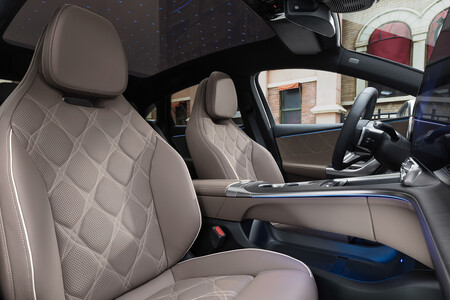
The seats are heated, electric, and AGR-certified (ergonomics for the back), with material options in leather, fabric or vegan. The lack of physical buttons will undoubtedly affect ergonomics.
Performance and range. Here, the standout figure is its range. Mercedes announces 751 km of WLTP range on a single charge from its 94 kWh battery, compared to 900 km for the BMW i3 with its 108.7 kWh battery.
Initially, the electric Classe C offers a 400 4Matic variant delivering 489 HP (20 HP more than the BMW i3), with two motors: a rear unit of 300 kW (408 HP) and a front unit of 60 kW (81 HP) that engages during strong accelerations or as all-wheel drive, then deactivating to save energy.
It includes a two-speed transmission on the rear axle: the first gear optimizes torque and power, and the second lowers highway consumption. Later, rear-drive versions will be added, along with a lower-capacity LFP battery to reduce the price.
Range and charging. It is equipped with a lithium-ion battery with 94.5 kWh of usable capacity, delivering a WLTP range of 751 km. Its 800 V architecture supports DC fast charging up to 330 kW (400 kW in the i3). Mercedes claims you can recover about 320 km of range in 10 minutes of fast charging.
Optional, it includes air suspension with real-time adaptive damping connected to the cloud from Mercedes: it detects potholes and adjusts the air suspension of other connected models that pass through the same spot. All of this to protect the passengers. Excessive technology? Perhaps.
It also offers, as an option, rear-wheel steering (4.5° angle at speeds under 60 km/h and 2.5° at speeds above 60 km/h), improving agility. It also provides a DC charger compatibility converter for 400 V chargers, something the Mercedes CLA initially lacked and that Mercedes had to add quickly.
In the end, the Mercedes Classe C Electric leans into space, technology, and efficiency, with a more affordable approach than BMW by reusing existing platforms. In return, it offers slightly lower range and charging power, at least on paper, than the Munich model.
Find Your Ideal Electric Car
If you have contemplated purchasing an electric car, this will be of interest. We have created the Personal Electric Car Recommender, which, in addition to showing models that fit your needs, will give you answers to the questions that commonly worry buyers, such as price, range, and nearby charging points.