In Brief
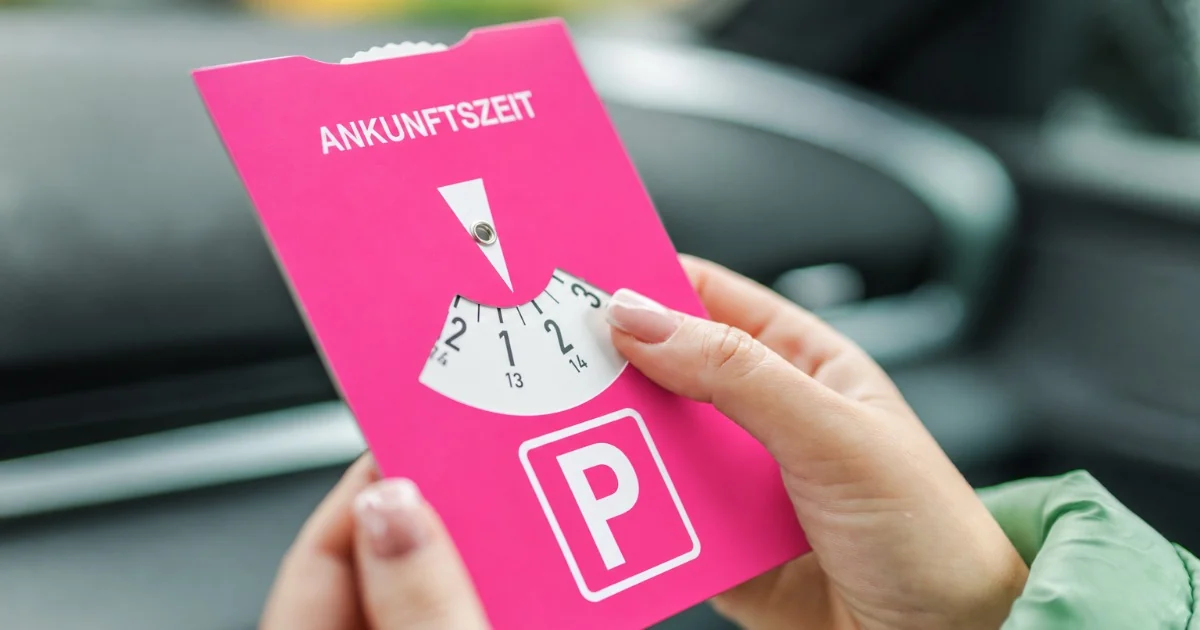
In Braunschweig, a female driver was fined €20 despite having her parking disc properly set, solely because its pink color did not comply with German regulations. In Germany, the parking disc must be blue, a color mandated by precise standards that turn it into a real traffic sign. Using a disc of another color is legally treated as an absolute absence of a disc. In France, the color rules are more relaxed as long as readability and format are respected. To avoid penalties during a trip to Germany, it is highly recommended to use an official blue disc.
You park on a timed spot, you carefully set your disc, you return on time… and you still find a notice under the windshield wiper. The scene looks like a motorist’s nightmare, except this time it isn’t overrun by overtime, or a missing disc.
It happened to a driver in the city of Braunschweig, in Germany. In her thirties, parked legally, with the arrival time indicated correctly and the allowed parking time respected, but something looked off to the officer: the disc was pink. The result was a €20 fine for this pink parking disc. Her father, Peter Helm, recounted the story on X with the message: “In Germany, you get €20 Verwarngeld for a pink Parkscheibe.” And suddenly, many internet users wondered whether a color whim could really be enough to trigger a ticket.
In Germany, a parking disc must be blue
Over the border, the parking disc isn’t just an accessory. German traffic law treats it as a bona fide signaling sign. Its shape, typeface, dimensions, and especially its color are defined to the millimeter by regulations and standards such as DIN 6171. “Blue is used for signs that indicate parking,” explains Martin Diebold, a traffic-law attorney in Tübingen, cited by SWR3. He adds: “That may be because parking zones used to be blue. We may have kept that blue.” For the attorney, this isn’t a trivial detail: “Everything is precisely defined, just like license plates are precisely defined.”
Concretely, in Germany, only the official blue-and-white disc format, or an electronically approved disc by the relevant federal authority, is valid. A novelty model, even if legible, is treated as if no disc exists. The inspection services explain they cannot verify on a case-by-case basis every exotic format without slowing down the entire monitoring system. As a result, the pink parking disc owned by the Braunschweig driver was deemed invalid. The offense is then the same as if no disc had been displayed, with a €20 warning fine for exceeding by up to thirty minutes, which can rise to €40 if the exceedance lasts longer.
Pink parking disc: can you contest it, and what about France?
Martin Diebold, however, does not completely close the door on contesting this type of fine. “It is worth a try. You can argue that the arrival time was correctly set and that the parking duration was respected. And that this pink parking disc did indicate everything correctly.” The argument is straightforward: the device’s purpose—to show how long the vehicle has been parked—was fulfilled. But the attorney remains realistic about the odds before a judge. “If the court argues: ‘From the start it was a non-compliant parking disc and that is why everything the disc indicated is void,’ then, unfortunately, I have little chance.” For now, the driver has paid the €20, a modest sum, but one that made her story go viral.
From a French perspective, the case raises questions because our “blue zone” disc is regulated differently. Since 2007, the official model is a 15 cm square with the parking pictogram and the inscription “Heure d’arrivée.” However, color isn’t fixed by a precise code: what matters is readability and contrast between numerals and background. In theory, a pink parking disc could remain within the rules here as long as it adheres to the correct format and required markings. To avoid any surprises on a trip to Germany, it’s wiser to keep a blue, official disc in the glove compartment. As radio host Flo Brückner humorously puts it: “Driver and parking disc, only one of the two is allowed to be blue. That’s how you travel safely and legally in Germany.”
Comparison Table
| Country | Disc color required | Official format | Fine amount | Validity conditions |
|---|---|---|---|---|
| Germany | Blue (DIN 6171 standard) | Blue and white, official format or electronically approved | €20 (up to 30 minutes overstay), €40 (longer overstay) | Strict: color, format, and typography are defined |
| France | Not fixed | 15 cm square, parking pictogram, and “Arrival time” text | Not specified | Readability and adherence to format |
Key Takeaways
- In Germany, the official parking-disc color is blue, mandated by precise standards.
- A differently colored disc, even if legible and correctly set, is treated as invalid under German law.
- Using a non-conforming disc can bring a €20 fine, rising to €40 for longer overstays.
- In France, color is not strictly mandated: readability and format take precedence.
- For trips to Germany, it’s advisable to use an official blue disc to avoid verbalizations.
- Appeals against such fines are possible, but odds of success are modest.
FAQ
Why was the driver fined in Germany despite a properly set disc?
The penalty was issued because the parking disc was pink instead of blue, the color required in Germany.
What is the fine for using a non-conforming disc in Germany?
The fine is €20 for up to 30 minutes of excess time, and can rise to €40 for longer overstays.
Can you contest a non-conforming disc fine in Germany?
A challenge is possible by arguing that arrival time and duration were correctly indicated, but the chances of success are slim if the court rules that the disc itself was non-compliant from the start.
Is disc color important in France?
In France, color is not strictly mandated by regulation: readability and compliance with the format are what matter.
Can a pink disc be used without risk in France?
In theory yes, provided it meets the required format and inscriptions.