In Brief
The Michelin Mille Pattes, created in 1972, is a one-of-a-kind experimental vehicle built by Michelin from a Citroën DS break. Extended to 7.3 meters and equipped with 10 wheels and two Chevrolet V8 engines totaling around 500 horsepower, it allowed heavy-duty tire testing in a highly demanding way thanks to an integrated 11th test wheel. Capable of reaching speeds over 150 mph, it was used to verify tire performance under extreme conditions without risking an entire truck. After a decade of on-track use at Ladoux, it is now on display at the L’Aventure Michelin museum in Clermont-Ferrand.
When kids drew cars, they often added wheels everywhere, for fun. In Auvergne, Michelin actually turned that fantasy into a concrete object: a lengthened Citroën DS, 10 wheels on the ground, 2 big American V8s at the back, and a truck tire tucked inside its belly to be pushed to very high speeds.
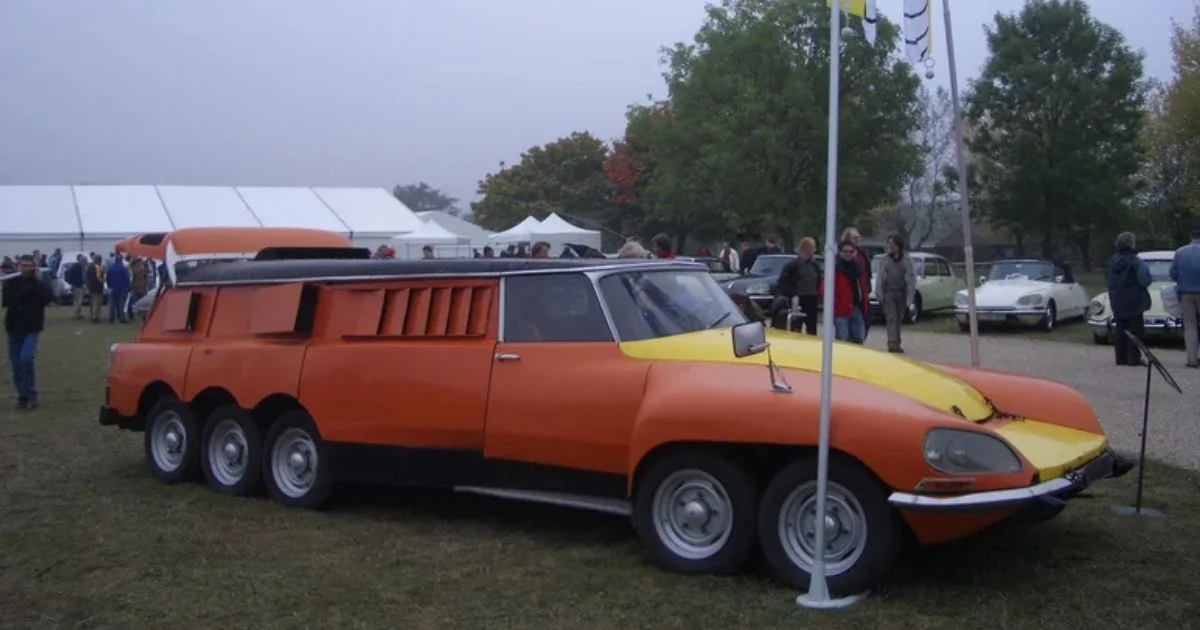
This rolling laboratory, developed in 1972, carried a formal official name, Michelin PLR for “Poids Lourd Rapide” (Fast Heavyweight), but everyone knows it by its far more descriptive nickname: Michelin Mille Pattes. A Citroën DS break transformed into a monster weighing more than 9 tons, capable of pushing a truck tire to speeds above 150 km/h safely… Behind its orange and yellow bodywork, which evokes the iconic Oscar Mayer Wienermobile, this extraordinary DS hides a genuine engineering lesson that its cartoonish appearance doesn’t reveal at first glance.
How the Michelin Mille Pattes Grew from a Citroën DS and a Safety Imperative
In the early 1970s, buses and trucks were moving faster and heavier on an expanding network of highways. For a tire maker like Michelin, it became vital to verify the behavior of heavy-duty tires at ever-higher speeds without exposing an entire road fleet to extreme on-track testing.
The group then controlled Citroën since 1935. The idea quickly took hold: to use a Citroën DS break, famed for its hydropneumatic suspension, and turn it into a closed laboratory, smaller than a semi-trailer yet capable of reproducing its constraints. The DS body was stretched to about 24 feet, or roughly 7.3 meters, and mounted on five axles, three of them rear axles borrowed from a Peugeot 504. Visually, it looked as if a DS wagon had gone to a limousine shop, with six extra wheels added just to see how far you could push it.
Michelin PLR: 10 Wheels, Two Chevrolet V8s, and More Than 9 Tons
Behind its DS-face, the Michelin PLR bears little resemblance to Citroën on the mechanical side. Instead of the original four-cylinder engine, there are two Chevrolet 350 cubic inch V8s—about 5.7 liters each—at the rear. Each block produced roughly 250 hp, for a total of around 500 hp, split between propelling the machine and driving the central test wheel, according to Michelin.
With its five axles, measurement equipment, two radiators, and the full hydraulic system, the beast weighed in at 20,172 pounds, about 9,150 kg. The footprint was imposing: roughly 7.3 meters long, about 2.45 meters wide and 1.56 meters tall, with ground clearance kept around 215 mm thanks to the DS hydro-pneumatic suspension, which kept the chassis level despite the mass.
- Year of creation: 1972
- Weight: 20,172 lb (about 9,150 kg)
- Wheels on the ground: 10 (2 front axles, 3 rear axles)
- Motors: 2 Chevrolet 5.7 L V8s
- Length: about 24 feet (about 7.3 m)
- Test speed claimed: up to 96 mph (about 155 km/h)
On the track, the Michelin Mille Pattes was used for tests up to 96 mph, about 155 km/h. Other accounts mention slightly higher top speeds, around 180 km/h, but Michelin emphasizes its ability to reproduce the long-duration conditions of a modern truck rather than chasing a record. Some articles also mention 700 hp and over 10.5 tons; the manufacturer’s official figures remain more modest, which does not stop the machine from ranking among the most extreme Citroëns ever built.
The Secret of the 11th Wheel and the Mille Pattes’ New Life
What truly sets the Mille Pattes apart from a mere ten-wheel monster is its 11th wheel, hidden inside its cab. At the rear of the cabin, engineers installed a movable hub carrying a truck or coach tire, sized 8R22.5 to 12R22.5. Once the car was rolling on the Ladoux test track near Clermont-Ferrand, a technician would lower this test tire onto the pavement via a hydraulic actuator.
This actuator could apply up to 7,716 pounds of load, about 3,500 kg, to that single tire. The team also adjusted camber angle, induced violent braking, varied load and speed, all while recording responses with a battery of sensors. At that moment, the number of tires in contact with the ground rose from 10 to 11. The rest of the wheels served to stabilize this “center of effort” so that measurements came from the heavy-duty tire, not from the vehicle’s movements.
After about a decade of service, in the early 1980s, the Michelin PLR gave way to more modern test rigs and laboratory machines capable of simulating truck stresses even more precisely. Michelin had already tested probe trucks before, such as the Willème WR8, but Mille Pattes remains the one that left the strongest impression, with its mutant-DS look and spectacular Ladoux tests.
Today, the machine enjoys a well-deserved retirement at L’Aventure Michelin, the brand’s official museum in Clermont-Ferrand. The ten-wheel vehicle is on display in its two-tone orange-and-yellow livery, and it remains occasionally roadworthy for events. For an enthusiast who studies it closely, the challenge is almost to pick out every detail by eye: the Peugeot 504 rear axles, the two V8s tucked behind the cockpit, and above all the architecture of the famous 11th wheel that shaped, over several years, the behavior of tires on our trucks and coaches.
Comparison Table
| Characteristics | Value |
|---|---|
| Year of creation | 1972 |
| Length | about 7.3 m (24 feet) |
| Width | about 2.45 m |
| Height | about 1.56 m |
| Weight | 20,172 lb (about 9,150 kg) |
| Wheels on the ground | 10 (plus an 11th test wheel) |
| Engines | 2 Chevrolet 5.7 L V8s |
| Total power | about 500 hp (2×250 hp) |
| Load on the test wheel | 7,716 lb (about 3,500 kg) |
| Test speed claimed | 96 mph (about 155 km/h) |
| Ground clearance | about 215 mm |
Key Takeaways
- The Michelin Mille Pattes was created in 1972 from a Citroën DS break to test heavy-duty tires.
- It features 10 wheels on the ground, an integrated 11th test wheel, and a 7.3-meter-long body.
- The vehicle houses two Chevrolet V8 engines delivering around 500 hp in total, and weighs over 9 tons.
- It could reach up to 155 km/h on Michelin’s Ladoux test track near Clermont-Ferrand.
- This rolling laboratory left a lasting mark on tire engineering before being replaced by more modern test benches.
- Today it is on display at the L’Aventure Michelin museum and remains a symbol of technical innovation.
FAQ
What is the Michelin Mille Pattes?
The Michelin Mille Pattes is a 10-wheel experimental vehicle based on a Citroën DS, created by Michelin in 1972 to test heavy-duty truck tires at high speed.
What was the Mille Pattes’ primary mission?
It served as a mobile laboratory to test the endurance and safety of truck tires under extreme conditions, thanks to a central test wheel.
What power did the Mille Pattes develop?
It was equipped with two Chevrolet 5.7-liter V8s, about 250 hp each, for roughly 500 hp total.
Where can you see the Mille Pattes today?
The vehicle is on display at the L’Aventure Michelin museum in Clermont-Ferrand and remains occasionally roadworthy for events.
At what speed could the Mille Pattes test tires?
The machine conducted tests up to 96 mph, about 155 km/h, safely on the Ladoux test track.