If you still think the Chinese brand BYD is nothing more than an electric car manufacturer, you’ll have to rethink. In Spain, the model that has the best sales success for the brand is the plug-in hybrid SUV Seal U DM-i. In fact, it was the best-selling PHEV in Spain in 2025 and also the top European seller with more than 70,000 units. Today the Chinese maker offers five PHEV models and seven electric ones. One of the most interesting is the BYD Seal 6 DM-i Touring.
The Seal 6 DM-i Touring Comfort of 212 HP, also available in sedan bodywork, is the one we tested. And with gas prices so high, this model is tempting with its range of over 1,100 km and modest consumption.
BYD Seal 6 DM-i Touring, between a PHEV and a long-range electric
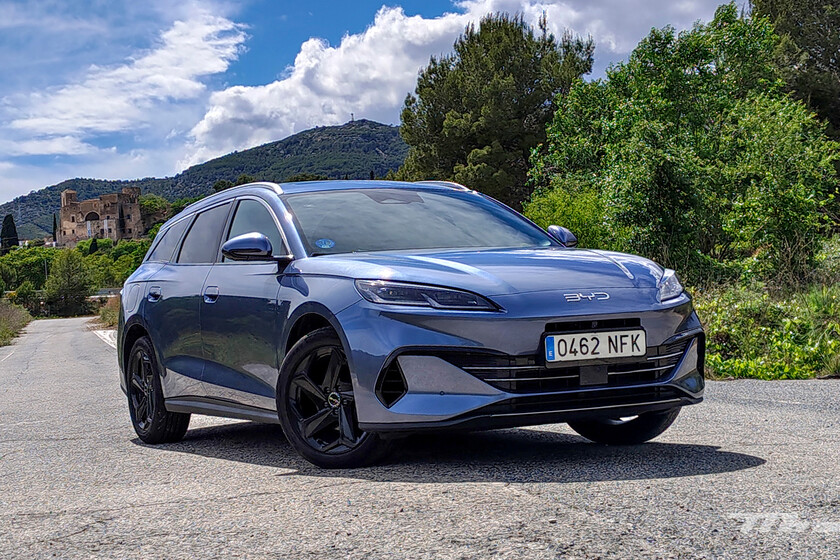
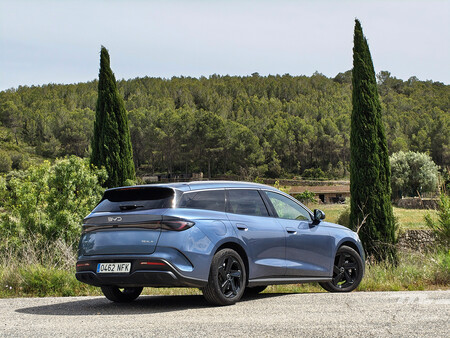
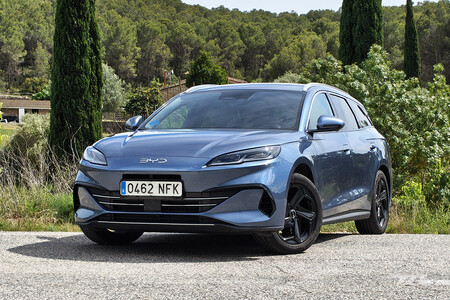
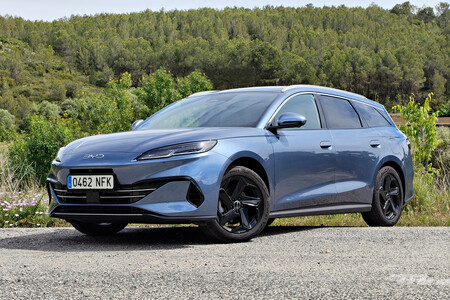
The BYD Seal 6 DM-i Touring is BYD’s first plug-in family estate. It is large, at 4.84 m in length, with dimensions close to the Skoda Superb Combi (4.90 m). But its price, starting at 35,040 euros, and how it is presented position it more as a rival to a SEAT León ST eHybrid or a Peugeot 308 SW plug-in hybrid.
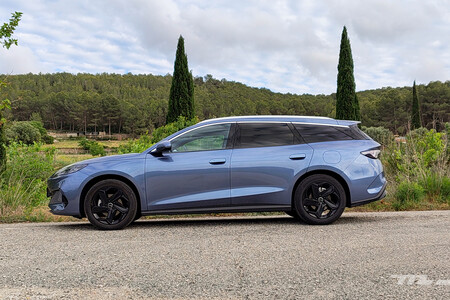
The Seal 6 isn’t ugly, but let’s be honest, it isn’t especially memorable either. It certainly doesn’t have the style of the Peugeot 308 SW or the Skoda Superb Estate. In any case, I find it much more successful than the Seal 6 sedan.

Mechanically it also differs notably from its rivals. Although it is a plug-in hybrid, its operation differs a lot from what the Volkswagen and Stellantis groups propose. The BYD works more like an electric car with a range extender than as a conventional PHEV.
The 1.5-liter gasoline engine of the Dual Mode-intelligent system, BYD’s term, with only 98 HP is not the car’s main motor but is there to keep the 19 kWh battery charged, while the electric motor of 197 HP moves the front wheels almost all the time.
That is, in BYD the gasoline engine assists the electric motor, whereas in European proposals it is the electric motor that assists the gasoline engine. What does that change? The consumption. Electric motors are far more efficient than gasoline ones.
A plug-in hybrid system designed for…not being plugged in
On paper it is excellent. In practice, not so much. Like all PHEVs, to achieve genuinely low consumption you must recharge the battery frequently. With only 19 kWh of gross capacity to move a 1,805 kg car, its electric range is simply adequate. Not the 100 km WLTP, it stays around 70 km.
Furthermore, it only supports AC charging up to 6.6 kW and DC up to 26 kW. Allowing only 26 kW on fast chargers does not encourage charging on the road or away from home. With the battery fully charged, the average consumption drops to about 5 L/100 km. But once exhausted, the average consumption rises to 7 L/100 km, and even up to 9 L/100 km on a highway at 135 km/h (tested in France, not Spain…).
With such high consumption can we achieve BYD’s enormous range claim? Obviously not. It all depends on the type of trip; on a highway at a gentle pace, we could reach 900 km without issue, and with more secondary roads 1,100 km is possible. And that in itself is a feat. But the promise of 1,500 kilometers in normal conditions is not fulfilled.
Behind the wheel of the BYD Seal 6, comfort and smoothness
It isn’t as quick as a pure electric (0-100 km/h in 8 seconds), but it is quite quiet even when the gasoline engine starts. In other respects, there is clearly room for improvement. The steering is somewhat vague and does not transmit much feel, while the suspension wobbles between comfort and firmness.
When it comes to the chassis, it offers a decent dynamic. This BYD still exhibits a slightly soft-handling behavior in corners and during braking.
A little more steering feel would be welcome to better appreciate the work of the front axle, and the suspension could be a bit more indulgent at low speeds and more composed at highway speeds. But that isn’t enough to spoil the driving experience. At least, the car is relatively comfortable, comfortable enough to cover miles without fatigue.
As for braking, it feels quite natural despite the constant transitions between energy recovery and friction braking. On the other hand, the aerodynamic and road noise seemed elevated above 120 km/h.
The only thing that can spoil the drive is the driver monitoring system, which keeps insisting that I “keep my eyes on the road” even when I’ve only looked away to check speed or because I’m approaching a roundabout and need to look left to see if a vehicle is coming…
And what about the interior?
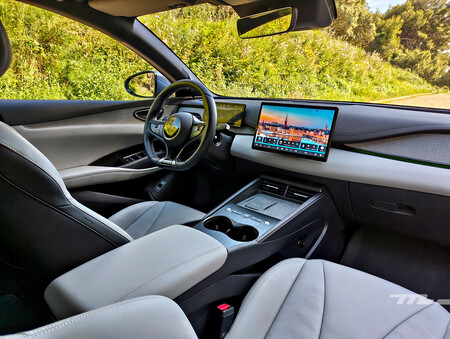
Honestly, this is where everything is more pleasant. The overall design reuses BYD’s characteristic wave motif. The dashboard and door panels showcase curved shapes.
The finishes are reasonably well made and there’s nothing jarring about the choice of materials. But the presentation isn’t as refined as inside a Skoda Superb Combi. A warm cabin demands a level of investment that BYD hasn’t chosen to apply here.
Anyway, a 15.6-inch touchscreen continues to sit at the top of the dashboard. The screen’s response is satisfactory for switching from one function to another, but the all-touch ergonomics grouped into a single screen remain impractical: difficulty grabbing controls, constant back-and-forth through menus, and, in the end, too much distraction at the wheel. Ironically, the reviewer is reminded of the minimal admonition, “keep your eyes on the road.”
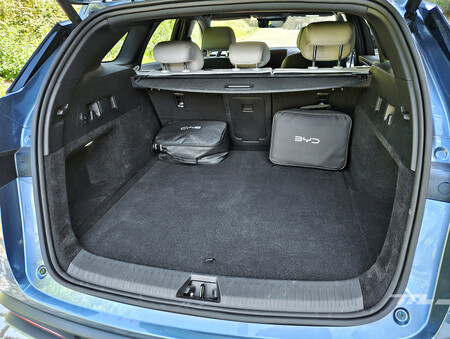
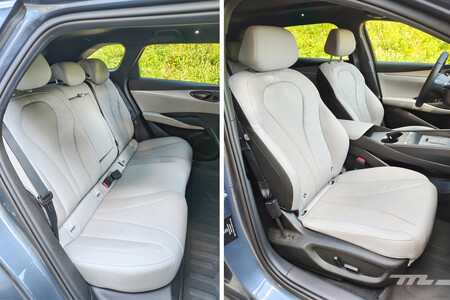
In the front it is perfectly comfortable; in the rear there is ample headroom and legroom, though it can feel tight if the driver prefers a low seating position. What isn’t tight is the boot space: 500 liters.
You’ll like its price
From €35,240. Undoubtedly, BYD’s price argument is the decisive one for this plug-in hybrid, and it is noticeably cheaper than all its rivals. The Peugeot 308 SW Plug-in Hybrid costs a little over €37,000 and the SEAT León eHybrid, one of the best PHEVs on the market, in a family body starts at €38,000.
As for the Volkswagen Passat Variant eHybrid, it starts at €44,900, and the Skoda Superb Combi iV around €50,000; both with comparable batteries and electric ranges but €12,000 to €17,000 more expensive. Simply put, there isn’t a cheaper plug-in hybrid station wagon for sale in Spain.
BYD Seal 6 DM-i Touring: our assessment
7.7
7.0
8
7.0
7.0
9.0
8
8
6.0
8
9.0
Pros
- Price and equipment
- Habitability
- Driving comfort
- Electric range
Cons
- Driver assistance systems so intrusive they hinder driving
- Fuel consumption with a depleted battery
- Absence of fast charging
On paper, the BYD Seal 6 has a lot in its favor. It costs considerably less than its rivals, comes generously equipped, and its consumption is very moderate—as long as you keep a very gentle pace. But as is often said, you get what you pay for, and the Seal 6 doesn’t live up to its rivals in dynamics or comfort. Not to mention the driver monitoring and assistance systems, so intrusive they become exasperating.
If you’re simply looking for a cheap family car, spacious, comfortable, frugal, with plenty of autonomy, and you don’t want or can’t plug it in often, the BYD Seal 6 is your car. And it even comes with a Zero Emissions label as a gift.
|
|
|
|
Motores |
Gasoline: 4 cylinders; 1498 cc, turbocharged; 98 HP and 122 Nm. Electric: 147 kW (195 HP) and 300 Nm |
|
capacidad de batería |
19 kWh (gross) |
|
potencia máxima total |
212 HP |
|
par máximo total |
300 Nm |
|
transmisión |
Front-wheel drive. Automatic transmission |
|
dimensiones (Largo x ancho x alto) |
4,840 x 1,875 x 1,505 mm |
|
batalla |
2,790 mm |
|
maletero |
500 liters |
|
peso |
1805 kg |
|
80 a 120 km/h |
5.6 s |
|
0 a 100 km/h |
8.6 s |
|
velocidad máxima |
180 km/h |
|
consumo medio homologado (WLTP) |
1.7 l/100 km |
|
Consumo medio en prueba con batería a 0 |
7 l/100 km |
|
Autonomía eléctrica máxima homologada (WLTP) |
100 km |
|
Autonomía eléctrica en prueba |
70 km |
|
PRECIO |
from €35,240 |
|
The car used for this test was provided by BYD. For more information, consult our corporate relations guide. |