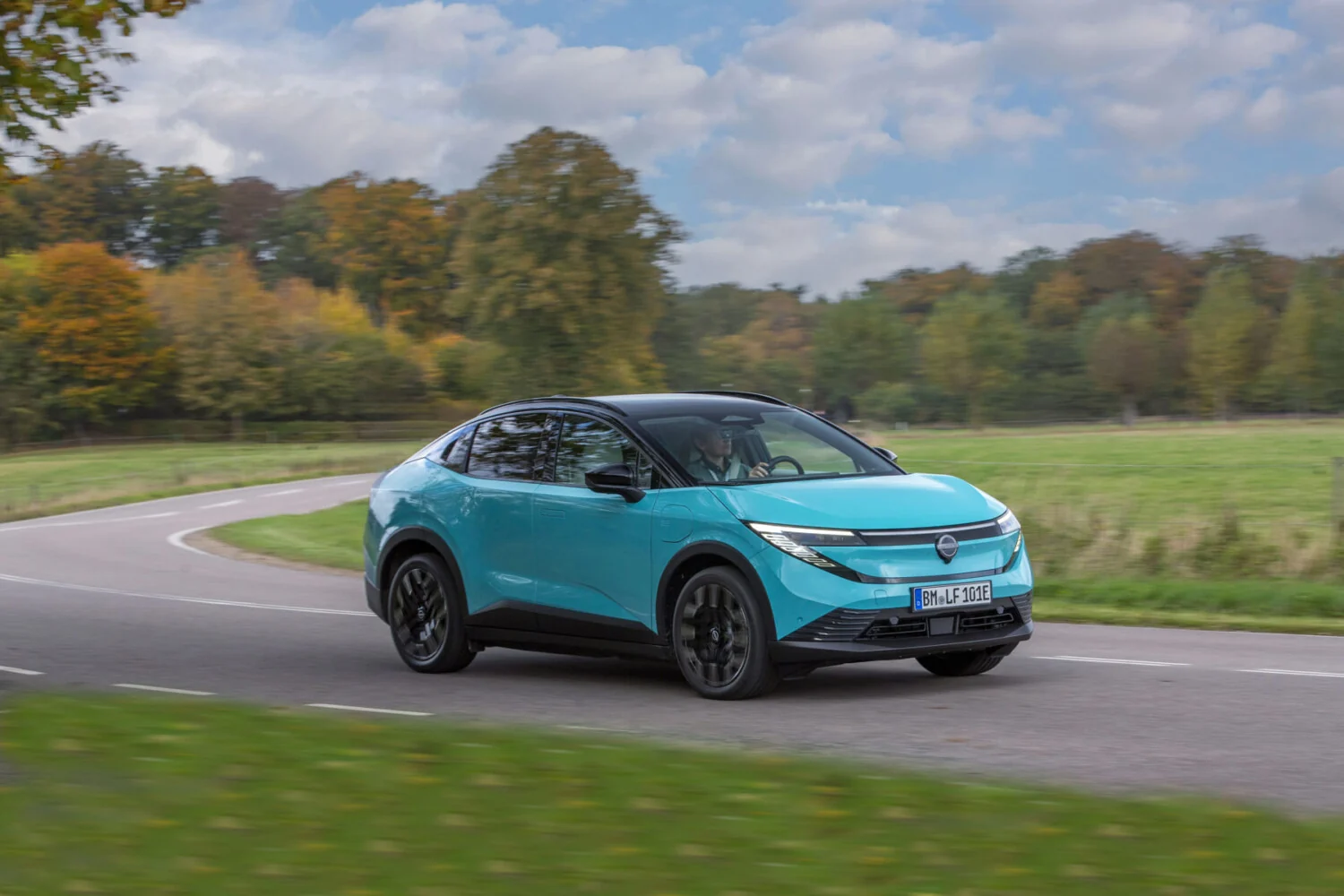
City streets, winding back roads, and highways: we spent a week with the Nissan Leaf long-range. Between restrained energy use, convincing comfort, and charging that could be better, this Japanese electric car showed it could go beyond the everyday commute.
A More Appealing Leaf, Without Turning It Into a Bulky SUV
It’s hard to recognize the electric pioneer beneath this new silhouette. For its third generation, the Nissan Leaf swaps its sedan-like profile for a crossover with sharp, taut lines, featuring a sloping roofline, flush-fit door handles, and a refined light signature.
The result is markedly more assertive than on the first two generations, without going overboard. What’s more, this styling shift does not come with an excessive growth in overall dimensions. At about 14 feet 3 inches long and 5 feet 11 inches wide, the Leaf sits in a sensible footprint on the road. It may look imposing at first glance, but a week behind the wheel confirms that its size is just right.
You don’t feel like you’re piloting a tiny city car, without having to contend with the drawbacks of a full-size SUV.
This balance is well suited to a car meant to fill multiple roles: commuting to work, urban drives, shopping trips, and, occasionally, hitting the open road for vacations.
À bord, une présentation moderne et une vraie vocation familiale
The Leaf also overhauled its cabin. The very horizontal dashboard can accommodate, depending on trim, two 14.3-inch screens. The multimedia system with Google built in makes it easy to access Google Maps and to plan routes that include charging stops more intuitively.
That equipment makes sense for an electric car designed to regularly venture beyond its usual perimeter.
The interior is minimalist, but Nissan hasn’t entirely sacrificed traditional controls: a handful of physical buttons remain accessible for common functions. Up front, the premium-looking presentation contributes to a sense of a higher-end feel.
In the rear, however, the relatively high floor and the sloping roofline limit comfort for taller passengers.
With about 15.5 cubic feet of cargo space, the trunk fulfills its role adequately for a car of this size. The Leaf isn’t the roomiest family car, but it offers enough for luggage and everyday use during a busy week.
En ville et sur petites routes, une Nissan électrique sans prise de tête
First pleasant surprise of the week: the Leaf requires no special effort to be appreciated day to day. Its size is manageable in city traffic, and maneuvers aren’t a test of patience, thanks to the smoothness typical of electric propulsion. With 217 hp and 355 Nm of torque for this 75 kWh version, the accelerations are immediate, without unnecessary brutality.
On back roads, the assessment remains positive. The Japanese model offers a convincing balance between body control and suspension suppleness. It isn’t as light as a compact city car, but its behavior doesn’t force you to slow down at every twist. Comfort remains the guiding principle.
Energy recuperation is adjustable via steering-wheel paddles. However, the e-Pedal Step function does not allow the car to come to a complete stop without braking: a limit to note for those who prefer one-pedal driving.
Sur autoroute, la Leaf montre qu’elle sait aussi voyager
Long trips often reveal an EV’s limits. Here, the Leaf holds up fairly well. Over the week, it demonstrated its ability to go from city streets to highways without losing its character.
The suspension strikes a good balance between highway comfort and enjoyment on back roads: the miles flow by without giving the impression you’re driving a car built only for daily commuting.
The 217 hp provide strong enough overtakes and quick insertions, and the car keeps that electric-smooth operation that makes electrics feel relaxed. It offers a cohesive package, with no real surprise in varied use.
Don’t expect it to behave like a sports car. But that isn’t its goal: what convinces here is the ability to plan a long highway stretch without discomfort and then return to urban driving just as comfortably.
Consommation : moins de 18 kWh/100 km sans difficulté
That’s arguably the most convincing point of this test. With the large 75 kWh battery, Nissan touts up to 623 km of range on the WLTP cycle, depending on trim. It’s an impressive figure, but of course real-world results vary, especially on the highway. In practice, the consumptions recorded during our week showed the Leaf staying reasonable.
In typical use, it’s easy to stay under 18 kWh per 100 km without aiming to set eco-driving records. On the highway, without paying special attention to efficiency, we averaged between 21 and 22 kWh/100 km. For a vehicle of this size with a generously sized battery, that’s very respectable.
These figures don’t guarantee you’ll routinely hit 600 km on a single charge. But they’re reassuring: range doesn’t demand constant concessions, and the Leaf invites you to drive normally, without constantly monitoring every acceleration or turning off cabin comforts.
Recharge rapide : correcte, mais on en voudrait davantage
The remaining snag that stops the long-range Leaf from earning a flawless score is charging speed. On DC fast charging, the maximum announced power is 150 kW. Nissan quotes about thirty minutes to go from 20 to 80 percent under favorable conditions. It’s not bad, but with a battery this large, we would have appreciated a system capable of accepting at least 200 kW to shave stops on long trips.
In practice, this limit doesn’t nullify the car’s road manners. It simply means that, when you need to cross a country, a stop still requires a bit of planning. The built-in route planner, paired with battery preconditioning, helps you anticipate these steps precisely.
On alternating current, the Leaf also features an 11 kW onboard charger. For those who can recharge at home or at work, most daily travel can be accomplished without relying on rapid charging.
Quel bilan après une semaine au volant de la Nissan Leaf ?
The lineup starts at about €35,300 with the 52 kWh battery and the 177 hp motor. To enjoy the long-range version with 217 hp, you’ll need at least €40,300, while higher trims push the price toward €47,000.
Prices that place it against well-established electric rivals, but with a simple argument. Its ability to balance everyday commutes with longer getaways is compelling.
After a week behind the wheel, it’s this versatility that sticks. The Leaf isn’t overly bulky in the city, nor tiring on the highway, nor excessively thirsty on long stretches. It doesn’t try to impress with a flashy temperament, but through ease of use. Comfort and measured efficiency do more to persuade than the 623 km printed in the brochure.
We wouldn’t object to faster charging and a bit more rear-seat space. Other than that, Nissan has found a cohesive formula: an everyday electric that doesn’t give up the miles.