On March 30, it emerged that Renault had formed a partnership with the French military equipment supplier Turgis-Gaillard to develop a ground drone for military and civilian use.
The war in Ukraine reshuffles the defense industry
The information described a prototype developed with the Belgian defense group John Cockerill, a small, lunar-looking device equipped with several cameras. John Cockerill also owns Arquus, the main French supplier of military vehicles to France’s armed forces. The division of labor was as follows: Renault brings its expertise in large-scale production, while John Cockerill provides intimate knowledge of the needs of the armed forces. A ground drone, in the literal sense, is an unmanned vehicle, remotely piloted, tasked with doing what we no longer want to entrust to a frontline soldier: going to see what lies behind the hill, for example. The context is not unfamiliar to this partnership. Renault presented this project as Europe seeks to accelerate its armaments production in response to Russian aggression. Recent conflicts, and in particular the war in Ukraine, have shown that drones—affordable and mass-produced—change the game. Yet the European defense industry, used to producing little and at high cost, struggles to keep pace with this rhythm. Automotive manufacturers know precisely how to do the opposite: high output, controlled costs, well-tuned supply chains.
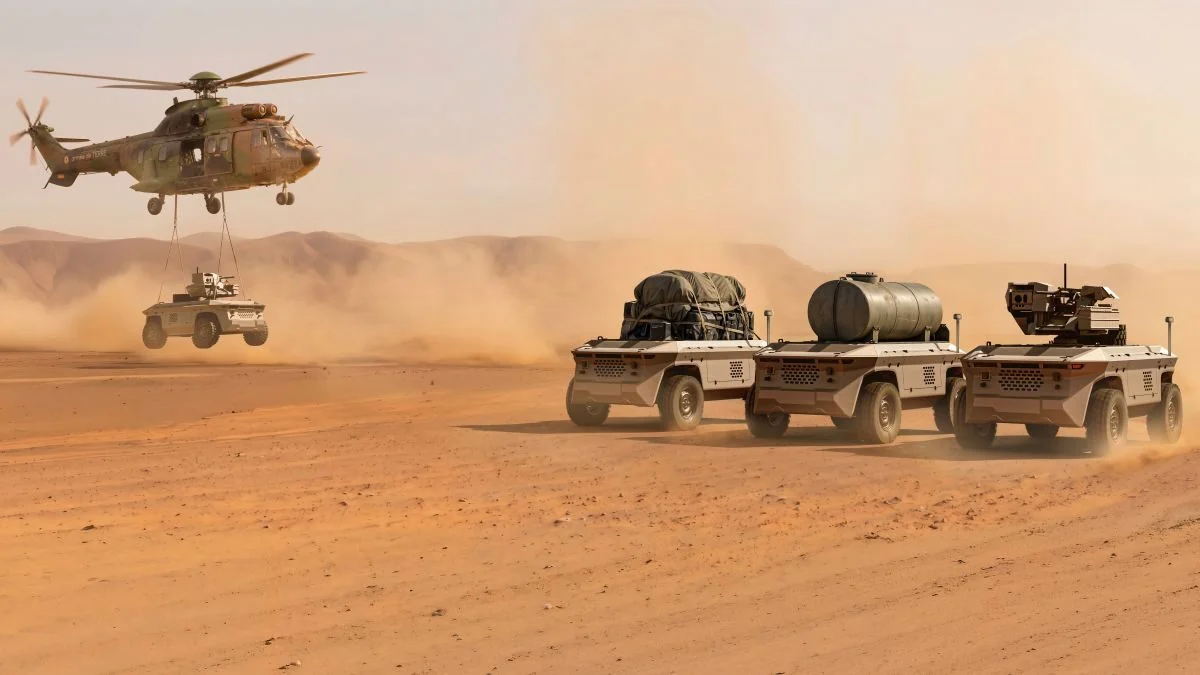
Forefront: a mass-produced ground drone with 70% of parts from serial production
The French Ministry of the Armed Forces itself has taken an interest in Renault’s ability to move fast. This drone fits into a broader strategy: the DGA awarded at the end of 2025 an initial contract of €35 million to Renault and Turgis-Gaillard for the aerial drone Chorus, and the group subsequently unveiled, with Thales, a lightweight kamikaze drone as well as a military vehicle named “4 Troop”. The remaining question now is the schedule. Today, we finally discover this new ground drone, named Forefront Concept. Technically, it resembles a rugged electric SUV: four-wheel drive, four-wheel steering, two electric motors. The announced specifications point to a 400-kilometer range, a one-ton payload, and an autonomy extender that can be installed as needed. About 70% of the components come directly from the automotive sector: batteries, motors, thermal management, onboard electronics. Renault thus avoids building a military platform from scratch, which lowers costs and speeds up timelines. But no production volume, no purchase commitments, nor any official production site have been publicly announced, and Renault remains cautious. The French army will evaluate the demonstrator during bridging and validation exercises and plans a robotic combat unit in 2027 as part of the Pendragon program, which Forefront Concept could join, though details are not yet known at this time.