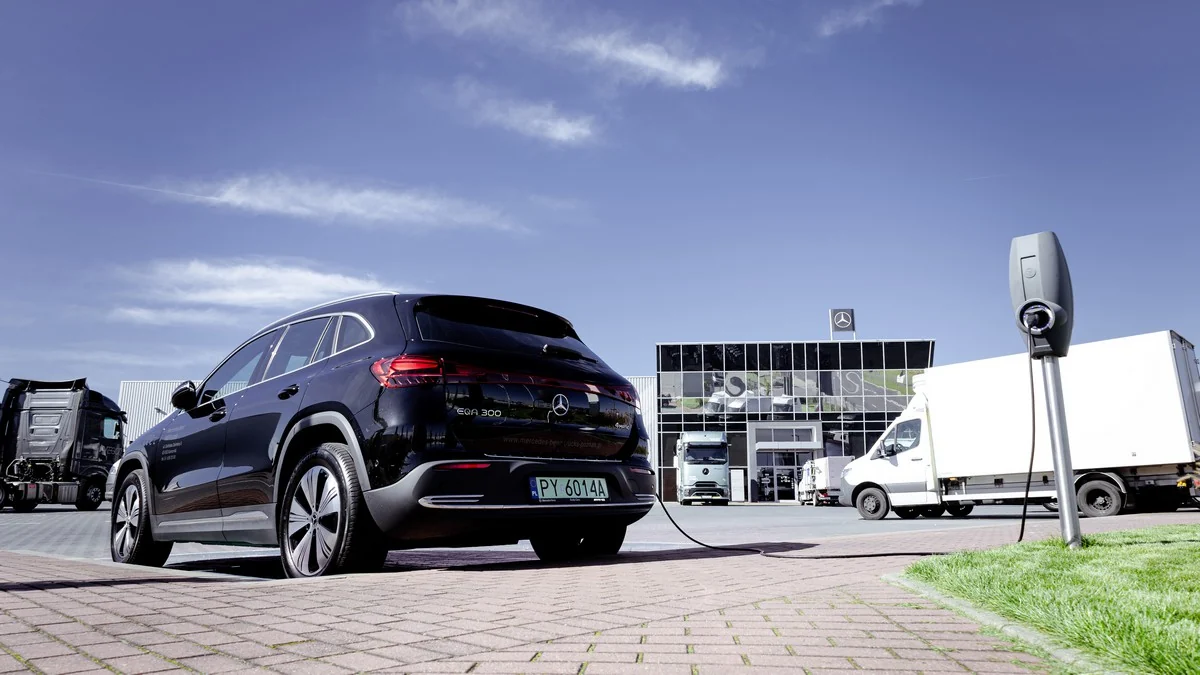
To properly develop electric propulsion, charging is essential. For this, many players have embarked on developing their own fast chargers. Mercedes is pulling out of the project and has even sold its fast chargers.
Mercedes Cedes Its Charging Network to Electra
It is in the German automaker’s third-quarter financial report that Mercedes discreetly announced its withdrawal from the European charging market. The German company thus hands over its network to the French operator Electra.
As a result, Mercedes will have to rely on external partnerships to charge its electric vehicles in the European market. In total, its network consisted of 374 rapid charging stations across 47 sites.
Following this decision, Electra becomes, according to the financial report, “the Premium Partner” just behind Ionity. Another consequence: Mercedes drivers will enjoy a reduced rate on all of Electra’s 5,000 charging points across 800 sites located in several European countries.
Mercedes specifies that this decision concerns only the European market. Consequently, the charging activity in the United States will not be affected. But then why did Mercedes take such a decision in Europe? A major argument put forward is economics. Indeed, the European market is consolidating around the major providers. As a result, small networks like Mercedes’ are neglected. This is enough to make economic viability precarious.
A Market with Shifting Dynamics
Mercedes will thus have achieved only part of the goal it set a few years ago. Building its own network requires a massive investment. Yet, brands have a real need to cut costs. The German automaker is also going through a difficult economic period.
And as Mercedes cedes its network but not without an advantage, the German automaker will gain privileged access to the network. At the same time, Mercedes can forge additional partnerships with other suppliers. This could enable it to offer highly attractive prices to its customers, without tying itself to a single EV charging network.
From now on, the stations that were previously under Mercedes-Benz have been integrated into Electra’s network. Payment terminals will be gradually replaced. Additionally, the signage at the stations will also soon be updated to clearly display the name of the new owner of the network.
Electra, for its part, does not intend to stop there. In fact, the French operator plans to invest €200 million in Germany in 2027. The goal: to have 15,000 rapid charging points in Europe by 2030.