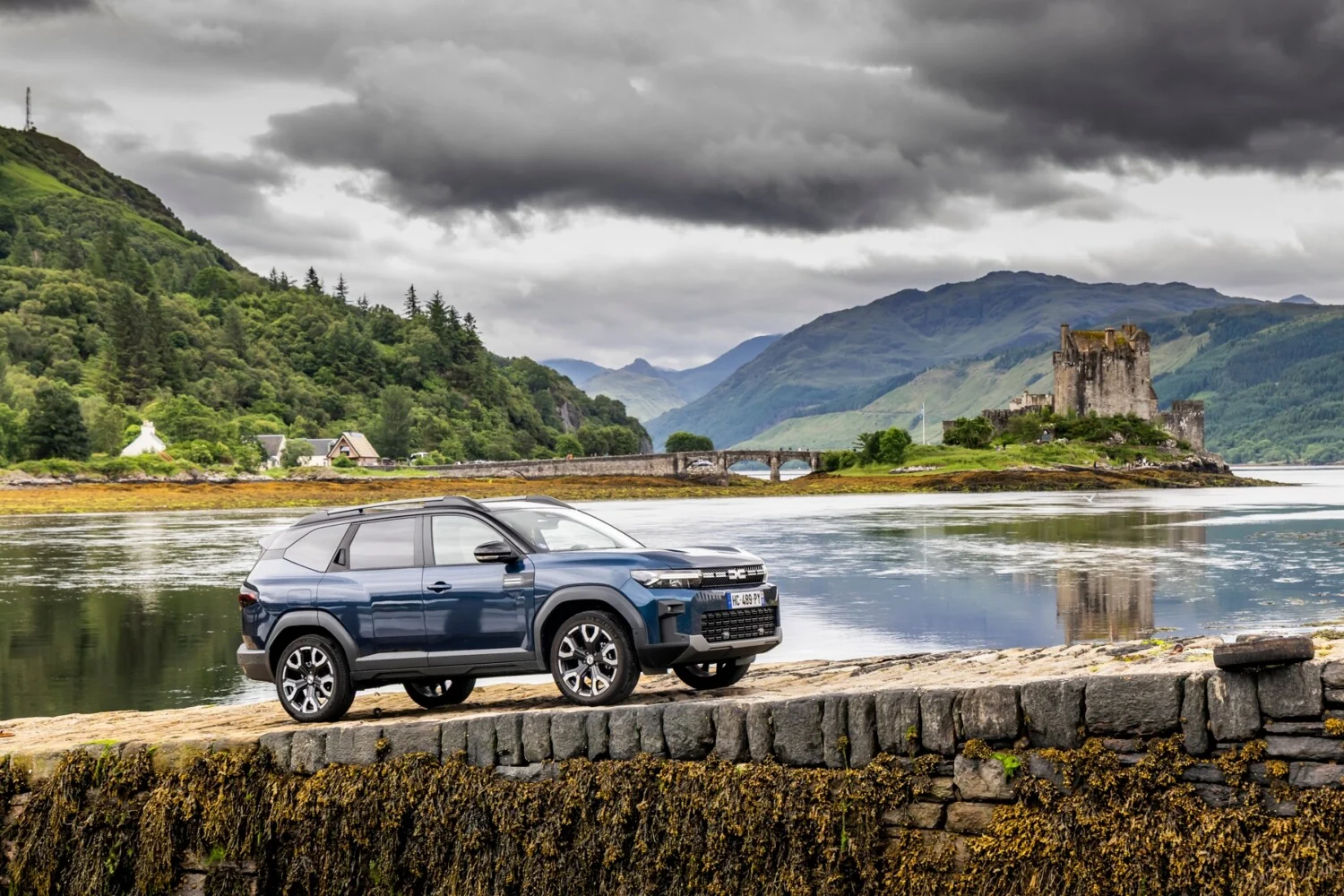
Let’s begin with a positive note, a token of gratitude, or at least a bright point, in these times: tested this summer of 2026 during five heatwaves, the Bigster and its air conditioning kept us cool in every moment without fail. Even after leaving the car in the scorching sun long enough to turn that forgotten Ice Tea inside into a warm infusion, four grownups can hop in and enjoy the brisk airflow almost immediately, including from the rear bench thanks to the rear air vents.
Dacia Bigster Hybrid 155 ch Journey: It Makes Noise!
Even in the city, in electric mode (our Bigster is a hybrid), cold air kept blowing out of the vents for our utmost pleasure. The only drawback: at startup, to cool the cabin while the AC is on full blast with the fan speed at maximum (level 8!), it’s loud!
Don’t play your favorite track at that moment and don’t start a long conversation: wait a few minutes for the blower to settle down, and it’ll be better. That said, even in cars far more upscale, blasting the AC at full tilt can be noisy. In any case, for anyone asking “Is a Dacia’s AC low-cost?” you have your answer.
To be frank, climate control influenced our destination for these 10,000 km: we sought coolness, and to do so, we headed for Scotland. So we set course for LeShuttle, which will take us from Calais to Folkestone in a good half-hour.
After noticing that the English still drive on the wrong side of the road, we observed that our Bigster immediately displays speed limits in miles per hour (mph) with a km/h “subtitle.” To switch the main tachometer to miles, you must intervene via the center screen. But even then, the readout remains in kilometers. It’s one of the benefits of digital gauges, now present in the Dacia lineup as well.
Dacia Bigster Hybrid 155 ch Journey: Heading to Scotland
The trek back toward Scotland takes a full day, during which we have plenty of time to lament the absence of Level 2 semi-autonomous driving. It isn’t offered anywhere in the lineup, even as an option. We can still rely on adaptive cruise control and a lane-keeping alert, but there’s no steering assist to keep you centered in the lane.
The adaptive cruise control has a flaw: even when you set the following distance to the minimum, it slows down early—too early—forcing you to ride the middle or left lane for long stretches when traffic is dense (or the right lane in the U.K.). At a steady pace with this cruise control, 70 mph (about 113 km/h) or even 130 km/h in France, the engine revs vary and it sometimes shifts to electric-only mode entirely. In fact, our Bigster is a full hybrid, meaning it cannot be plugged in for charging, but it can roll in zero-emission mode for short bursts. This includes at 130 km/h on flat terrain for a few seconds. The UK’s lower speed limit reminded us of a simple truth: going slower often means consuming less.
Dropping from 130 km/h (to reach Calais) to 113 km/h noticeably reduces fuel appetite by nearly 1.5 L/100 km! In these days of costly fuel, you have to choose: arrive faster or drive cheaper. Another benefit is the reduced noise level: the biggest wind noises are noticeable at 130 km/h, even when the car is running in electric mode. Therefore, dropping to 113 km/h significantly lowers the decibels inside, even if we didn’t measure an exact difference with a sound meter. Still, the 70.5 dB recorded at 130 km/h isn’t stellar (the class average sits around 68 dB), but the frequencies aren’t overly annoying, so you can travel without earplugs.
Dacia Bigster Hybrid 155 ch Journey: With a Full Battery, the “Engine Braking” Illusion Disappears
In Glasgow, our first Scottish city, the car often runs in electric mode in urban zones: that’s where it consumes the least. Like an EV, every lift of the foot at a junction, at a red light, or at a stop is an opportunity to recharge the battery, which then releases that energy at the next acceleration. Hence the lower city fuel consumption. In fact, as with some electric cars, the gear selector offers a “B” position that yields slightly more regenerative braking in electric mode, giving the sensation of stronger engine braking. Just be aware: when the battery is full, this faux “engine braking” disappears!
The question then arises of how to handle downhill stretches since the driver cannot manually command anything from the real gearbox and thus cannot enjoy true engine braking… The streets of Glasgow, sometimes in rough condition, showed us that the ride in this Bigster can be a bit firm at low speeds: the 19-inch wheels we tested were an optional upgrade (the standard size with the Journey trim is 18 inches, and 17 inches on the entry-level and Expression trims).
Both the Bigster examples we’ve tested with standard wheels have impressed us with comfort that’s better than the Duster, but with 19-inch wheels, this is no longer the case. So we advise skipping that option to save about €300 and preserve a little more plushness.
With its 5 cm longer wheelbase compared to its smaller sibling and 23 cm more overall length, the Bigster is naturally easier to park and harder to weave through traffic in the city than the Duster. Its boxy shape and the available front, rear, and side cameras (optional in the €600 Parking Pack) aid maneuvering. You can choose which camera to use; it’s straightforward, and the resolution is decent—an undeniably practical option.
Dacia Bigster Hybrid 155 ch Journey: No Sports Pretensions
Leaving Glasgow, we head north into the Highlands, where the highway is sparse and the roads wind through stunning scenery. It’s green, it’s fresh, and it feels wonderful; we even enjoy driving with the sunroof open (an optional €1,000 on the Journey), a Bigster exclusivity in the Dacia lineup.
No turbulence issues, even at highway speeds when we eventually head back down, and the interior remains reasonably quiet up to about 90 km/h, but it remains a bit loud at true highway speeds. At a relaxed pace, the ride is generally pleasant, with only barely perceptible hiccups when the combustion engine re-engages. These hiccups become more evident if you push hard with partial torque drops during steep climbs. But unless you’re in sport mode, these annoyances are fairly rare. The available power and torque are always more than enough, even with four aboard and luggage: the electric portion provides that instant response to the right pedal input.
As expected, there’s no sporty pretension here, nor any real thrill, but overall the car never feels underpowered. Where the Bigster excels beyond mere adequacy is in its handling. A bit higher than the Duster (still 5 cm taller, at 1.71 m), you might fear more body roll, yet it remains surprisingly flat in the corners. There’s no adaptive suspension or active anti-roll system in the Bigster, so performance is all the more commendable, likely aided by the 19-inch wheels on the test car. Another plus is the well-tuned low-frequency damping, absorbing big road deformations without any noticeable body movement.
All of this comes with a comfort level that’s restored to a suitable standard for highway cruising; only city driving tends to be a touch firm. The compromise sits at a high level, though do not expect sporty handling: the steering is heavily assisted and offers little road feedback.
Despite this solid point, we still prefer 17- or 18-inch wheels for comfort, since sportiness isn’t the goal here. A note on those 5 cm of extra height versus the Duster: the Bigster tops out at 1.71 m, making it one of the tallest in its class and letting the driver sit a bit higher than average. If you buy an SUV to feel dominant…
Dacia Bigster Hybrid 155 ch Journey: Its Biggest Weakness?
Throughout our travels, we appreciated some aspects while lamenting others. On the plus side, the defogging system is highly effective during a day filled with heavy rain. Likewise, the night lighting performance is solid, though not matrix or full-LED (the high beams use halogen bulbs). Also well thought out is the trunk lighting design: initially dim, it was upgraded by the YouClip lamp that clips to the interior hatch panel. YouClip are small portable accessories that can clip onto various places inside the car and serve multiple purposes: lamp, hook, phone holder, cup holder, eyeglass case, etc.
We wrap up by noting that after a roughly 1,000-km daily grind over several days, we didn’t suffer from any physical discomfort—back and seat included. Conversely, several small annoyances did pop up, not critical but noticeable. Chief among them is a very sensitive radio that loses signal easily in tunnels or covered areas. At night, the P button next to the gear selector, which engages the Parking mode, isn’t illuminated: if you discover the car in the dark, you may not find it. Finally, the Bigster lacks an Auto Hold function, which would allow you to avoid keeping your foot on the brake at red lights. Some drivers manage without it, but the ideal solution would be to have a dedicated button to enable or disable it depending on taste or situation. When we returned to France, we again enjoyed the summer heat thanks to the strong dual-zone automatic climate control.
The last miles into Paris were done at night, during which the ambient lighting inside the cabin felt noticeably absent: despite a clear step up in equipment compared with earlier Dacia models, the Bigster still lacks several touches typical of a mainstream SUV, and even less of the premium vibe. All of these details, coupled with the low-grade interior plastics, currently stand as the Bigster’s biggest weakness, especially when pitted against newer Chinese rivals that offer more value for the money or even lower prices.
Dacia Bigster Hybrid 155 ch Journey: Its Pros
- Spacious interior
- Fuel economy
- Equipment level
Dacia Bigster Hybrid 155 ch Journey: Its Cons
- Rising prices
- Interior plastics
- Comfort with 19-inch wheels
The verdict from l’Auto-Journal: 3.5/5
Undeniably, the Bigster makes for a solid travel companion: roomy, reasonably easy to live with if you avoid rough handling, it will appeal to nomadic families with a controlled cost of use. Yet moving upmarket in equipment, while pleasant on a daily basis, does not come with a higher-quality presentation, and the price increase pulls it away from Dacia’s core values. This makes it more exposed to competition, especially from Chinese brands that are increasingly assertive: life could be tougher for this Bigster than it was for its smaller sibling, the Duster, in the past.
Find our 10,000-km test of the Dacia Bigster Hybrid 155 ch Journey in l’Auto-Journal issue 1218, dated October 1, 2026.