In Brief
The Smart #2, unveiled at the Paris Motor Show in 2026, marks the return of the compact two-seater electric with a price hovering around €20,000. A sportier Brabus version is already in the works, as evidenced by the official images released. The standard model relies on an 80 hp motor, a top speed of 140 km/h (87 mph), and a range of 290 km. Specific Brabus details are not yet known, but it promises to lift the performance of the base variant. Deliveries of the Smart #2 are slated to begin in the first half of 2027.
Smart clearly doesn’t plan to wait long before expanding its new city car lineup. Unveiled at the Paris Auto Show in 2026, the Smart #2 signals the return of the famous tiny two-seater, formerly sold as the ForTwo. The new generation definitively parts ways with internal combustion in favor of electric power, with an entry price announced around €20,000. But a sportier variant is also on the horizon. Smart has already released several images of a future Smart #2 Brabus, signaling that its urban runabout hasn’t forgotten its roots.
The Smart #2 Brabus Begins to Reveal Itself
The Brabus badge’s return on the smallest Smart isn’t particularly surprising. Earlier ForTwo generations already benefited from higher-performance versions, and the automaker continues this tradition with its electric lineup.
The Smart #1, #3, and #5 are offered in Brabus variants. The new #2 should therefore follow the same path, even if its final specifications remain unknown.
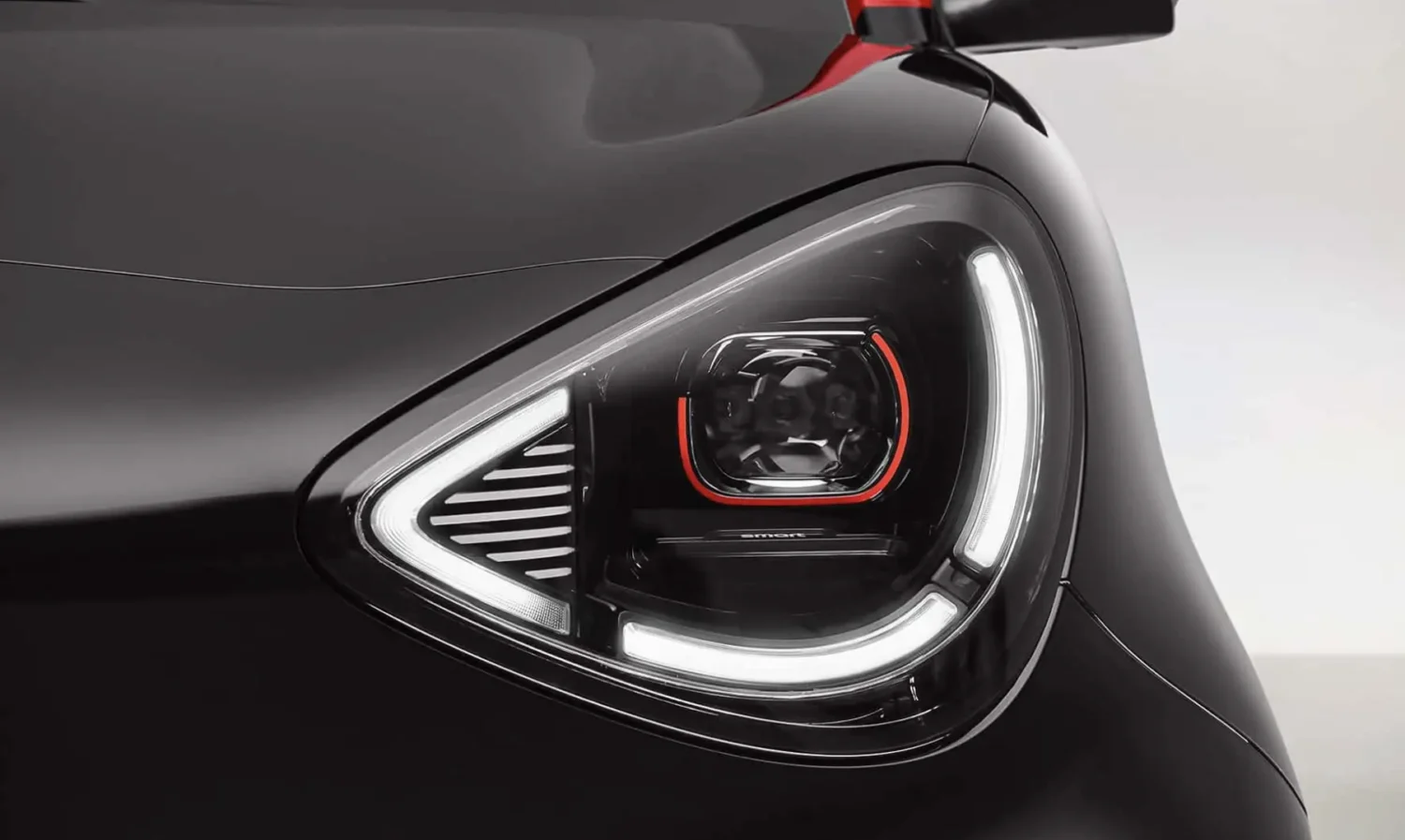
For now, the first images released by the brand show a city car with a black body accented by red details. A color combination regularly used to distinguish the brand’s sporty variants.
Further modifications are expected as well, notably in the bumpers and other exterior elements. Wider tires are also contemplated to accompany this power boost.
The goal is, of course, to give this tiny electric more personality without compromising its unusually compact footprint.
An 80-Horsepower City Car to Start
Before the Brabus arrives, Smart still needs to market the standard version of its new #2. This model retains the two-seat city-car concept and is sized for easy urban maneuverability.
Under the sheet metal, the maker has installed a rear-drive electric motor delivering 80 hp and 130 Nm of torque. It propels the car from 0 to 60 mph in about 11.6 seconds, and to 62 mph (100 km/h) in that same ballpark.
The top speed is listed at 140 km/h (87 mph), while the range reaches about 290 kilometers (roughly 180 miles). These specifications are tailored primarily for everyday urban use.
Technically, the new generation also stands out for adopting a five-link rear suspension—a design not previously seen in this vehicle class.
The forthcoming Smart #2 Brabus would naturally enhance the base model’s performance. Yet to be determined are the exact degrees of improvement.
By way of comparison, the old Smart ForTwo Brabus from generation 453 featured a 109 hp gasoline engine. Another variant, Brabus Ultimate E, offered 92 hp thanks to its electric drive.
Geely, Smart’s co-owner, also has in its lineup a small electric called the E2, equipped with a 116 hp motor. It’s a configuration that could potentially be considered for the future Brabus, but no official power figures have been released yet.
What Price and When for the New Smart #2?
Deliveries of the standard Smart #2 are planned for the first half of 2027. Its entry price is expected to hover around €20,000, placing it back in the arena of affordable urban electric cars.
The Brabus variant will likely cost more, but Smart has not released any official pricing or launch timing for it yet.
A convertible version isn’t officially ruled out. The old ForTwo offered a convertible option, and a new drop-top variant could soon join the lineup. Nothing has been confirmed yet, but it seems plausible that the Smart #2 will not merely be a basic electric city car. With the Brabus arrival on the horizon, it could attract buyers seeking a small car with a more assertive character.
Comparison Table
| Model | Powertrain | Power (hp) | Torque (Nm) | 0-100 km/h (s) | Top speed (km/h) | Range (km) | Estimated price (€) |
|---|---|---|---|---|---|---|---|
| Smart #2 (2026) | Electric | 80 | 130 | 11.6 | 140 | 290 | ~20 000 |
| Smart ForTwo Brabus 453 | Gasoline | 109 | – | – | – | – | – |
| Smart Brabus Ultimate E | Electric | 92 | – | – | – | – | – |
| Geely E2 | Electric | 116 | – | – | – | – | – |
Key Takeaways
- The Smart #2 is a new electric city car planned for 2027, with an entry price around €20,000.
- A sporty Brabus version is already in the works, but its specs remain unknown.
- The standard Smart #2 offers 80 hp, 130 Nm of torque, 0-60 mph (0-100 km/h) in 11.6 seconds, and a 290-km range.
- The Brabus tradition is carried on, aiming to amplify the sporty personality of the lineup.
- The car retains its two-seat city-car format, with an engineering layout not seen in this class.
- A convertible version isn’t confirmed yet, but isn’t ruled out in the near term.
FAQ
When will the Smart #2 go on sale?
The standard version of the Smart #2 is slated for release in the first half of 2027.
What are the performance figures for the Smart #2 standard?
The Smart #2 standard is powered by an 80 hp electric motor, accelerates from 0 to 60 mph in 11.6 seconds, reaches a top speed of 140 km/h, and offers about 290 km of range.
What price is the Smart #2 expected to carry?
The starting price announced for the Smart #2 is around €20,000.
What differences can be expected for the Brabus version?
The Smart #2 Brabus should deliver improved performance, a more aggressively styled exterior, and unique details, but official technical specs have yet to be disclosed.
Is a convertible version of the Smart #2 planned?
A cabriolet variant isn’t ruled out, but no official information has been released on this topic yet.