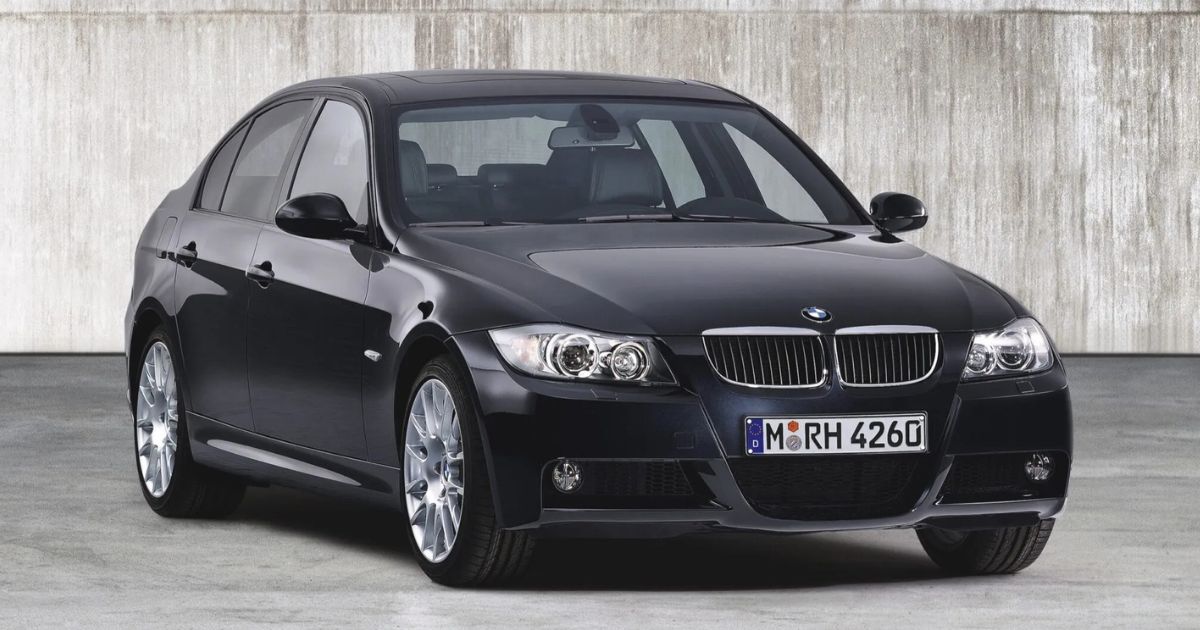
A BMW built to win world championships, powered by a race-ready 4-cylinder engine manufactured in the same plant as the F1 engines, offered at the price of a used compact. On paper, it sounds like a collector’s dream—especially since an E30 M3 now fetches around $75,000 (about €70k). And yet, there exists a sedan that checks all of these boxes, while still being affordable around $9,000.
Long overlooked, this curiosity is the BMW 320si. Born in the mid-2000s to meet homologation rules for the World Touring Car Championship, it helped BMW win major titles while slipping from the public eye. As a result, you can now find examples between £3,900 and £7,995 (roughly $5,200–$10,600, around €4,800–€9,500) in the United Kingdom, at the price of a simple compact, while hiding a true baby M3 DNA that intrigues enthusiasts more and more.
BMW 320si: a WTCC-homologated 3 Series born to race
Behind the 320si lies first and foremost a homologation model story. Like the original E30 M3, or other road-going racing icons, it was born because regulations required the manufacturer to build a certain number of road versions to enter competition. In the mid-2000s, BMW aimed for WTCC glory, a championship governed by the Super 2000 rules that capped displacement at 2.0 liters.
The E90 M3, still to come and powered by a V8, could not meet those constraints. BMW thus started from the standard E90 3 Series and built a four-cylinder version, lightweight and aggressive, designed to take on Seat and Alfa Romeo on race tracks. The brand needed at least 2,500 units to satisfy FIA, and it ultimately built 2,600, including 500 for the UK, with none officially shipped to the United States, where WTCC participation was limited and where the road-going performance would likely have drawn a smirk.
Under the sober skin, a dedicated 2.0-liter naturally aspirated engine and a sharpened chassis
Technically, the BMW 320si isn’t just about a badge. BMW started from the 1,995 cm³ N46 four-cylinder found in the 320i, but reworked the engine extensively. The bore grows from 84 to 85 mm, the stroke is shortened by 2 mm to 88 mm, final displacement hits 1,997 cm³, with enlarged valves and a higher compression ratio of 11.0:1. The Valvetronic system is abandoned in favor of a classic throttle body, the redline is pushed to 7,300 rpm, and the head is cast at Landshut—the same plant that built F1 engines—with a carbon valve cover saving about 10 kg.
On paper, the numbers may surprise pure enthusiasts. The bespoke 2.0-liter engine in the 320si develops 171 hp (173 metric horsepower) and 143 lb-ft (194 Nm), a clear gain over the stock 320i’s 141 hp. The 0–60 mph time is listed at roughly 8.0 seconds, with a top speed of 140 mph. The car comes with the M Sport package as standard, a 4.10:1 final-drive ratio that allows reaching top speed in sixth gear, larger front brakes, and 18-inch Motorsport-style wheels with wider tires. Visually, though, apart from those wheels, a few details like satin-chrome mirrors and large brakes can easily be mistaken for a regular 3 Series with an aesthetic package.
Pricing, reliability, and the future of this $9,000 baby M3
It’s precisely this discreetness, combined with measured performance, that helps explain the still modest value of the BMW 320si. The original article cites that about 500 examples were delivered to the UK, finding buyers for between £3,900 and £7,995, i.e. roughly $5,200–$10,600 (about €4,800–€9,500). The author also notes that an E30 M3 now runs around $75,000 (nearly €70k) and a nice E90 M3 commands about $35,000 (a little over €30k), while a 320si with reasonable miles can still be found under $10,000 (around €9,000), and even under $6,000 (about €5,400) for a higher-mileage example.
But if this homologation sedan remains so affordable, it’s also because of a clearly identified Achilles’ heel. The aluminum cylinder sleeves specific to the 320si’s engine tend to wear, up to the point of disintegration under extreme use. The best remedy today is to rebuild the engine with steel sleeves during a rebuild, a costly procedure even if the car itself isn’t expensive to buy. On track, the WTCC 320si did shine, delivering BMW and driver Andy Priaulx WTCC drivers’ and constructors’ titles in 2006—its first full season—and again in 2007, which fuels the idea that this is a model more important than people realize.
This duality between racing pedigree and delicate mechanical reliability fuels some ambiguity about its future value. The author notes he wouldn’t be surprised to see prices rise once enthusiasts remember the 320si’s role in BMW’s recent history, citing another BMW sport model whose value surged after the fact. He also hopes any rise would come only after 2030, the year the 320si becomes eligible for import to the United States under the 25-year rule, opening the door to a renewed wave of demand for a model that had until now been largely Europe-only.
For European collectors and drivers, this means there’s still a window where this baby M3 remains priced like a simple, modern diesel compact. With a limited production of 2,600 units, a WTCC championship record with back-to-back titles, and a rare four-cylinder layout for a 3 Series, the 320si checks several boxes sought after in the young-timer market, while demanding particular attention to the health of its engine—a factor that will largely shape its future story in collections.