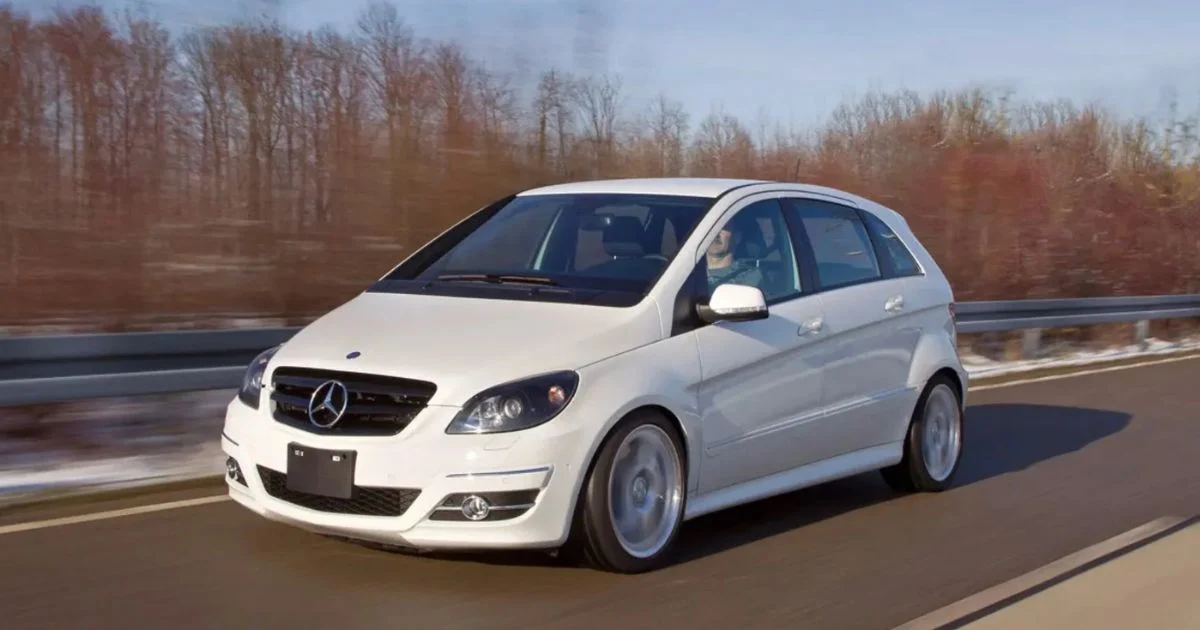
In the mid-2000s, Mercedes-Benz was living a curious double life. On one hand, the brand filled its lineup with AMG models powered by large naturally aspirated V8s. On the other, it stepped downmarket with small front-wheel-drive hatchbacks, such as the unassuming family-oriented B-Class. And one day, these two worlds collided.
In 2009, at the Rastatt plant in Germany, a simple diesel minivan served as a testbed. Apprentices transplanted a 5.5-liter naturally aspirated V8 from the AMG donor pool. The result, dubbed the Mercedes B55 V8, was never offered for sale, but it left a lasting impression on enthusiasts. A unique transformation that is resurfacing today at the Mercedes-Benz Museum.
Mercedes B55 V8: an apprentice project born in Rastatt
Launched in 2005, the first W245 B-Class was produced at the Rastatt plant in Germany. This site also functioned as a major training hub for the brand’s apprentice technicians. In 2009, the plant manager, Peter Wesp, wanted to entrust his team with a project that was far from standard, based on a B-Class. The idea on paper was simple, but the execution in the workshop proved far from it.
With the apprenticeship master Andreas Würz, the decision was made to use a B 200 CDI reserved for training. Würz laid out the measuring tape, checked the engine bay, and confirmed that a big V8 could fit without cutting the shell. The brief given to the apprentices was concise, yet carried a heavy constraint: to profoundly transform the mechanics while leaving the bodywork almost untouched in order to keep a discreet car.
Under the hood of the Mercedes B55 V8: a big 5.5-liter, 388-hp
The base car was a modest B 200 CDI front-wheel drive, designed for diesel efficiency rather than track days or blazing tires. The apprentices removed the four-cylinder and installed in its place a 5.5-liter naturally aspirated V8 delivering 388 hp. This engine produced 391 lb-ft of torque (about 530 Nm) and was powering many AMG models at the time. It was already giving way to the 6.2-liter, then to the quieter 4.0-liter V8 biturbo in other lineups.
The V8 tucked in with relative ease, but steering and especially the exhaust posed challenges. The crew built a bespoke exhaust system from existing parts, finished with a dual central rear outlet. The car adopted a W210 E-Class rear cradle on a dedicated subframe, turning it into a true rear-wheel-drive machine. Brakes came from a C32 AMG, the suspension used KW coil-overs, and the cabin was trimmed in Alcantara on the roof and seats. The weight ended up around 3,571 pounds (about 1,620 kg), roughly 396 pounds more than a standard B.
A unique Mercedes B55 V8: a relic of another era
Officially, this Mercedes B55 never became a production AMG model; it remained an internal training exercise. At a glance, the B55 keeps its tall, van-like silhouette, simply riding on larger wheels. The bodywork tweaks were minimal, making it a true sleeper in the eyes of enthusiasts. When in motion, everything changes, with the rumble of the V8 and the ease of laying down rubber on the rear axle. Würz estimated a 0-60 mph time in under six seconds for this very special compact.
The Mercedes B55 V8 remained a one-off, kept by the brand and shown at events. In presentations, its performance was often highlighted, with a top speed around 155 mph (approximately 250 km/h). A recent Mercedes-Benz Museum Instagram post rekindled interest in this mechanical curiosity. Today, with CO2 regulations, noise limits, and a shift toward hybrid or electric propulsion, such a project would be more difficult. The B55 thus stands as a tangible time capsule of an era when such daring mash-ups were still possible.