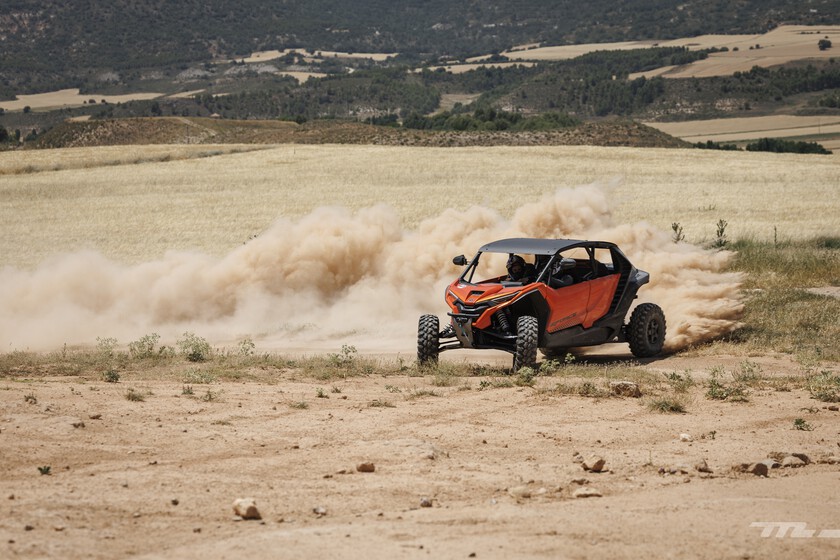
What for? That is the main question when considering getting a buggy. Why would you spend 30,000 euros on a car that isn’t quite a car? The answer is: why not?
Within the subculture of off-roading and 4x4s there is a nearly unknown niche that nonetheless drives a very significant market for some brands. We wanted to get a closer look at it with the spectacular CFMOTO Z10-4 Turbo.
CFMOTO Z10-4 Turbo: a beast at home
“It’s a senseless contraption,” you may think. Probably. It’s also true for a Nissan Patrol swapped with a six-cylinder BMW engine and an automatic ZF transmission, and they’re becoming increasingly fashionable.
According to ANESDOR data, the quads and buggies (category L) moved 6,321 units in 2025, a 25.1% rise compared to 2024. It may seem small, but it is very meaningful—especially considering that 67.6% were sold to private individuals while 31.1% went to companies, with this group growing 35.5%.

It is normal for brands like Polaris, Yamaha, or Can-Am to show growing interest in expanding their footprint. Perhaps what they did not anticipate is the surge of CFMOTO, which has claimed a top-three spot among best-selling models with the CF500-2, CForce 520, and CF625-6, totaling over 3,500 units.
CFMOTO is not a new player in the segment, but it leads the market. That’s why they decided to ride this wave with a much more ambitious bet in these Z10 Turbo, which are available in two- and four-seat versions. An overwhelming move to go head-to-head with the big players. It hasn’t come to sit at the kids’ table eating Nutella pastries.
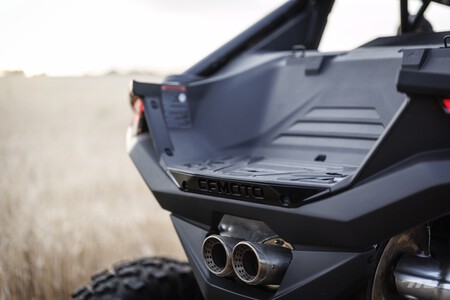
This four-seater is the one we tested: same mechanics but more space and therefore more versatility, with a longer chassis and the same concept of being a machine that can deliver massive fun off-road.
It is the first SSV model with a turbocharged engine from the Chinese brand, but before diving into the mechanics let’s take a look around. It presents an extremely aggressive look, with sharply angular lines and a clear show of its features: a reinforced chassis and long-travel suspensions.

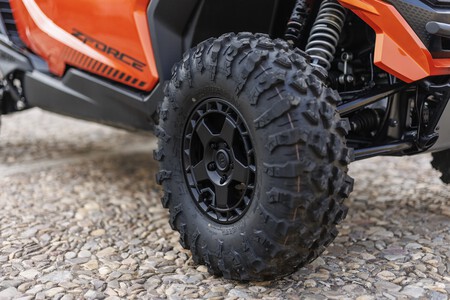
Reinforced bumpers, winch, massive aluminum skid plate, 14″ beadlock aluminum wheels with 30″ tires. The impression it conveys is clear: robustness.
And allow me to call it “family” because indeed it is a family vehicle in the sense that it is a 2+2 where the rear seats are fully usable, with almost the same space and sports seats with just the right padding and four-point safety harnesses. A statement of intent.
What there isn’t is a windshield. Only small doors that lead you into a Spartan interior with grab handles that contrasts with a digital driver display and a 12.3″ tablet for the infotainment system that surprised me with how complete it is.
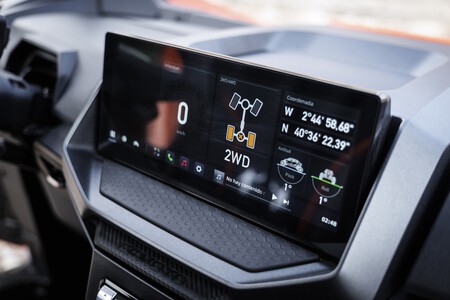
It comes with connectivity (Apple CarPlay only), rearview camera, allows viewing the chassis configuration we will discuss later, NFC start, CFMOTO app…
It is clear that the materials aren’t on par with those of a €30,000 car because the interior is designed to survive daily exposure to dust and mud, and to be washable with a pressure hose. It’s not that the finishes are low-quality; in fact, the fit and finish seem good; it’s just that durability takes precedence over style.
Mud, dust, and mischief

I found CF MOTO’s approach quite interesting in the sense that it isn’t a machine cobbled together from leftovers of other models. The Z10-4 Turbo is born by and for itself with a first-rate set of its own equipment starting with the engine.
The block is an exclusive development around a 998 cc inline three-cylinder with turbocharged induction. In raw numbers it delivers 154 HP at 7,750 rpm and 136 Nm. All transmitted to the wheels through a CVT transmission.
Oh no! A CVT, how awful. Well, what can I say but I think it’s an intelligent choice.
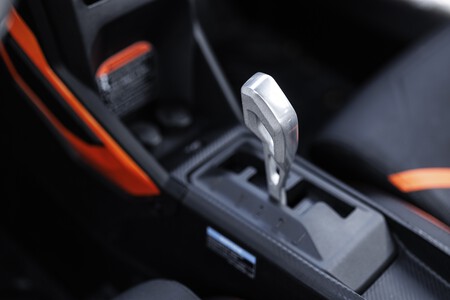
The engine pushes hard and with a lot of fury through a progressive curve and feels very flat thanks precisely to the CVT’s operation, which also greatly simplifies adapting to a vehicle that doesn’t behave like a conventional car.
There is some lag when you press the throttle hard. It doesn’t have the immediacy of an atmospheric engine with a manual, so you have to understand that to spin up the Z10-4 Turbo with throttle you need to anticipate the curve’s onset a bit and swing it to smooth out the line.
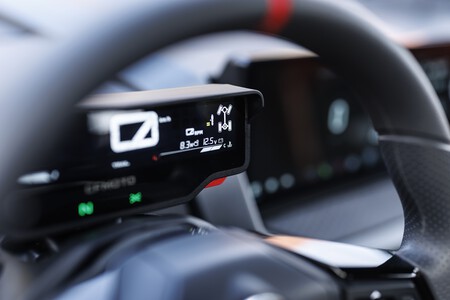
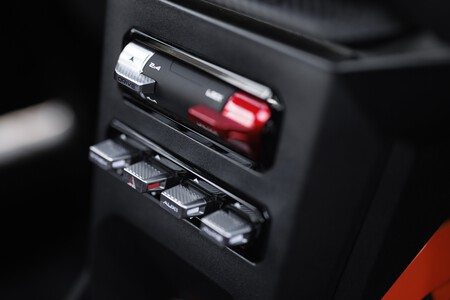
The transmission also offers three selectable modes for rear- or all-wheel drive. The corner entry felt somewhat slow but very precise, with a progressive drift in 2WD. With 4WD engaged it’s a machine capable of extremely rapid, highly effective travel.
The overall package is simply colossal. It has a wheelbase of 3,276 mm, which, for perspective, is almost a meter longer than a 911 Turbo’s 2,450 mm. That length is fundamental for stability so it behaves like a predictable car with calm reactions (that’s what the two-seater is for).

That said, it’s important to note there are massive weight transfers and under very aggressive supports we can reach the suspension limits and unload the inner side, with the risk that entails before hitting the tire’s grip limit.
And this thing is well equipped. The tires are CST Pulse XT in 30×10-14″ size with a blocky tread that grips like a demon on both hard and loose terrain. In exchange, the little we’ve driven on asphalt has produced a generously loud rolling sound.
The fully tubular chassis is tuned with fine precision. It features Fox QSE shocks adjustable in three levels accessible from wheel-mounted drive modes to adapt to terrain and use. It isn’t as cutting-edge as Can-Am or Polaris’ dynamic systems, but it works very well.
We have independent suspension at all four corners, with a front double wishbone and a rear control arm that handle 437 mm and 508 mm of travel respectively, plus a ground clearance of 356 mm.
Those are brutal figures on paper, and they don’t fully reflect what they’re capable of; they swallow ruts, potholes, and rocks with shocking ease. Along with the four-level variable steering with a lot of feel, it becomes an incredibly interesting car-like off-roader if what you’re after is fun.
Why spend €30,000 on a buggy?
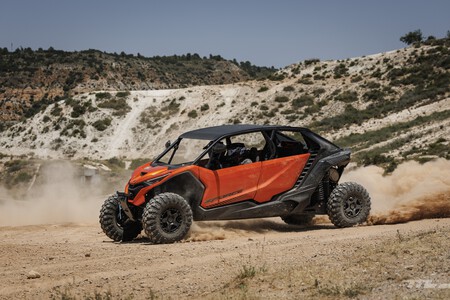
Now for the delicate part. I can assure you that the CFMOTO Z10-4 Turbo is unlike anything you’re used to, or at least very different. It’s €30,395 in price on the list for a vehicle homologated as industrial. Is that expensive? It depends on what you’ll use it for or what you compare it with.
If we compare it directly with its rivals, the two-seat Polaris RZR Pro R costs €50,990, and the Can-Am Mavericks start at €30,299 for the two-seater and €44,599 for the Maverick Max X RS Turbo RR four-seater.
Could it be cheaper? It could, but chances are it would be less fun as well. Although CF MOTO has decided to release the Z10 Turbo Basic variants in both two- and four-seat versions that are 3,000 euros cheaper: from 24,495 euros. The drawback is that only 50 units will be available for the Spanish market.
I had an incredible time with the Z10-4 Turbo, and if I lived in one of those nature-filled depopulated areas of Spain or worked in the countryside, I might consider a buggy like this.
Perhaps even my driving license might not be too happy about it.
CF MOTO Z10-4 Turbo 2026 – Technical data
|
CF MOTO Z10-4 Turbo |
|
|
|---|---|---|
|
Engine |
|
|
|
|
TYPE |
Three-inline cylinders. Turbo |
|
DISPLACEMENT |
998 cc |
|
|
|
MAXIMUM POWER |
154 HP at 7,750 rpm |
|
MAX TORQUE |
136 Nm |
|
|
|
TRANSMISSION |
CVT OmniDrive Automatic |
|
Dimensions |
|
|
|
|
LENGTH |
4,038 mm |
|
WIDTH |
1,626 mm |
|
|
|
HEIGHT |
1,740 mm |
|
WHEELBASE |
3,276 mm |
|
|
|
WEIGHT |
1,000 kg |
|
TRUNK CAPACITY |
N/D |
|
|
Performance and economy |
|
|
|
0-100 KM/H |
N/D |
|
|
|
TOP SPEED |
N/D |
|
NORMED FUEL CONSUMPTION |
N/D |
|
|
PRICE |
30,395 euros |
Associated expenses for attending this presentation were covered by the brand. For more information, consult our corporate relations guide.