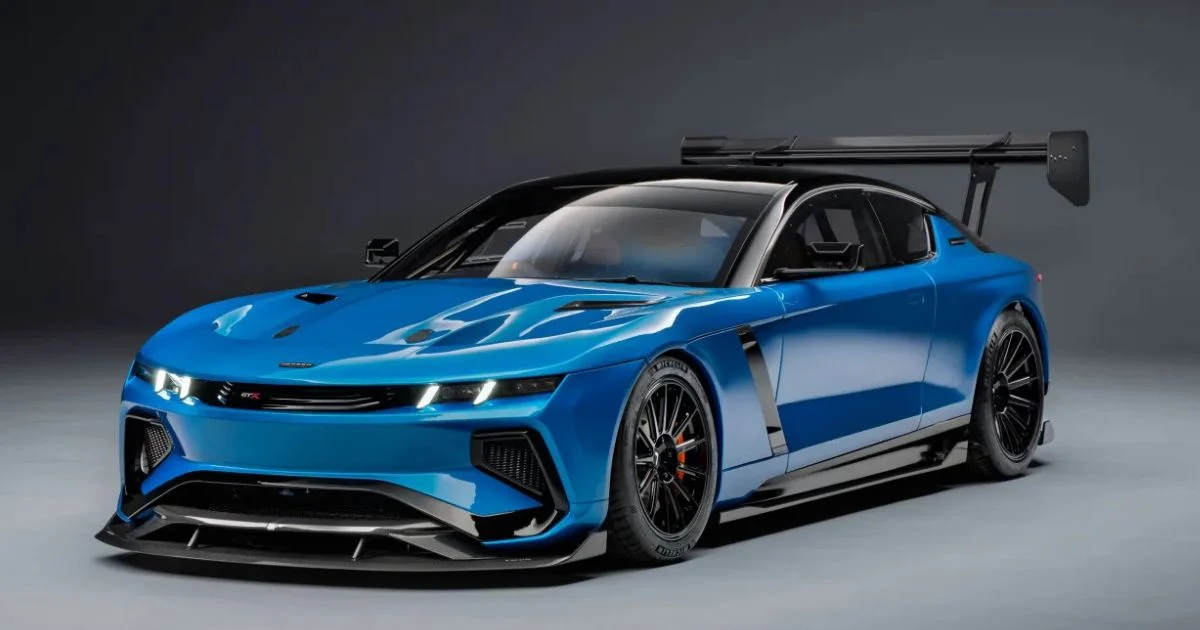
For many enthusiasts, the name Interceptor still conjures a refined, discreet British grand tourer—the kind of quiet, long‑distance GT built for a gentleman driver, with a V8 purring softly, room for four, and a driving experience that feels almost serene. That image now belongs to a past era, because the next Interceptor will never see the road and is aimed at the pure circuit. A supercharged V8 delivering close to 1,000 horsepower, a stripped-down chassis, extreme aerodynamics, and an FIA‑spec cabin: the tranquil GT is morphing into a track weapon.
At the wheel is Jensen International Automotive,builders of modernized Interceptors, pushing the envelope once again. Unveiled in 2026, this first development car is a circuit-only prototype, not road-legal. It serves as a laboratory for a future road-going Interceptor GTR and GT, while already delivering hypercar-like performance figures. The reveal carries a familiar name, Jensen Interceptor GTX, and this time, the quiet GT has disappeared.
Jensen Interceptor GTX: from a gentleman’s GT to a dedicated track weapon
The Interceptor of the 1960s and 1970s was a four-seat coupe penned by Vignale, equipped with a Chrysler V8 and an automatic transmission. The GTX, by contrast, gets a 6.8-liter supercharged V8 drawn from the LT5 Corvette ZR1 block. Tuned by Late Model Engines, it produces roughly 960 hp. The potential would climb toward around 1,200 hp, with a 0–60 mph time in the low 2‑second range. This power is delivered to the rear wheels exclusively through a transaxle layout and a six-speed sequential Samsonas gearbox.
Under the aluminum bodywork shaped by Coventry Metalcraft, the GTX sits on an aluminum chassis as well. Corner-to-corner aluminum control arms pair with purpose-built three-way adjustable Nitron dampers. Braking relies on AP Racing calipers clamping steel rotors, hidden behind 20-inch wheels. The tires are Michelin Pilot Sport, clearly tuned for the track. The extreme aerodynamics, with a front splitter, a massive diffuser and an adjustable wing, would generate more than 350 kg of downforce on track. “We’re not chasing tenths of a second, but the joy of driving,” David Duerden tells MotorTrend.
A race-ready cockpit and a supercar price tag for the new Interceptor
Forget the old GT’s leather rear bench: inside, the GTX looks more like a race car. An FIA‑approved roll cage structures the cabin, paired with carbon seats and six-point harnesses. A full fire-suppression system is installed, and a configurable MoTeC digital display replaces traditional gauges. The dashboard prioritizes function and keeps distractions to a minimum. There’s a touch of Alcantara, a bit of padding, orange stitching accents, and leather door pulls to remind that Jensen is still Jensen.
The brand is quoting a price range between £850,000 and £950,000, roughly €1,000,000. Production is not expected to begin before 2028, with another year of development planned for this track-focused variant and no firm date yet for future road-going variants. “The Interceptor GTX is the first physical expression of our vision for Jensen’s future,” says Jensen CEO David Duerden to Auto Express. “It brings together everything we believe a modern Jensen should be—distinctive, engaging, beautifully designed, and rewarding to drive. Even if it’s only the first step, the GTX clearly signals the direction we’re taking and marks the dawn of an exciting new era for the brand, laying the groundwork for future road-legal models.”