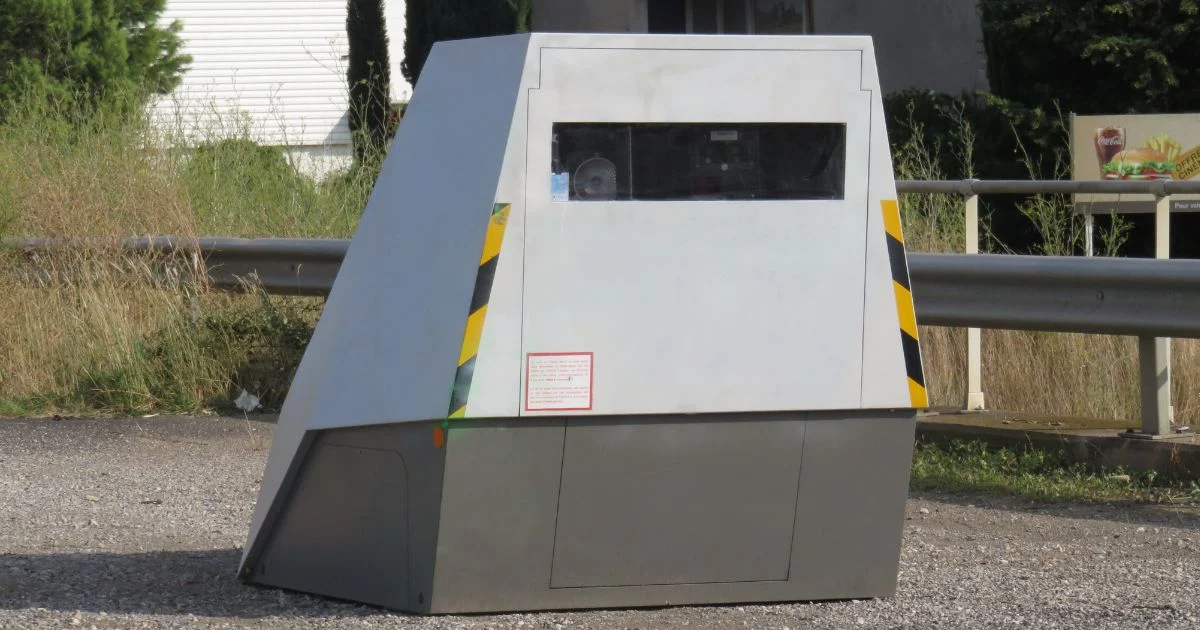
A flawless speed radar, not a smudge of paint, not a single tarp, and yet it was barely doing any good. On the D928, at Rocquemont, near Saint-Saëns, in Seine-Maritime, the standalone unit has stood in place since May 2025. By September 2026, it seemed to be watching mostly the field along the shoulder. A puzzling scene for drivers who daily travel this route known as the Rouen road.
This autonomous work-zone radar monitors speeds in both directions. It was installed at the village exit, just after the level crossing, toward Saint-Martin-Osmonville. On this stretch limited to 80 km/h (about 50 mph), the prefecture chose this device after noting speeds could be surprisingly high. Rocquemont even hosted, for several months, a pedagogical speed radar to raise driver awareness. Watching this unit appear to aim at the field rather than the road underscores how a journey can change in an instant.
On the D928, Rocquemont’s autonomous radar suddenly misoriented
The area housing this radar de Rocquemont, en Seine‑Maritime is far from insignificant. It sits on the D928, Rouen road, about 100 meters from the railroad crossing, heading toward Saint-Martin-Osmonville. A few miles away, motorists can reach the A28 freeway via the Moulin d’Ecalles interchange. This axis carries heavy traffic, with drivers tempted to speed once they leave the village. The prefecture therefore selected an autonomous radar capable of flashing in both directions.
In September 2026, for no known reason, regulars on the D928 noticed the unit shifted from its place. The housing remained spotless, but the angle with the road wasn’t the same. Its window seemed to be aimed mostly at the neighboring field. No paint or tarp marked the glass, a sign that orientation had gone awry and the device had stopped functioning for a few days. On Thursday, September 24, 2026, the unit had returned to its original position and its alignment with the D928.
D928 in Seine-Maritime: a heavily monitored stretch where every radar counts
The D928 that threads through the Seine-Maritime countryside between Rouen and Blangy-sur-Bresle is classified as a secure route over roughly 61 kilometers (about 38 miles). Along this stretch, signs warn of frequent checks and several zones host autonomous booths that are moved as needed. Within less than twenty kilometers (about 12 miles) between Rocquemont and Neufchâtel-en-Bray, three work-zone radars monitor speeds in both directions. For all of that to work, each booth must be properly oriented. Otherwise, the beam misses the path of vehicles and the photos become unusable.
Rocquemont isn’t new to the turbulences surrounding its radars. On January 26, 2026, another device installed in the commune was covered with an agricultural tarp during farmers’ protests. In that case, the radar was completely blind as long as the tarp stayed in place. The September 2026 incident is very different, since no damage was found on the unit, which remained pristine on the outside. Misoriented for a few days, Rocquemont’s radar ceased to perform its expected role on the D928. It regained its place and its expected effectiveness on September 24, 2026.