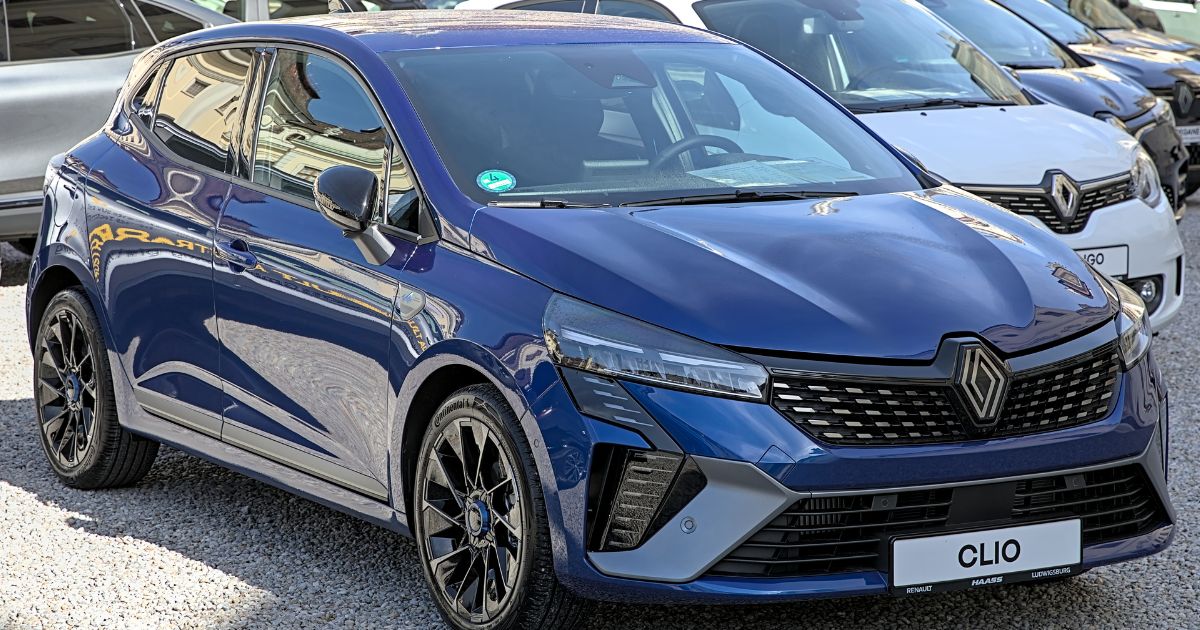
They’ve just returned from a week in Dubai, still mentally on vacation. At Lyon–Saint-Exupéry airport, the bags are retrieved, and the shuttle to the long‑term parking is ready as well. For Fanny and her partner, a 25‑year‑old from the outskirts of Clermont-Ferrand, the nightmare begins there. At the far end of Parking P5, their Renault Clio 5—a car they had just bought a few months earlier—waits for them, perched on concrete blocks.
All four wheels have vanished, leaving a sleek city car immobilized on blocks of concrete. The couple had left their car in this official long‑term lot for a few days, advertised as monitored 24/7. It raises questions for anyone about to trust an airport parking facility with their vehicle. Because behind this wheel theft at Lyon airport, many people wonder what could happen to their own car.
A Renault Clio 5 Found Resting on Concrete Blocks at Lyon’s P5 Parking
The incident unfolded on Saturday, September 12, 2026, as the travelers returned from Dubai. Fanny and her partner emerge from the terminal, board the P5 parking shuttle, and head to the outdoor area. Among thousands of parked vehicles, their Clio is nowhere to be found. “We couldn’t locate the car, so we used the remote to flash the headlights.” Fanny, 25, is quoted by Le Parisien.
As they drew closer, the couple saw that the bodywork wasn’t damaged, but the car seemed shockingly low. “We found that it was very low…” A few seconds later, the horror became clear. “We realized they had stolen all four wheels!” The Renault Clio 5, purchased just months earlier, was now resting on concrete blocks.
The Parking P5 is marketed by Aéroports de Lyon as a long‑term, access‑controlled space, under continuous video surveillance. Access is only via a free shuttle that runs around the clock, serving several blocks named after islands. The official site highlights constant monitoring and high user satisfaction. In reality, thieves apparently had ample time to remove four wheels without being caught.
The parking rules state a crucial point: parking is at the user’s risk and peril. The amounts paid for parking are treated as simple usage rights, not as a custodial service. Aéroports de Lyon disclaims liability for accidents, damage, or theft of the vehicle or its contents. For drivers, the contrast between reassuring marketing and the legal text leaves a lingering sense of insecurity.
Wheel theft at airport parking: what does it mean for drivers?
The Lyon wheel‑theft case sits within a broader, well‑documented trend. According to Roole, an automotive‑club study, the Renault Clio remains the most stolen car in France in 2025. Hundreds of cases are recorded, with some vehicles stripped of wheels, accessories, and even seats. In the Toulouse metropolitan area, local press reported about 200 wheel thefts in a single year, predominantly affecting Clios.
Against this backdrop, the question of insurance becomes central. Theft coverage is not automatically included in every auto policy; without it, there’s no payout for theft. The Service-Public site notes that even when theft coverage is purchased, it mainly protects the vehicle as a whole, not always its accessories. Wheels, rims, batteries, or body components are indemnified only if stolen from a locked location after break‑in. The site adds that, in many cases, wheel theft falls outside indemnity unless a specific, tailored policy is in place.
For an airport parking lot open to the elements like P5, insurers will still require a police report and supporting documentation. Photos of the car on the blocks, the police findings, and any signs of break‑in can count toward the claim. The outdoor, non‑enclosed setting may complicate claim recognition under the policy terms. For owners of widely common compact cars, this uncertainty compounds the shock of arriving to find a wheelless vehicle.
Some drivers will opt for parking closer to terminals, in covered and busier lots such as P0, P1, P3, or P4. Others will consider the automated, robotized P5+ where cars are kept in a gated area operated by robotic car systems. That spot costs a bit more than a standard long‑term space, but yields very high customer satisfaction. The decision should also include adding anti‑theft lug nuts and choosing a well‑lit, clearly visible spot. A thoroughly reviewed insurance policy can also help prevent ending up with a car perched on blocks at return.