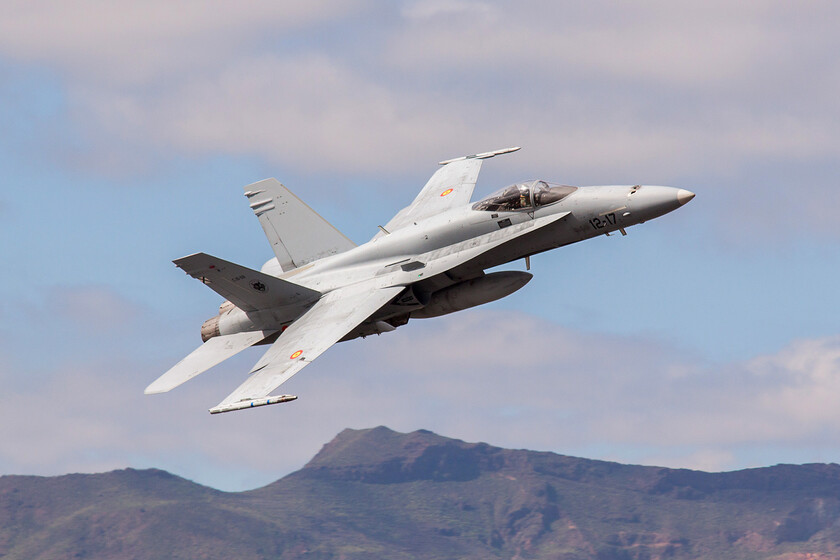
In the early hours of September 24, two F-18 fighters from the Spanish Air and Space Force took off from Romania’s Mihail Kogalniceanu Base to monitor a group of “aerial targets” detected by Romanian radar north of Chilia Veche, near the border with Ukraine.
The alert was raised a little more than an hour later without any confirmed incursion into Romanian airspace being recorded. The episode, one more among the 18 that Spain has managed in this mission since August, nicely summarizes the role that the Spanish F-18 Hornets have been playing on the eastern flank of NATO for almost four years.
H2
Currently, Spain has around 200 personnel deployed in Romania, seven F-18s and an A400M refueling aircraft, in addition to a long-range surveillance radar. In October, three NH90 helicopters will be added, an unprecedented reinforcement for this mission, to counter drones. The contingent, named Paznic Aerotactical Detachment, forms part of the Reinforced Air Police (eAP) that NATO launched in 2022 after the invasion of Ukraine.
Spain’s presence on the eastern flank is not limited to Romania. Since 2022 the Air Force has rotated through Lithuania (Vilkas), Bulgaria (Strela) and Estonia (Ambar), pairing F-18s from Wing 12 and Wing 15 with Eurofighters from Wing 11 and Wing 14. Each rotation lasts between four weeks and four months and responds to the Alliance’s request to bolster surveillance over the allies that border Russia and Belarus. Spain shares the mission with Germany, Italy, France, Belgium, the United Kingdom and other partners who have sent their own fighters to the same region.

The incident this early morning is not an isolated case. In 2022, 38 Russian aircraft were intercepted in Bulgaria, Lithuania and Estonia. From December 2022 to March 2023 in Romania, 12 alpha scramble alerts (alerts in which fighters take off immediately to respond to an incursion).
In March 2026, in the Baltic near Lithuania, two Su-24s were intercepted. In August 2026 in Romania, there were 15 “alpha scramble” alerts and one drone shot down. Up to September 24, the Spanish Air Force had managed 18 alerts. There have been more than 85 public activations since the operation began.
The Hornet, a key piece in this deployment, has been in service in Spain for four decades. It arrived on July 10, 1986 at Zaragoza Air Base, when four units from the United States landed to initiate the FACA program (Future Combat Aircraft and Attack), the largest defense investment by the democratic government up to that point.
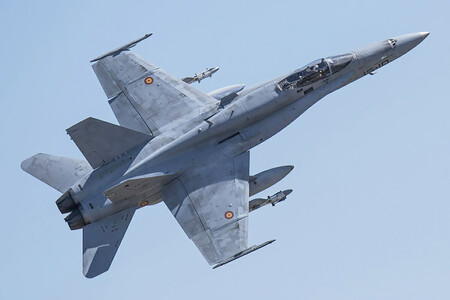
The Air Force received 72 new EF-18A/Bs between 1986 and 1992, later supplemented by 24 second-hand F/A-18A units from the U.S. Navy between 1995 and 2000 under the EF-18A+ designation. In the early 2000s the original fleet was modernized to the M configuration, the current version in service.
The Government has confirmed that the F-18 will extend its operational life to 2035-2040, potentially allowing it to reach 55 years of service, well beyond what was planned when it entered service. The decision is not driven by a technical preference but by the lack of an immediate alternative.
Spain ruled out purchasing the F-35 in 2025 for political reasons (complete reliance on the manufacturer’s US servers) and industrial reasons (American manufacturing, exorbitant maintenance), prioritizing European investment and avoiding dependency on the United States. The natural substitute, the sixth-generation FCAS fighter Spain was developing with France and Germany, was canceled in early July due to Dassault and Airbus’s inability to agree on the division of work.
Meanwhile, the Falcon and Falcon II programs have added 45 more Eurofighters, bringing the total to 114 aircraft, to progressively replace the oldest Hornets, starting with those patrolling the Canary Islands.
Spain has always avoided relying on a single fighter supplier, alternating between American platforms (Phantom, F-18) and European ones (Mirage F1, Eurofighter) to avoid being tied to a single manufacturer or the political conditions of a single ally.
The F-18 in life extension and the Eurofighter in numerical expansion are today the two pillars of that strategy. And thus, four decades after that flight from the United States, the Spanish Hornet remains on the front line of response to Russian aerial provocations on the eastern flank.
Images | Spanish Air and Space Force, Ministry of Defense Spain, Wing 15