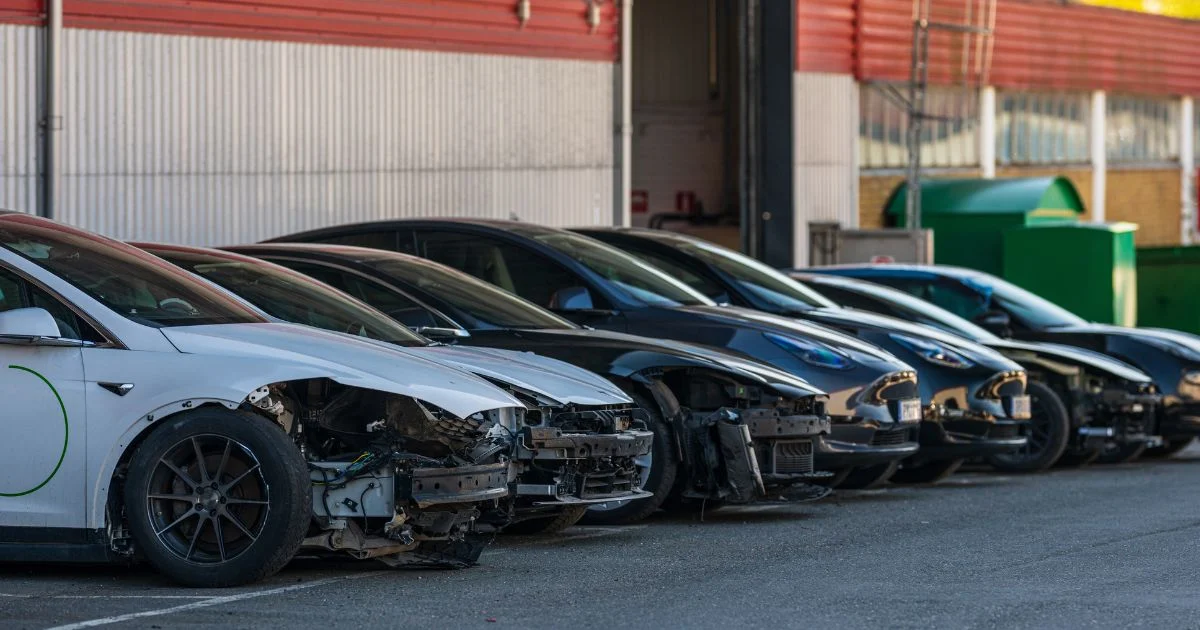
Nearly one in five electric vehicles is classified as a total loss while still young on the odometer—a figure that raises questions. And behind this ratio lies a brand that dominates sales, a massive database of vehicle histories, and a very particular administrative status in the United States: the infamous salvage title, which designates a vehicle declared a total loss by the insurer.
EpicVIN, the American specialist in vehicle histories, pored over 273 million VINs spanning 338 models that had appeared at auctions or in sale advertisements, rather than relying on state registration records. As of August 2026, 13.7% of the cars studied carried a salvage-title or equivalent designation, meaning nearly one in seven vehicles. Yet, for Tesla, the rate climbs to around 18–19%, which translates to roughly one out of five cars from the brand entering these markets having been declared salvage. A salvage-rate markedly higher than the average for a relatively young fleet, raising questions about the true repair costs of these electric vehicles.
To find a manufacturer with an even higher share, the report cites Saturn at 24.4% of vehicles with salvage status, for an average age of 22.8 years, i.e., a much older fleet. Among brands still active, GMC appears as the poor performer, with 8.3%, thus less than half Tesla’s score. This contrast is all the more striking since the California-based automaker remains the top electric-vehicle maker in the United States, with almost 50% market share, and its fleet is the youngest in the segment.
Repair costs, design, and the used market: why so many Teslas end up in salvage
In detail, the Tesla Model 3 tops the absolute number of salvage-title vehicles in the electric arena: 341,078 units, or 19% of the Model 3s studied. The Tesla Model Y SUV shows a slightly higher rate, at 19.1%, though the sample size is smaller. In contrast, other well-known battery-powered models are far less often designated salvage: the Nissan Leaf reaches 9.5%, and the Hyundai Ioniq 5 only 2.4%.
To really understand what these numbers are saying, it helps to recall what a salvage title is. In the United States, this status is given when the insurer deems a vehicle a total loss because the estimated cost of repairs exceeds a certain percentage of its market value. Logically, older cars are more exposed, their value falling faster than the cost of labor or parts. EpicVIN notes that 19% of Teslas labeled salvage have an average age of 5.2 years, which is an exception to the general rule. In Europe, the logic is similar, even if the terminology differs: for example, an “economically irreparable vehicle” or a severely damaged vehicle in France, Cat S/N in the United Kingdom, and Totalschaden in Germany.
The study also reminds us that such a status does not necessarily reflect poor reliability or unsafe driving. It tells primarily an economic equation: repair costs versus residual value. Electric vehicles already suffer pronounced depreciation, and Teslas in particular have seen used prices swing due to the volatility of new-vehicle pricing. In a market dominated by SUVs, sedans like the Model 3 often fetch lower resale prices. It only takes a repair to be complex or involve expensive components for the threshold for total loss to be crossed more quickly than with a gasoline-powered car.
The brand’s particular design approach also plays a role. Tesla’s platforms rely on large aluminum castings at the front or rear, and a floor-mounted battery pack that requires substantial work in the event of a hit beneath the chassis or within the structure. This design choice streamlines production and adds rigidity, but it concentrates a large portion of the vehicle’s value into a few assemblies that are costly to repair. Add high-voltage procedures and a need for specialized labor, and insurers are quick to classify a car as economically unreparable.
Some of these vehicles are eventually put back on the road after repairs, bearing a “rebuilt” title. EpicVIN notes, however, that roughly 1.5% of the cars analyzed carry this designation, across all models. For a used-car shopper, the risk of stumbling onto a rebuilt unit remains limited, especially at the dealership, but it isn’t zero—particularly for U.S.-imported Teslas whose salvage history may not be clearly listed on the title. That’s why, before buying, it pays to pull a detailed history report that reveals whether a vehicle has ever been declared a total loss, and possibly rebuilt, and to understand what that implies for insurance, resale value, and the model’s real durability.