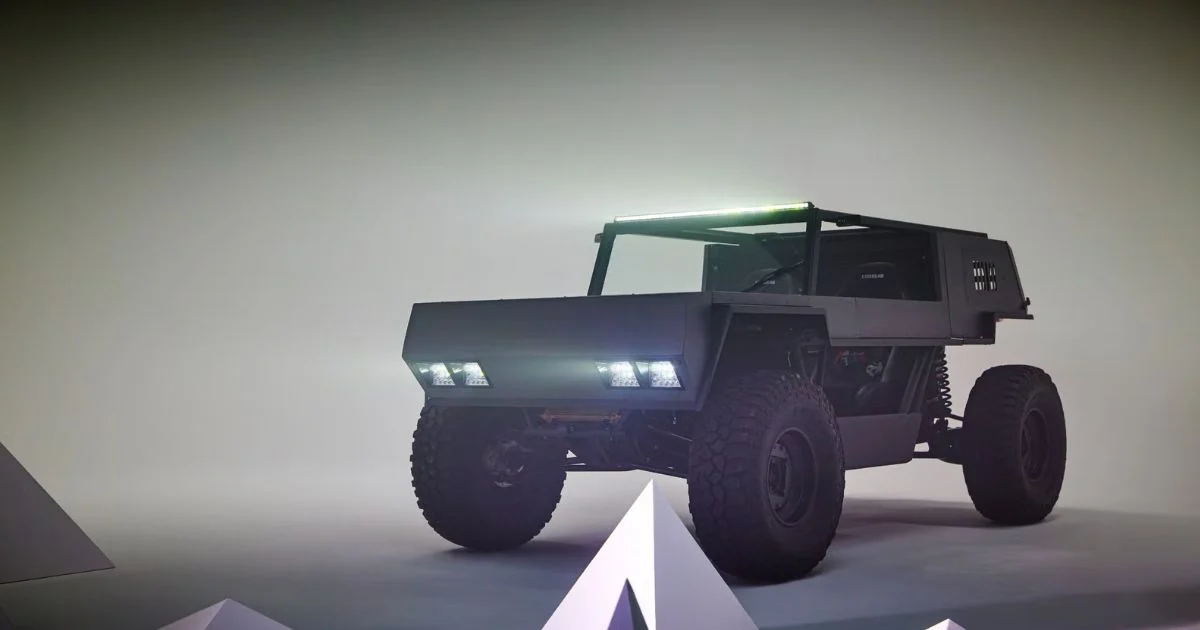
From afar, it would look like a Martian rover escaped from Interstellar. Up close, this rolling cube hides long-travel dampers, a turbocharged engine, and a genuine SSV chassis. The origin of this machine isn’t a hardcore off-road tuner, but a furniture designer. Joey Ruiter, known for his minimalist objects and rolling curiosities, tackled a Can-Am this time. A playground ideally suited for this creator.
In town, Joey Ruiter is a furniture designer who has racked up awards. But whenever possible, he translates that radical mindset to automobiles. His four-wheeled creations—Reboot Buggy, Consumer Car, and Another Sedan—have even been shown at the Petersen Museum in Los Angeles. With the J.Ruiter RVR, he pushes a step further toward science fiction. The base remains a Can-Am Maverick X3 RS Turbo RR, a real 200-hp SSV. Its name, RVR, pronounced “Rover,” nods to exploration vehicles. And the tension between a dune buggy and a spacecraft is precisely what makes the RVR so captivating.
J.Ruiter RVR: a coachbuilt off-roader based on Can-Am Maverick X3
Under the rover-inspired styling, the RVR stays a genuine Can-Am Maverick X3 RS Turbo RR in stock form. Ruiter first studied several UTVs, the side-by-sides used for rallying and recreation. The Can-Am won out due to “the right numbers and the right elements: lower driving position, performance, weight.” He then bought a nearly new Maverick X3, equipped with a 200-hp Rotax turbo inline-three. Out of the box, this SSV already claims 0 to 60 mph in about 4.5 seconds. The suspension—Fox, trophy-truck style—completes a chassis tuned for bumps and rough terrain.
The mechanics stay stock, so all the magic happens in the new coachbuilt body. “I didn’t drill a single extra hole or weld anything onto the chassis.” He told Road & Track that the original shell was completely removed. “You could say my body is basically useless. It’s made in a way that’s a bit more refined and more mechanical.” The development happened at full scale, built right around the chassis with very simple materials. “Cardboard, tape, hot glue, and a few steel cuts. Repeating that process again and again until you get something that works,” he details.
A J.Ruiter RVR straight out of Interstellar, to drive like a machine
Visually, the RVR lines up with square volumes and a front end that lacks a conventional grille, which the designer calls “abrupt.” “I had a few fixed reference points on the Can-Am that I simply could not move,” he explains. “You have a starting point, but also a lot of fixed foundations,” he compares it to renovating a house. In this strict frame, he aims to emphasize the machine’s mechanical side, “without giving it the look of some insect.” The overbuilt wheel arches eventually accommodate 35-inch wheels, nearly 89 cm in diameter. Ruiter describes the look as “puppies and kittens,” almost endearing, with square wings he calls “redneck.” Even the project’s name wandered between a cheeky “Can’t-Am” and a “TARS Rover.” The latter nods to the Interstellar robot and to Mars rovers. The Nolan film homage also shows up in the photo shoot, designed to feel like a space mission.
Despite its angular silhouette, the RVR remains close in weight to the stock Can-Am, only marginally heavier. “I reconfigured it and redid the clutch tuning. So I recovered part of those performance figures,” he says. When discussing handling, he repeatedly uses the word “amplified” to describe this new driving experience. “I wanted it to feel like it punches through the air. Like it shouldn’t be going that fast,” he confesses. “I narrowed the field of vision and lengthened the hood. You gain a stronger sense of moving this machine through the world,” he adds. Facing the showpiece Reboot Buggy, his breakout project from 2013, he doesn’t hesitate. “The little brother excels. It’s better in every way,” he asserts about the RVR. For now, this buggy remains a personal design experiment, conceived as a one-off. But if a few enthusiasts express interest, Joey Ruiter says he’s ready to build a small run.