Early in this century, the Chinese Navy was a coastal force, far behind the great naval powers. Today China is building warships at an unprecedented pace and is turning the sea into one of its major theaters of military expansion. Notably the South China Sea, one of the planet’s most disputed strategic regions.
In this Cold War-style struggle in the waters of this strategic corridor, China has built artificial islands that dangerously resemble military bases and has been testing new and advanced technologies for years. Among them, gigantic unmanned submarines over 40 m in length. Now, satellite images have revealed the key piece to get them to operate: a colossal mother ship capable of transporting them out to sea.
Giant Autonomous Submarines
XLUUV, which stand for Extra Large Uncrewed Underwater Vehicle, are not unique to China. The major naval powers have been developing large autonomous submarines for years, such as the US Boeing Orca. But what the Chinese excel at is in size: they are the largest sighted to date and could inaugurate a new class, the XXLUUV.
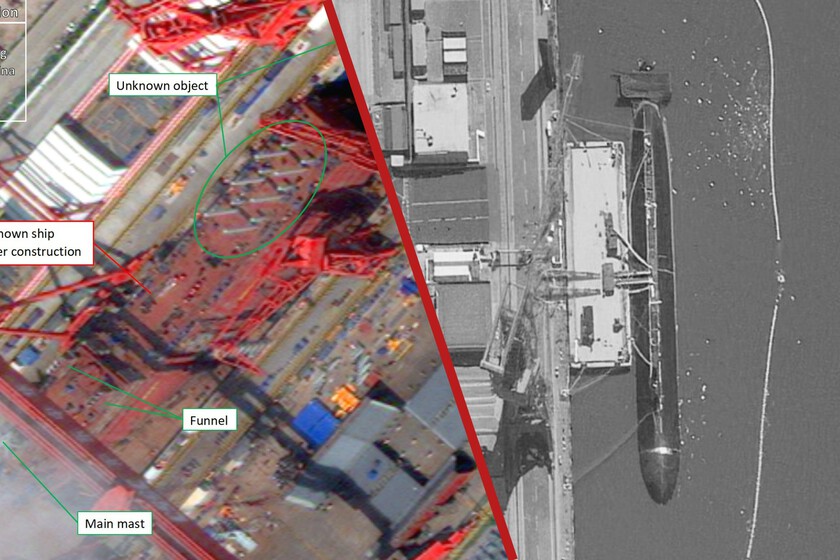
Exactly a year ago, satellite images captured two different models in testing near Hainan, an island in the South China Sea. From the photographs, it was estimated that they measured roughly 40 to 42 meters in length. To put it in context, the American Orca is about 15 m. But by design they did not resemble traditional crewed submarines: they lacked a sail and were equipped with X-shaped rudders. In other words, they had all the ingredients to be autonomous.

Source: Naval News
The task of these enormous robotic submarines falls into the realm of speculation, since China has not confirmed their function or objective. According to Naval News analysts, their enormous size opens up broader possibilities for the XLUUVs: more space for sensors, communications systems, power sources, or different payloads.
A crewed submarine of similar dimensions could carry eight heavy torpedoes: removing the crew from the equation leaves room for more. The same goes for mines. Among its possible roles are surveillance or reconnaissance tasks, or serving as escorts for naval forces over extended periods.
The Missing Piece: A Mothership
The major challenge of these unmanned submarines is logistics: how to take them to sea without consuming a large portion of their range during transit, and, in turn, how to recover them afterward. In tests with the XXLUUVs, China has turned to floating dry docks, or at least that is what one of the images suggested. But it seems the People’s Republic is already working on a far more ambitious solution: a colossal vessel designed to transport them and deploy them at sea.
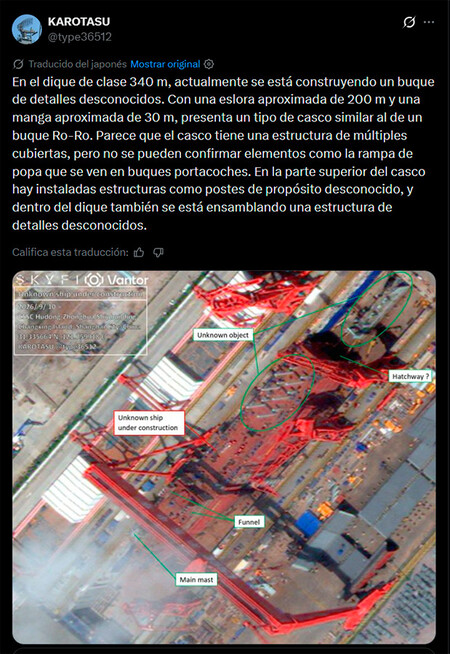
New satellite images taken at a Chinese shipyard have revealed what appears to be precisely that. A vessel of 200 m in length, with a hull similar to Ro-Ro ships that transport cars from China to other markets. But with a different design, and elements or structures of unknown function.
Naval News, which analyzes the images, notes that the most plausible interpretation is that it is a mothership for unmanned submarines, with a look similar to that of an amphibious transport. A view echoed by Military Watch Magazine, which details its appearance: at the stern there appears to be a floodable dock with a platform that can submerge via 12 vertical lifting arms. A system that could submerge, or bring to the surface, these giant Chinese submarines.
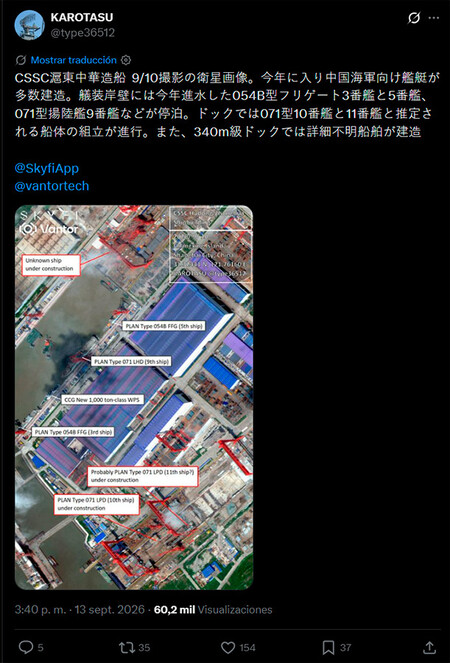
It also includes an interior hangar that, by size, is equally perfect for housing these Chinese XXLUUVs, able to accommodate up to four. According to Naval News, having this space is one of the main signs that the ship is being conceived as a mothership for these robotic submarines. Be that as it may, as with the submarines, China has not confirmed its function.
Little more can be inferred from these images, but analysts from these military outlets agree that this enormous ship would solve one of the main hurdles for these autonomous titans. Not only would it transport them to a theater of operations and recover them afterward, but it could serve as a hangar, workshop, and launch platform. In short, China would not only be building the largest robotic submarines ever conceived, but also appears to be aiming to create a transport to carry them wherever they are needed.
Images | Vantor, Naval News