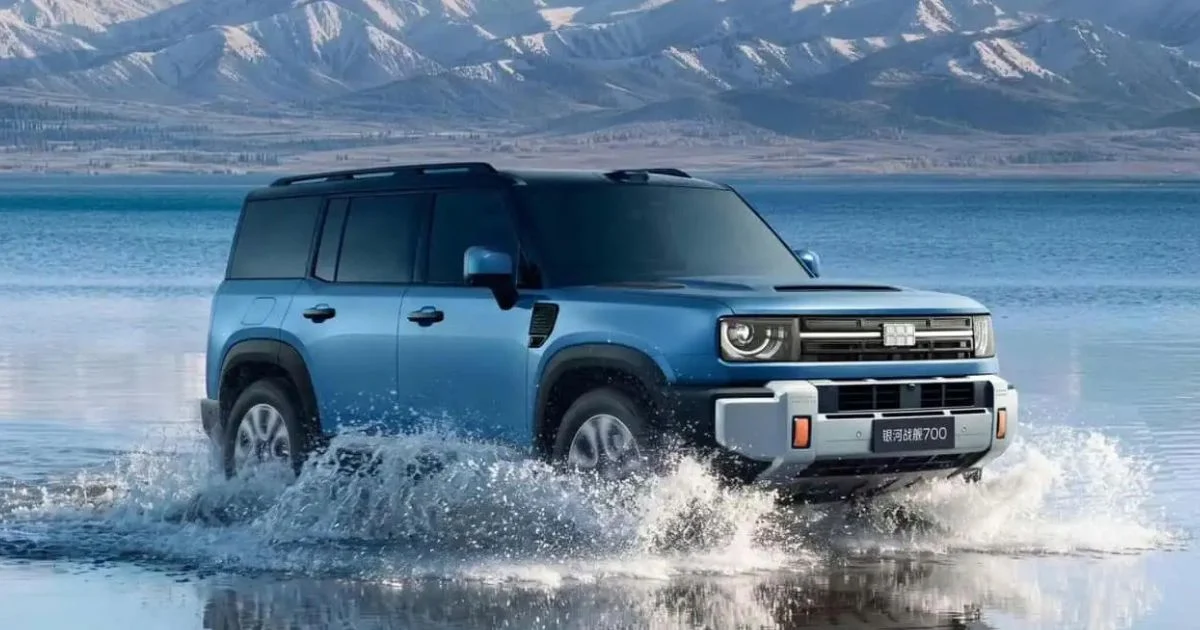
In China, you can buy an SUV with built-in karaoke, dancing suspensions and voice assistants everywhere. The local market overflows with technologies more spectacular than the next. And yet, one automaker has just taken another step. It is marketing a 4×4 that can roll on the road… but also move across water. Not as a quirky concept, but in series production for real customers.
This extraordinary SUV isn’t just about entertaining the crowd. Its aquatic mode is pitched as a last-resort solution. It targets flooded zones or deeper bodies of water. That is precisely the originality of the new Geely Battleship 700. This massive plug-in hybrid SUV borrows the styling of a Land Rover Defender. Between fords, it can activate an emergency flotation mode. It then proceeds like a small boat, changing the way we think about a family 4×4.
Geely Battleship 700: a giant 1,113-hp SUV built for off-road exploration
On paper, the Geely Battleship 700 already checks all the boxes for a rugged modern 4×4. It sits on a body-on-frame architecture. Its length runs close to 5.1 meters and its mass approaches 2.9 tons. That puts it in the same league as the Toyota Land Cruiser or the Land Rover Defender. Under the hood, a 2.0-liter turbocharged gasoline engine works in concert with three electric motors, one at the front and two at the rear. The combined peak output reaches 1,113 hp, a figure that more closely resembles a supercar than a family SUV.
The electric motors draw power from a 47.14 kWh battery. Geely claims a combined gasoline-electric range of 1,770 km, according to the Chinese CLTC cycle. For off-road crossing, the Battleship 700 boasts a generous ground clearance. It lists an 800 mm wading depth, differential locks and a can-do “spin on the spot” function. A crab-wrowse maneuver is also available for tricky terrain. Despite this level of technology, the base price in China sits just under $30,000, or about €27,500. It can climb to $58,000, around €53,000, depending on the trim. The model is already on sale domestically, and Geely plans exports to other markets, including Australia.
A true amphibious SUV: how the emergency flotation mode works
To become an amphibious SUV, the Battleship 700 doesn’t rely solely on its wheels. At the rear, two propellers of roughly 11.5 hp each are built into the bumper, replacing the look of faux exhaust tips. Once the vehicle is in the water, these propellers kick in. They allow speeds of a little over 6.4 km/h (about 4 mph). An onboard sonar also helps map obstacles underwater, helping avoid collisions beneath the surface.
Geely presents this system as an “emergency flotation and evacuation mode”. The company stresses that this is a backup system, not an invitation to cross a lake for fun, InsideEVs reports. Concretely, the Battleship 700 can “swim” for about 40 minutes thanks to its propellers. It can also float for up to two hours if propulsion is turned off. By contrast, the rival BYD Yangwang U8 offers a “emergency flotation mode” of 30 minutes. It uses its driven wheels to move, though it’s less effective in water than true propellers. Elon Musk had promised that the Tesla Cybertruck could serve “briefly” as a boat in an emergency, but that never came to fruition in production.
Beyond the gadgetry: what the Battleship 700 reveals about the Chinese SUV wars
If the Battleship 700 is making waves, it’s not only because of its horsepower numbers. In China, the competition is such that giant screens can’t cut it anymore. AI-based voice assistants or built-in fridges don’t differentiate the vehicles. Manufacturers are stepping up their game with spectacular, sometimes playful features. We’re seeing suspensions that “dance” or karaoke systems built into the cabin. With this amphibious SUV, Geely pushes the bidding toward safety-centric technologies. They’re designed to protect occupants in extreme situations.
The Battleship 700 doesn’t stop with floating. Geely has also added an oxygen-distribution system. This system can be used via a mask or directly in the cabin during high-altitude travel. That equipment fits the same logic: a vehicle built for adventure and survival, not just onboard amusement. The question remains whether this new generation of tech-laden SUVs focused on safety will stay confined to the Chinese market and a few countries like Australia, or if we’ll someday see amphibious SUVs cruising European streets.