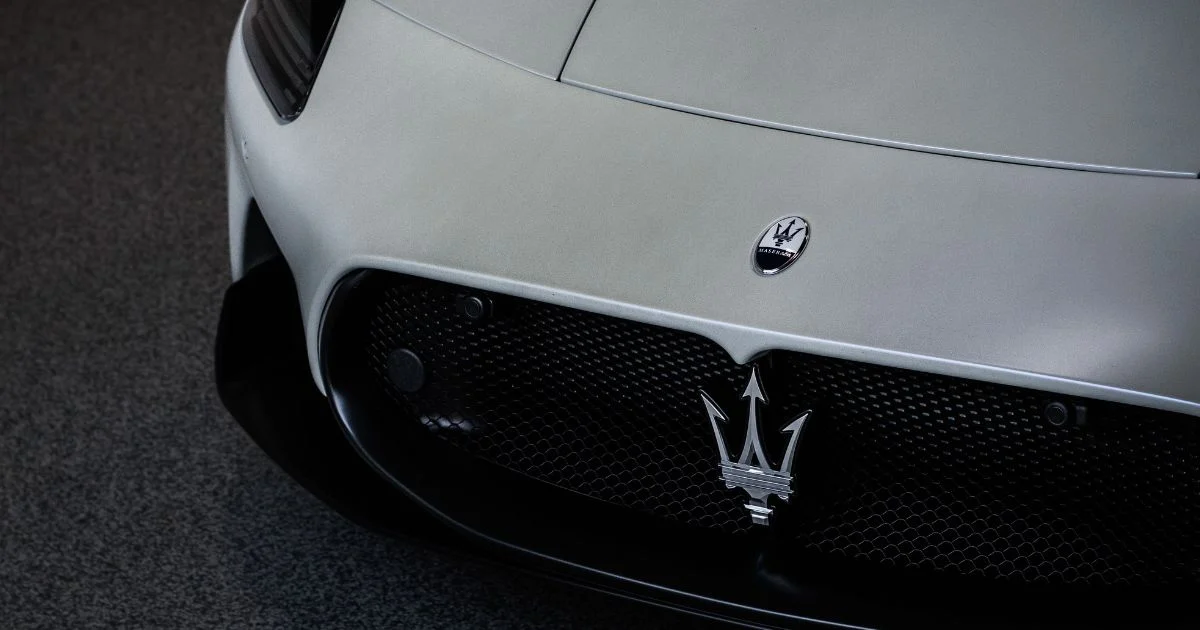
For more than a century, Maseratis have rolled out of Modena to celebrate a distinctly Italian luxury. Yet recent numbers tell a far less glamorous story. In 2017, the brand delivered about 51,000 cars worldwide. By 2025, it had moved only 7,900, with revenue of €726 million. The brand posted an adjusted operating loss of €198 million and a margin of -27.3%. To keep the Trident above water, Stellantis is now looking far beyond Emilia-Romagna.
Because the road ahead envisions a partnership radically removed from Maserati’s traditional roots. Several Asian media outlets have reported an advanced agreement between Maserati, Huawei and JAC Group. The goal would be to co-develop two new 100% electric models. These cars would be sold under the Maextro brand in China, and badge Maserati elsewhere in the world. They would rely on the Harmony Intelligent Mobility Alliance platform, the software and electronics backbone designed by Huawei. One could imagine a next Maserati generation whose brain is programmed in Hefei, rather than Modena.
Maserati Huawei JAC: a rescue plan that hinges on China
If the Trident brand ends up there, it’s because the slope has sharply inverted. After the peak reached in 2017, with around 51,000 cars delivered, volumes have continually declined. In China, sales fell from about 14,500 units in 2017 to just over 1,000—a collapse in a market that remains strategic for premium brands. In the latest year, Maserati sold 7,900 cars, far from the 11,300 of the previous year. The business model no longer holds up without external support, especially to fund the shift toward electrification.
The most-discussed hypothesis today envisions a very clear trio. JAC Group would ensure engineering and body production at its Hefei industrial complex in China. Huawei would supply the Harmony Intelligent Mobility Alliance platform and its assisted-driving system Qiankun. The electric powertrain and the connected cabin would also come from its catalog. Maserati would retain control of exterior and interior design, but also of chassis development. The vehicles would be marketed under its badge, at the top of the Stellantis lineup. The bodies produced in China would then be shipped to Italy for final assembly. The finished cars would be prioritized for the Middle East, Italy, France, and Germany.
Maextro, HIMA: a Maserati electric car conceived in China
The name Maextro already designates a lineup of very high-end sedans and SUVs. This offering is being developed jointly by JAC and Huawei. The flagship S800 measures more than 5.5 meters and targets the Chinese market segment above 700,000 yuan. It combines a 896-channel LiDAR and a Huawei DriveONE electric powertrain. The announced rapid charging would take you from 10% to 80% in just over ten minutes. The first weeks of sales generated more than 6,500 orders. This volume places the sedan at the top of its domestic premium market. It is this technical backbone, steered by the Harmony Intelligent Mobility Alliance ecosystem, that Maserati could adopt under its own bodywork.
The models studied for the Trident would include a large electric SUV and a zero-emission GT. The former would position itself as a more technologically advanced alternative to a simple platform-derived derivative, rather than a mere homegrown variant. The latter would complement the current Maserati GranTurismo Folgore. Its electronic architecture would be designed from the start for extended range and over-the-air updates. This industrial plan envisions bodies built in China and then assembled in Italy. It arrives against a backdrop of heightened tariffs on Chinese electric vehicles imported into the European Union. The projects remain at the official-discussion stage, however. The brand has scheduled December 2026 in Modena for its Capital Markets Day to detail its electric strategy and to clarify the role of this Chinese partnership.