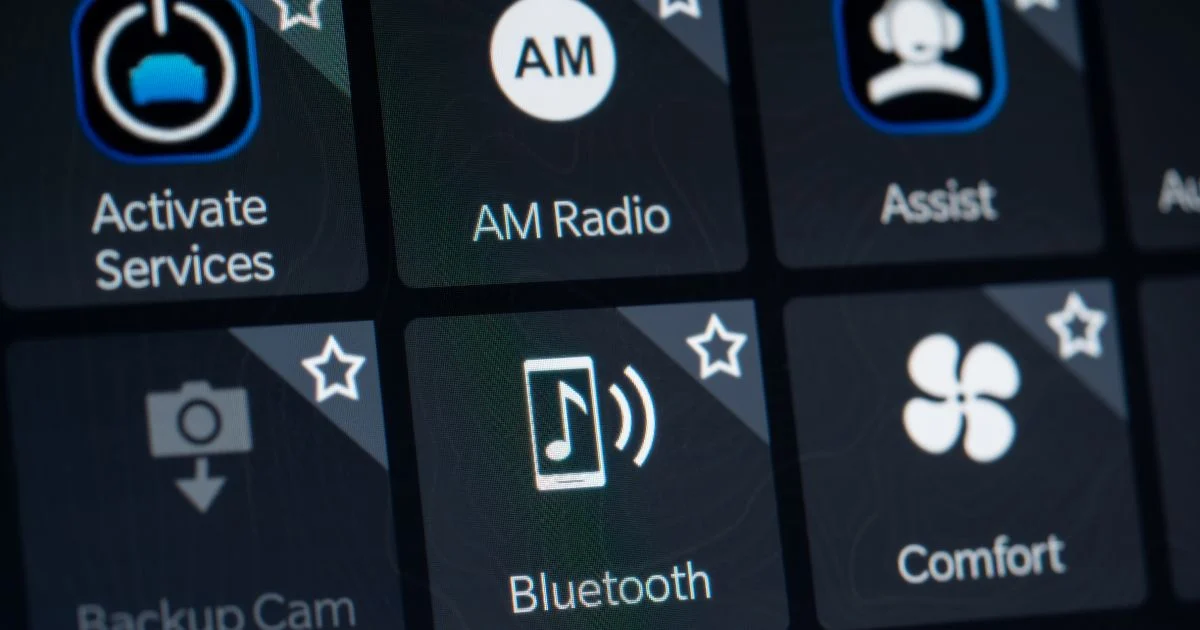
We had almost forgotten it, tucked away between the background hum of talk shows and the baseball games: car AM radio. For many drivers, the touchscreen, Bluetooth, and apps have long since replaced the good old “AM” button. And yet, this technology once thought doomed has risen back to the top of the American political agenda, to the point of threatening the plans of the most cutting-edge EV makers.
In mid-September 2026, the United States House of Representatives passed the “AM Radio for Every Vehicle Act”. The measure would require the federal Department of Transportation to make AM reception mandatory, standard equipment, in all new passenger cars. It still needs to be voted on by the Senate, then signed by President Donald Trump, who backs it according to Radio World. If it goes through, AM radio could become a staple in every car sold on the American market, from small internal-combustion city cars to 100% electric SUVs.
What the AM Radio for Every Vehicle Act would change for new cars
Concretely, the bill would require the Department of Transportation, via the NHTSA, to publish a federal rule obligating manufacturers to integrate an AM tuner in all new passenger vehicles sold in the United States. The AM radio would be offered as standard equipment, with no added cost to the customer and no paid option. According to estimates cited by the Congressional Budget Office, between 2 and 2.5 million vehicles per year would be affected by a technical retrofit, mostly electric vehicles, for a federal cost of about $1 million (roughly €930,000) spread over five years.
A first version of the law, already dubbed the AM Radio for Every Vehicle Act, had been introduced in 2023, but it ran into the lobbying of automakers. They highlighted the cost of maintaining a function deemed infrequently used, and, above all, the risks of electromagnetic interference in electric cars. On the other side, the National Association of Broadcasters supported the measure, describing it in a press release as “essential legislation for public safety.” Proponents note that AM bands remain a key support for the U.S. emergency alert system, even though a 2015 act tasked FEMA with modernizing this tool to depend less on radio alone.
Why manufacturers wanted to move on from AM radio, especially with EVs
If lawmakers put AM back at the center, it’s also because many automakers had begun removing AM from the list of standard features. Tesla, BMW, Rivian, Volvo, Mazda, and Volkswagen have already dropped AM radio from some electric models, citing interference from motors and power electronics on this frequency band. Ford had even planned to remove AM from the Mustang Mach-E and F-150 Lightning before reversing course in the face of customer backlash and mounting political debate; the automaker has since halted production of the F-150 Lightning.
The manufacturers’ arguments are clear: in an age of connected screens, streaming, FM, and satellite radio dominate. Behavioral studies show that most recent drivers mainly consume content via their smartphones or built-in services. “Most buyers and owners of today’s vehicles listen to streaming content on their phones, connect to satellite radio, or flip between FM stations,” says Robby DeGraff, head of product and consumer research at AutoPacific, cited by The Drive. And he adds: “I don’t think its absence would be enough to deter someone from a new model.”
Proponents of AM counter with another figure: more than 4,300 AM stations are still active in the United States, and around 80 million Americans—nearly 23% of the population—listen to AM every month. The AARP, the leading advocacy group for Americans over 50, notes that roughly one in three Americans in that age bracket listen to AM radio while driving, a audience for whom simplicity and reach still matter. This contrast is even starker given that, on this side of the Atlantic, the AM band has almost vanished from car radios in favor of FM and DAB+, with no law promising such a regulatory reprieve.