Soria has just premiered its BES: the BES or Low Emission Zone of Soria. Yesterday, Wednesday, September 16, this area of the city center was activated, with hardly any changes. “The alterations will be minimal. You won’t notice a significant change“, states the website itself. And indeed, much of it already hosts a pedestrian zone where vehicles could no longer circulate.
Moreover, the BES of this Spanish capital, the second smallest in the country, only restricts access to cars and vehicles without a label, with a wide list of exceptions. Environmental groups have criticized that it is “ineffective at improving air quality“, that it can be easily annulled judicially and that it merely seeks to secure European subsidies without actually reducing traffic in the city.
A ZBE that lets almost everyone through
The BES of Soria is now up and running, beginning with the usual information period that will last until November 1. From that moment, fines will begin for improper access, amounting to 200 euros as dictated by the DGT for a serious offense. Although as designed, it does not aim to generate excessive fines.
This ZBE in the Castilian city covers an area of about 300,000 m², bounded by streets such as Paseo de San Andrés, Espolón, Ferial, Santa María, N-234, San Pedro, Postas, Caballeros, Mariano Granados or Nicolás Rabal. The streets that form its perimeter remain outside the restricted zone, so any vehicle can circulate, including those without a DGT badge.

Map of Soria Low Emission Zone. Source: BES
Which cars are prohibited from entry? Only vehicles without a label will be restricted; they will receive a warning until November 1 if captured by the cameras already installed and operating. Or the corresponding penalty when fines begin. The rest, with labels B, C, ECO and ZERO, can circulate without restrictions.
Multiple exceptions. Vehicles without a label can access in many scenarios: residents are exempt, those who have a parking space (owned or rented) inside, those who must access for work reasons, or those with a vehicle registered as historic. Also carriers. In all these cases they must inform the town hall to obtain authorization and have their plate included in the exceptions.
Additionally, municipal vehicles, police and fire departments, technical service vehicles, urban buses and buses from concessionary companies that provide gardening or cleaning services are included. In this information period, the City Council will add their license plates to the exceptions system.
In streets that were already pedestrianized, and in an urban park
The BES website already warns that “citizens will hardly notice it” because “its application is largely limited to an area that already restricted vehicle circulation”. In other words, a large portion of the streets within the zone were already pedestrianized or subject to circulation restrictions.
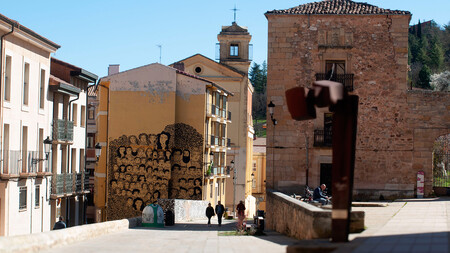
Sorovega Street (Soria)
The local outlet SoriaNoticias noted yesterday on its premiere of the ZBE that this is indeed the case, concluding that many streets are not relevant for traffic, being pedestrian stretches. The novelty lies in access to certain parking lots, garages and specific roads. Also that the BES signage, currently, is not very informative about the restrictions.
For example, Calle Real already had restrictions before the BES was implemented. What essentially changes is that access is now monitored by cameras. The same happens on routes like Doctrina/Instituto, Numancia and Puertas de Pro, which were already pacified or had circulation restrictions and are now integrated into the controlled zone of the new ZBE. It is added that Dehesa Park occupies one third of the BES area.
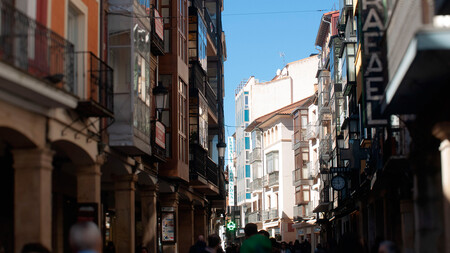
El Collado Street (Soria)
Nor is it a surprise. When the information campaign began in July to explain the BES layout, Ana Alegre, Councillor for Sustainable Development and the Environment, already commented that “Citizens will realize that it won’t affect them much. And it’s no coincidence that the map of this ZBE closely resembles the center that Soria had already pedestrianized: the city’s socialist mayor, Carlos Martínez, stated earlier this year that “it basically corresponds to the already pedestrianized and pacified zone”.
The City Hall itself presented the ZBE as a new phase of its Pedestrianization Plan, covering about 302,270 m². Martínez highlighted then that the project was based on prior pedestrianization efforts in the center over the last decade.
A ZBE questioned and threatened, under the shadow of European funds
Behind this implementation there is also European money. Framed within the Soria 2030 plan, the municipal project included this ZBE as a new phase of its Pedestrianization Plan reaching more than 300,000 m². Some actions for which it received 1.8 million euros from the EU’s Next Generation funds. Additionally, the changes to the Doctrina parking have entailed an investment of nearly 3 million euros, also funded by European funds tied to the low-emission zones program.
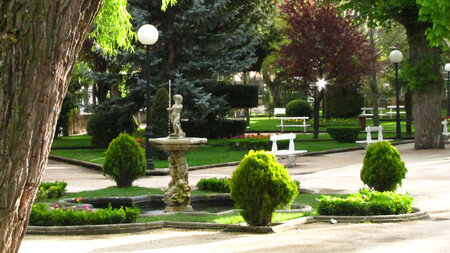
Dehesa Park (Soria)
That is precisely what the environmental group ASDEN criticized after its final approval in June. The group argues that its design does not address criteria to improve air quality, but rather a set of “minimums” to ensure the funds. Not only because large parts were already areas where cars could not circulate, but also due to the wide number of exceptions, which will continue to allow passage for the most polluting vehicles.
Another criticism from this group is the drafting of the ordinance, with legal gaps, susceptible to being overturned by justice, as has happened in other cities. Among them, that the technical project has not been published or that there was no public participation. Also that the Municipal Council for the Environment was not convened or that it was not contemplated in the 2019 Sustainable Urban Mobility Plan (PMUS).
In fact, they already threaten to overturn this newly arrived ZBE. At the end of August, the Soria PP announced it will appeal to the courts against the BES implementation, calling it unnecessary and questioning whether European subsidies condition mobility restrictions. Vox has also rejected it in the same terms. The socialist council defends that, being in an initial phase, its operation will be evaluated and more stringent restrictions could be applied based on the results and their impact on air quality.
Images | Bajas Emisiones Soria