In the 1950s, nuclear energy was seen as the miracle solution to all energy problems. And that included nuclear-powered cars. The ones that existed never progressed beyond the prototype stage or were outright scams.
Today, China is considering using nuclear energy in mobility, but not in cars—rather for military mobility. The Asian giant has set out to equip its army with nuclear-powered battle tanks.
Farewell, turbines and diesel. Hello, the atom
Chinese military researchers have presented a concept for a battle tank propelled by a compact nuclear reactor and armed with an electromagnetic cannon capable of striking targets up to 450 km away. The study, published in June in the Chinese scientific journal Acta Armamentarii and signed by the Inner Mongolia First Machinery Group (a historic Chinese armor manufacturer) together with the Beijing Institute of Technology, places the entry into service of the nuclear version after 2045.
p
But why equip a tank with a nuclear reactor? Do they really need a battle vehicle that does not have to refuel for years? The appeal of the nuclear reactor lies not in the electric propulsion autonomy it might provide but in the enormous amount of energy it can deliver promptly to feed its electromagnetic cannon.

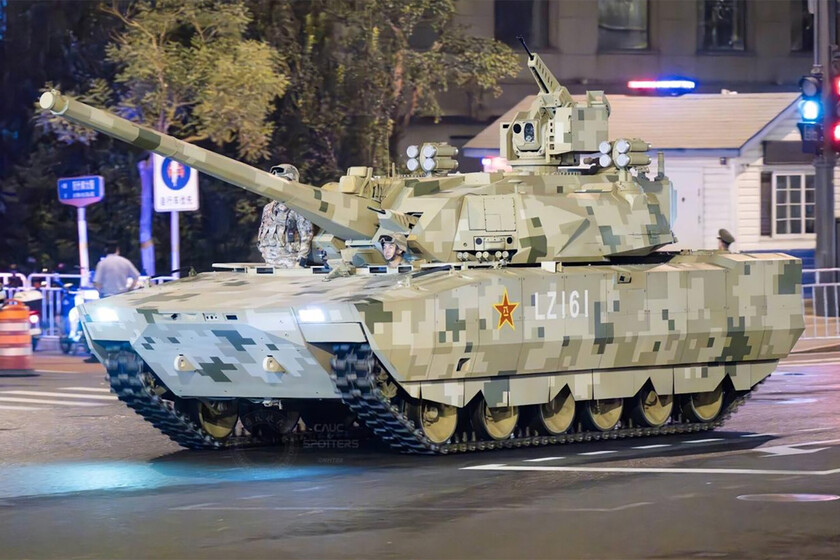
Next-generation Chinese armored fighting vehicle and Type 99A battle tank.
A railgun, also known as an electromagnetic cannon, is a weapon that fires projectiles using electromagnetic force rather than an explosive propellant, such as gunpowder.
The projectile, a metal object without its own explosive charge, is placed between two parallel conductive rails. By running a very high electrical current—on the order of millions of amperes—for a few milliseconds through those rails, a magnetic field is generated that pushes the projectile forward, accelerating it to hypersonic speeds, on the order of several kilometers per second.
The advantage over a conventional cannon is the muzzle velocity of the projectile, which translates into greater range and purely kinetic impact energy, without the need for a warhead.
The problem, and the reason no army has actually deployed it in an operational way, is that firing a single shot requires releasing an enormous amount of electrical energy in an extremely brief instant, something that demands capacitors, batteries, or flywheels capable of storing and discharging that energy, in addition to rails that withstand extreme wear from the electric arc and heat generated with each shot. And this is where the compact reactor comes into play, delivering the energy needed for the shot.
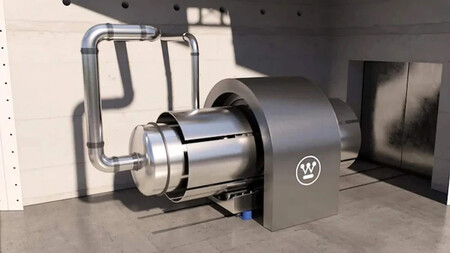
Westinghouse Nuclear’s Evinci miniature reactor.
This tank, weighing around 60 tons, i.e., within the same class as the Abrams, Leopard 2, or Leclerc, would not initially carry a nuclear reactor. The first generation could use a diesel genset of about 1,500 horsepower combined with supercapacitors and flywheels to feed a railgun of 10 megajoules (MJ) — equivalent to throwing a one-ton car against a wall at more than 500 km/h — with an estimated range of 150 km, plus an electromagnetic armor of 2 MJ. The electromagnetic armor is a kind of active protection that neutralizes an antitank missile by heat and magnetic field before it can pierce the hull.
The second generation would raise the cannon energy to 20 MJ (equivalent to sending a one-ton projectile against a wall at 1,100 km/h) with a range around 300 km, while the active armor would rise to 10 MJ. It would feature advanced energy storage equipment, such as solid-state batteries, superconductors, and a smart onboard microgrid for management.


A Type 99A at the 90th anniversary theme exhibition of the Chinese People’s Liberation Army (2017).
Only in the third phase, after 2045, would the diesel give way to a small modular reactor (SMR) of 10 MW, cooled by lead–bismuth, feeding a 50 MJ railgun capable of firing projectiles at about 3.5 km/s (12,600 km/h) and reaching 450 km.
The authors themselves acknowledge the engineering magnitude of the challenge. The reactor would have to fit in just 2 m3, with radiological shielding not exceeding 3 tons and a fuel reload interval of at least five years. Add to that the heat dissipation inside a armored vehicle and the need to withstand shocks of up to 30 g on rough terrain.
The other problem is electrical, not nuclear. A 50 MJ electromagnetic cannon requires releasing a huge amount of energy extremely quickly, something a reactor, designed for steady power delivery, cannot do on its own. The charge would have to be accumulated between shots in capacitors and batteries, turning power electronics—more than the reactor—into the real bottleneck of the project.
One military equipment expert consulted by the South China Morning Post described the idea of installing a fission reactor in a crewed battle vehicle as unrealistic, given the shielding and cooling required and the risk that the loss of the vehicle in combat would also mean the loss of the reactor.
His alternative is to move the concept to an unmanned platform, where nearly unlimited energy would make more sense for feeding lasers, microwave weapons, radars, and electronic warfare, rather than for a conventional crewed tank.
For now, the work remains a peer-reviewed conceptual study, not an ongoing program. It is basically a Wunderwaffe, or miracle weapon, like the ones boasted by the Nazi regime in World War II that never materialized.
Images | Waibo, Westinghouse, Tyg728