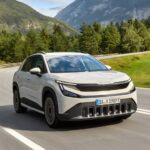
Skoda continues expanding its electric lineup, this time with an urban SUV that becomes its smallest electric car… and also the cheapest.
It is called Skoda Epiq and it is also the first car from the Czech brand to be manufactured in Spain, specifically at the Landaben plant in Navarre.
It’s small, but very practical
Skoda has long taken electrification seriously and launched its first fully electric models, but it’s now stepping up its game and shaping a comprehensive zero-emission family. After the Enyaq and Enyaq Coupé, the Elroq arrived to sit one notch below those two mid-size SUVs and cover one of the market’s most popular segments, the compact SUVs.
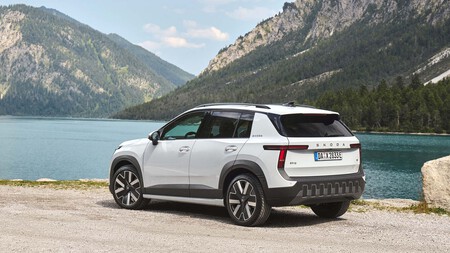
Now, the Czech brand’s electric family grows again, both at the bottom with the Epiq and at the top with the Peaq. The former directly enters another of the most significant categories, the urban SUVs, with a length of 4.17 meters, and it is especially important for our country because it is the first Skoda to be manufactured in Spain, specifically at the Volkswagen Group plant in Navarre, where it shares space with its German cousin, the Volkswagen ID. Polo.

It’s the smallest electric car from Skoda. Essentially, the new Epiq is an Elroq in a smaller size. It’s an interesting move by Skoda because the Elroq is a good electric car, but its size (and price) don’t fit everyone.
There are people who need less interior space and prefer a smaller, more manageable model for daily city life, but large enough for occasional getaways and trips. And, of course, at a more affordable price.
Precisely what the Epiq offers compared to the Elroq, which measures 4.49 meters in length. The 0.32-meter shorter length is noticeable (for the better) when maneuvering through city traffic and parking, but it’s also large enough to serve as the sole car for a couple and even a small family.
Skoda Epiq: interior
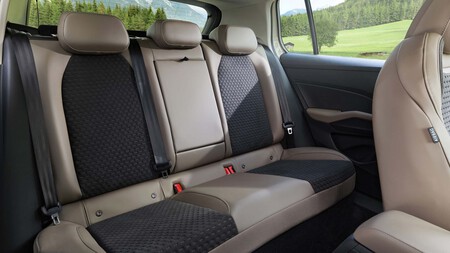
Just looking at the rear seats; there isn’t as much room as in the Elroq, but two average-sized adults can travel perfectly. What stands out most in terms of space is the boot: it has 475 liters of capacity, a volume more typical of a compact SUV than of a city SUV.
This space is one of the keys of the new MEB+ platform on which it sits. It’s the same one used by other Volkswagen Group models, such as the CUPRA Raval, the Volkswagen ID. Polo and the Volkswagen ID. Cross.
It is 100% designed for electric cars and it really takes advantage of the space, leaving plenty of room for passengers and for the boot in a compact exterior footprint. In this sense, the Epiq fares better than a combustion Kamiq in the same segment. It is one of the advantages of full electrification, and the Volkswagen Group is taking advantage of it like never before.
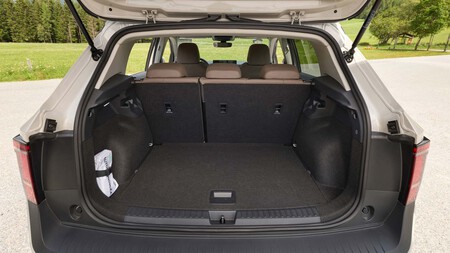
Beyond its generous interior, it features a very clean design, so it is fully usable, and Skoda’s ‘Simply Clever’ solutions are present, such as hooks, tie-downs, cargo separators, and a practical two-level floor.
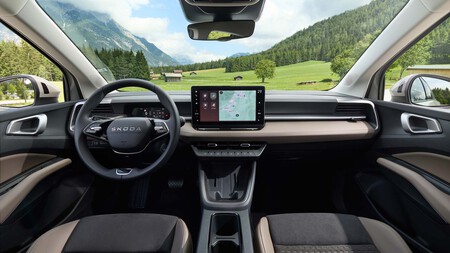
Inside there are also many compartments for items, including one hidden in the driver’s door to store an umbrella (one of Skoda’s trademarks). It’s always handy to keep pockets clear, and it’s also nice that Skoda hasn’t gone overly modern and has complemented the digital instrument cluster and the central touchscreen with practical physical buttons for quick (and straightforward) access to key functions.
Less practical is the sliding touch control beneath the central screen for raising and lowering the audio volume. The traditional dial is more intuitive and effective.
If anything more is desired, a larger instrument cluster would be nice. The information shown on this panel is correct and easy to read because the layout is well designed to view all data at a glance, but it would look much better with a larger display capable of projecting those data with bigger typography.
With the size of the central touchscreen there’s no problem, neither with the multimedia: it has a clear and intuitive interface, so it’s easy for anyone to use, it’s well connected and responsive.
I must give a special mention to the built-in navigation; I know most of us rely on Google Maps or Waze via Apple CarPlay or Android Auto, but in this test I used the car’s native navigation to move around Austria and Germany and it’s among the best on the market today: the map is easy to understand, the directions are clear, and it works perfectly, with no competition from Google Maps or Waze. It also tells you how much battery you’ll have on arrival, and it’s spot on.
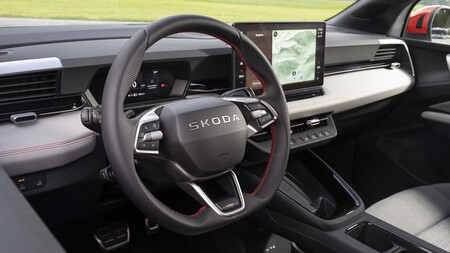
Otherwise, it’s easy to find a comfortable driving position, you can sit quite low and visibility is very good. If we talk about build quality, it delivers; it isn’t the segment benchmark, but there are many padded surfaces, the adjusters are solid, and overall it gives the impression of being well built, that it will hold up well over time, and that the value-for-money is good.
Here’s how the Skoda Epiq performs
And what about the technical side? Well, there are three versions that shape the Epiq lineup: 35, 40 and 55. The 35 is the entry-level, with an electric motor of 116 hp and an LFP battery of 37.5 kWh to accelerate from 0 to 100 km/h in 11 seconds, reach a top speed of 150 km/h, and homologate a WLTP combined range of 310 km. For charging, it can do DC at a maximum power of 50 kW and needs 33 minutes to go from 10% to 80% on a fast charger.
The 40 is the mid-range option and makes a leap in two key aspects: performance and charging speed. It reaches up to 135 hp, enough to go from 0 to 100 km/h in 9.8 seconds, and although it also uses the 37.5 kWh battery of the 35, it can charge up to 90 kW, so the improvement in this respect is significant because, instead of needing 33 minutes to recover from 10% to 80% of charge, only 23 minutes are needed.
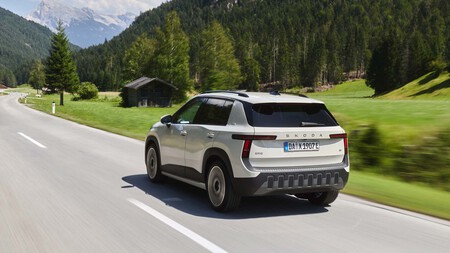
At the moment, Skoda has not been able to confirm whether the 35 will reach the Spanish market for private buyers or only for fleets, but they will arrive this month and October the 40 and the 55.
The latter is the top of the range and is the version I was able to drive in the first test. It also seems the most interesting option in the lineup, not only for its power but also for its battery and charging capability.
Like the 35 and the 40, it is front-wheel drive, but the electric motor used delivers up to 210 HP and allows 0 to 100 km/h in 7.1 seconds, and a top speed of 160 km/h.
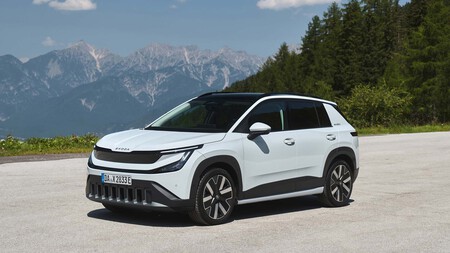
In city driving, that acceleration prowess comes in handy, but it’s equally capable on the highway: overtaking or merging onto the motorway is as simple as stamping the right pedal. It isn’t a missile, nor is that its aim, since it isn’t a sporty car, but it moves with great agility in any scenario and is easy to drive.
The tuning is very Skoda, meaning a good balance between dynamism and comfort. The suspension, while not overly stiff, is firm and the steering has the weight that is often missing in many Chinese cars.
In this sense, it’s a car tailored very much to European tastes, and that, in a context where Chinese brands keep arriving, is becoming a valuable asset because, with rare exceptions, the manufacturers from that country have not yet learned to “read the room” with Europeans and understand how we like cars to behave.
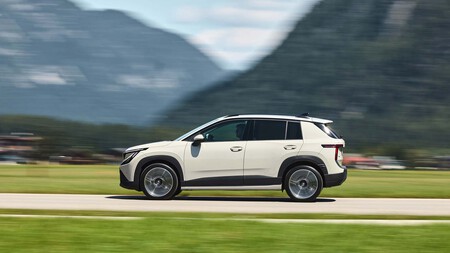
And that also comes from being comfortable, both on the open road and in the city, where the one-pedal driving feature is appreciated because it makes everything easier and avoids the need to touch the left pedal.
Regarding the battery, the Epiq 55 uses a 52 kWh NMC pack to certify 440 km of range. The maximum DC charging power is 105 kW, so from 10% to 80% takes 24 minutes.
The first test hasn’t allowed me to verify precisely how close it gets to the advertised range, but it shouldn’t be far since the average consumption, mixing city routes, secondary roads, and highway stretches (including German Autobahn sections with no speed limits and driving at the car’s top speed), was only 13 kWh/100 km.
With that average, theoretically it can go around 400 km on a full charge, but it’s easy to bring that consumption down, so the 440 km announced by Skoda seems perfectly plausible.
Price of the Skoda Epiq
The 55 also seems the most interesting in terms of price. For now, Skoda has not been able to confirm whether the 35 will be available to private customers or limited to fleets, and we don’t yet know the price of the 40, which will be available in our country this month, but we know that the 55 is already on sale with a starting price of 33,100 euros with the Urban finish. With the mid-range Selection ending from 36,100 euros and the First Edition starting at 38,600 euros.
Seen like this, the prices aren’t particularly attractive (or competitive) for an urban SUV, but there’s a trick, as there often is with advertised prices. With the Auto+ Plan incentives and Skoda discounts, the Epiq 55 Urban drops to 25,850 euros cash and 22,800 euros financed, the Epiq 55 Selection goes to 28,250 euros cash and 25,200 euros with financing, while the Epiq 55 First Edition starts from 30,650 euros cash and 27,600 euros with financing.
Images | Skoda

Looking for your next electric car and overwhelmed by so many options? It’s normal.
More than 45,000 readers have already tried it. And you?
Advice provided by the brand