In Brief
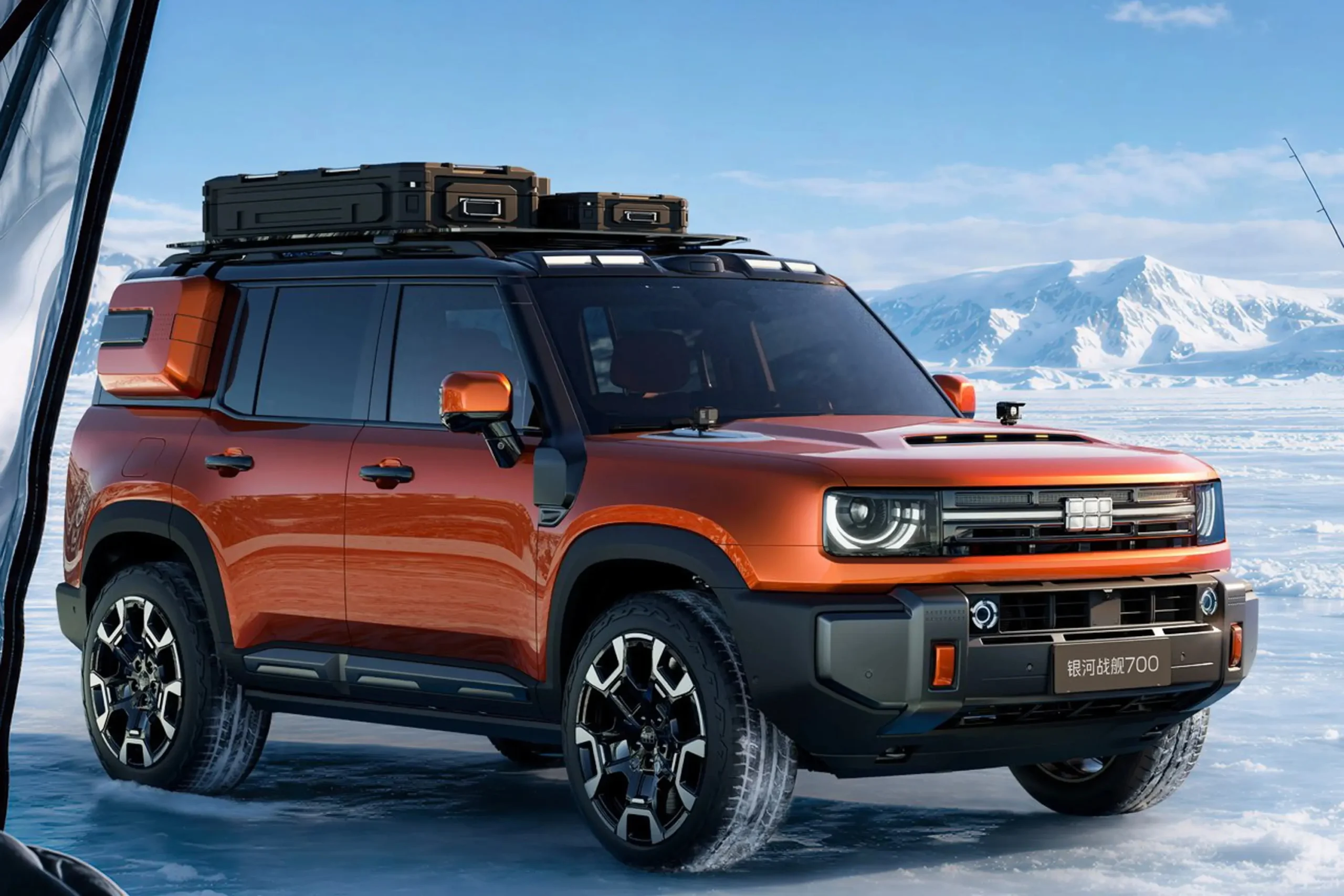
Renault and Geely, through their joint venture Horse Powertrain, unveiled an impressive plug-in hybrid system named 3DHT200. This powertrain outfits the upcoming Geely Galaxy Cruiser 700, sending 4,920 Nm to the wheels and capable of climbing slopes up to 45°. It’s a compact architecture that integrates two electric motors, an internal combustion engine, and a dedicated transmission for off-road. Focused on performance and integration, this technology also targets reduced fuel consumption and a combined output exceeding 1,100 hp.
A boxy SUV, dizzying figures, and a hybrid that promises to scale ramps like a climbing wall. The joint venture Horse Powertrain, owned by Renault and Geely, just revealed a new plug-in hybrid system dubbed 3DHT200, capable of delivering up to 4 920 Nm to the wheels and announcing climbs of up to 45°. This powertrain will debut in the forthcoming Chinese SUV Geely Galaxy Cruiser 700, a boxy 4×4 whose aim is clearly rugged off-road performance.
Behind this show of force lies a well-structured industrial strategy. Created in 2024, Horse Powertrain Limited unites Renault and Geely’s thermal and hybrid engine activities, with a shared capital of 45% for Renault, 45% for Geely, and 10% for Aramco, and about 19,000 employees. Its mission: supply powertrain assemblies to many brands within the two groups. The 3DHT200 becomes the third member of the 3DHT family and the first specifically sized for off-road use, with a PHEV 13-in-1 architecture and a 3‑speed hybrid gearbox dedicated to the engine side. This block will power the future Galaxy Cruiser 700, a model that already serves as a rolling laboratory for this technology and inevitably raises questions about what Renault could do with it tomorrow.
A compact 3DHT200 hybrid, 13-in-1, and torque-focused design
At the heart of this new unit lies a rechargeable hybrid architecture somewhat different from what Renault currently offers in Europe. The 3DHT200 brings together two electric motors: a P1 motor of 110 kW, or 148 hp, which starts the internal combustion engine and generates electricity, and a P3 motor of 230 kW, or 308 hp, dedicated to propulsion. This P3 drives the wheels directly through a single-ratio reduction gear and can exceed 20,000 rpm, enabling sustained speeds even when the primary effort is electric.
Between the two, a 3‑speed hybrid transmission on the engine side distributes the workload according to load and speed, with a stated promise: a 0-60 mph time in the vicinity of 3 seconds for large SUVs, while targeting 5 L/100 km.
Another standout feature is the level of integration. Horse Powertrain speaks of a 13-in-1 system, where the two electric motors P1 and P3, their controllers, the on-board charger, the DC-DC converter, the power-distribution module, the transmission-control unit, the power and thermal-management controllers, the 3DHT gearbox, and the motor reducer are all housed in a single compact sump. The package would cut the unit’s volume by about 10%. The engine maker has also evolved its permanent-magnet synchronous motors, moving from a “2V/VV” arrangement to a “3V/VVV” magnet design. The announced result is a 15% increase in torque density and a 20% increase in power density, for similar dimensions, which directly contributes to wheel torque availability.
4 920 Nm to the wheels, 45° slopes, and a Galaxy Cruiser 700 on display
These technical choices translate into a figure Horse Powertrain highlights: a maximum wheel torque of 4,920 Nm. This value accounts for the gear ratios of the transmission and the reduction gear, so it does not correspond to engine torque measured at the crank as on a conventional spec sheet. In practice, it serves mainly as a traction indicator, with a stated goal: allow an off-road vehicle to climb slopes up to 45°. This slope level, roughly a 100% gradient, sits closer to the ramps automakers test on than to everyday terrain, but it gives a sense of the traction potential being sought.
On the Geely Galaxy Cruiser 700, this front 3DHT200 unit is paired with a rear electric motor to form an electric all-wheel-drive system, a type of e-4WD. The SUV thus adopts a three-motor architecture for a combined power rating of 830 kW, or about 1,113 hp, with advanced 4×4 features such as crab mode, tank turn, and even an 80 km/h launch test. Ground clearance and wading capability are complemented by water-fording ability up to 800 mm, while the target consumption remains 5 L/100 km for a vehicle of this size. The Galaxy Cruiser 700 is planned to launch first in China, and this initial use of the 3DHT200 opens the door to possible variants for other Horse Powertrain client brands, including Renault, Dacia, or Alpine, though no specific applications have been announced yet.
Comparison Table
| Characteristic | Announced Value |
|---|---|
| Maximum wheel torque | 4 920 Nm |
| Maximum climbable slope | 45° |
| P1 motor power | 110 kW (148 hp) |
| P3 motor power | 230 kW (308 hp) |
| Combined power (3 motors) | 830 kW (1 113 hp) |
| 0-60 mph acceleration | About 3 seconds |
| Target consumption | 5 L/100 km |
| Wading capability | 800 mm |
Key Takeaways
- The Horse Powertrain 3DHT200 hybrid system delivers up to 4,920 Nm at the wheels.
- It enables an SUV to climb slopes of up to 45°.
- The Geely Galaxy Cruiser 700 will be the first model to feature this technology.
- The combined output of the three motors reaches 830 kW (1,113 hp) with an electric AWD system.
- The powertrain promises a fuel consumption of 5 L/100 km despite its performance.
- The “13-in-1” integration offers about a 10% reduction in volume versus comparable systems.
- This innovation could be adapted to other group brands, including Renault, in the future.
FAQ
What is the maximum wheel torque of Renault and Geely’s new hybrid system?
The 3DHT200 hybrid system delivers up to 4,920 Nm of wheel torque.
What slope can the SUV equipped with this system climb?
The Galaxy Cruiser 700 can handle slopes up to 45° thanks to the 3DHT200.
What is the announced combined power for the Geely Galaxy Cruiser 700?
The combined power of the three motors reaches 830 kW, about 1,113 hp.
What consumption does this new hybrid SUV aim for?
The target consumption is 5 L/100 km despite its performance.
Will this hybrid block be offered on Renault models?
For now, no specific Renault application has been announced, but it remains possible in the future.