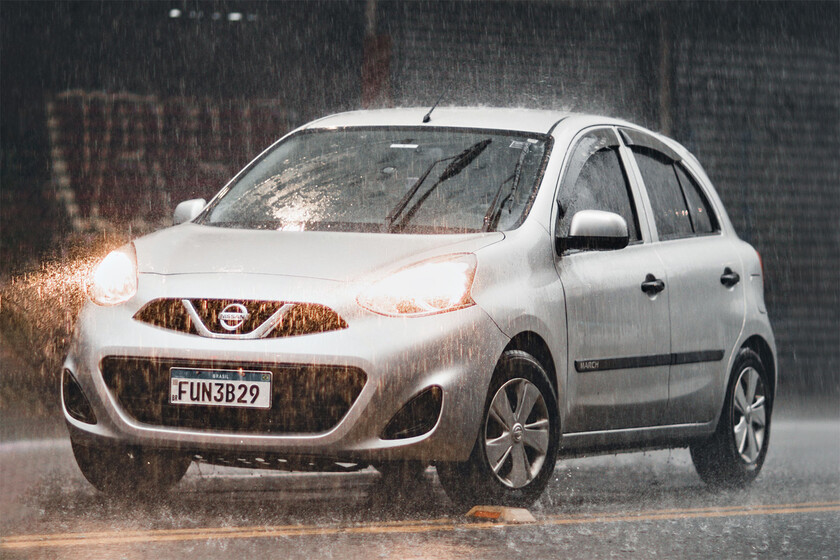
Protecting a car’s paintwork involves quality varnishes, frequent washes, sealing layers, and even covers. But according to a study published in Nature and picked up by Ars Technica, there is a threat that few take into account—the rain droplets themselves. Yet not in the way we imagine.
And what if rain damages cars not only because of the dissolved salt and acidity it carries, but also because of the electricity it bears? This is the surprising conclusion of a study published on August 26, 2026 in the journal Nature, led by a team from the Max Planck Institute for Polymer Research (Mainz, Germany), in collaboration with the University of Bonn, the South China University of Technology, MIT and Johannes Gutenberg University, of Mainz.
Drops that perforate the coating like an electric arc
Until now, rain-induced corrosion was explained by three known mechanisms: salts and acids dissolved in the water, the repeated mechanical wear of droplets as they strike a surface, and the resulting oxidation due to ambient oxygen. On this basis, most anti‑corrosion protections, such as paints or polymer films, are designed.
The team led by Zhongyuan Ni, Rüdiger Berger and Hans-Jürgen Butt has identified a fourth mechanism, previously ignored, the electric charge. As droplets of water slide over insulating surfaces, they become spontaneously electrified, a phenomenon similar to the static electricity generated when rubbing a balloon.

The phenomenon is called sliding electrification. When a water droplet—naturally charged in storms, on waves, or in waterfalls—slides over an insulating surface (a leaf, a window, a canopy), it exchanges electric charge with that surface. When it then drops onto a metal, it releases that charge.
To demonstrate it, the researchers slid water droplets over four common insulating surfaces: a plant leaf, a sheet of PVC foam, polystyrene and quartz coated with a hydrophobic coating (PFOTS), before letting them fall onto copper plates coated with Teflon.
After a few dozen droplets, there was no visible wear. But after 3,000 impacts, equivalent to a moderately rainy afternoon, the Teflon was perforated and the underlying copper severely corroded, with pits deeper than the film’s thickness. By contrast, uncharged droplets that fell without sliding beforehand left no trace after the same number of impacts.
The electric charge measured remains tiny: between 0.2 and 2 nanocoulombs per drop, far less than a conventional static discharge you might feel when touching a metal door handle. Yet, relative to the size of a raindrop, this charge corresponds to a potential difference that can exceed 1,000 volts at the moment of impact.
According to the researchers, this electric field can become intense enough to trigger dielectric breakdown, literally a small arc that punctures the insulating coating, before electrochemical reactions attack the metal beneath.
The authors point out that this mechanism could explain, at least in part, why some metal structures, despite being well maintained, degrade faster than expected. The Eiffel Tower, for instance, needs a full repaint roughly every seven years, a monumental task whose exact wear mechanisms had remained unclear. Ships, building facades, monuments and, of course, car bodies are other surfaces potentially affected.
For cars, the challenge is direct. The paint and varnish layers that shield the sheet metal from rust could be more vulnerable than previously thought, not only to UV rays, gravel spray, or pollution, but also to this electric phenomenon hitherto invisible.
The researchers caution, however, that the commercial coatings used on vehicles tend to be thicker than the Teflon film tested in the lab, which could limit the effect in practice, without eliminating it entirely.
The study thus opens a new line of inquiry to develop protective coatings that can resist not only mechanical wear and chemical attack, but also these microelectric discharges. According to the authors, dielectric strength will henceforth be considered an additional criterion in the design of industrial paints and varnishes.
Images | Alan Paura, Matheus Bertelli, Lübna Abdullah