In Brief
The Praga Bohema set a new benchmark at Spa-Francorchamps on August 12, 2026 during a track day, eclipsing the Pagani Huayra Roadster BC with a lap of 2:21.420. This record was achieved without any special prep and on street tires, underscoring the Bohema’s effectiveness in conditions close to real-world use. The combination of a light chassis, high aerodynamic efficiency, and a favorable weight-to-power ratio allowed the Czech hypercar to outpace more powerful rivals. While this time remains claimed, it establishes a new standard for road-legal hypercars at Spa.
At Spa-Francorchamps, seasoned track-day regulars lifted their eyes from behind their steering wheels as a black, low-slung hypercar with a multitude of wings swept through Eau Rouge at an unusually high speed. Not a Pagani, not a Ferrari, but a little-known silhouette from the Czech Republic, tucked among a routine client track day.
This lap wasn’t intended to count for anything more than any other run, yet the time posted upon returning to the pits upends a benchmark set in 2020 by an Italian icon. In 2:21.420, the Praga Bohema asserts a new record for a road-legal car on the Spa-Francorchamps circuit, faster than the Pagani Huayra Roadster BC which previously stood as the reference. And it’s especially the way this time was achieved that has enthusiasts buzzing.
Praga Bohema Spa Record: a 2:21.420 to Beat Pagani
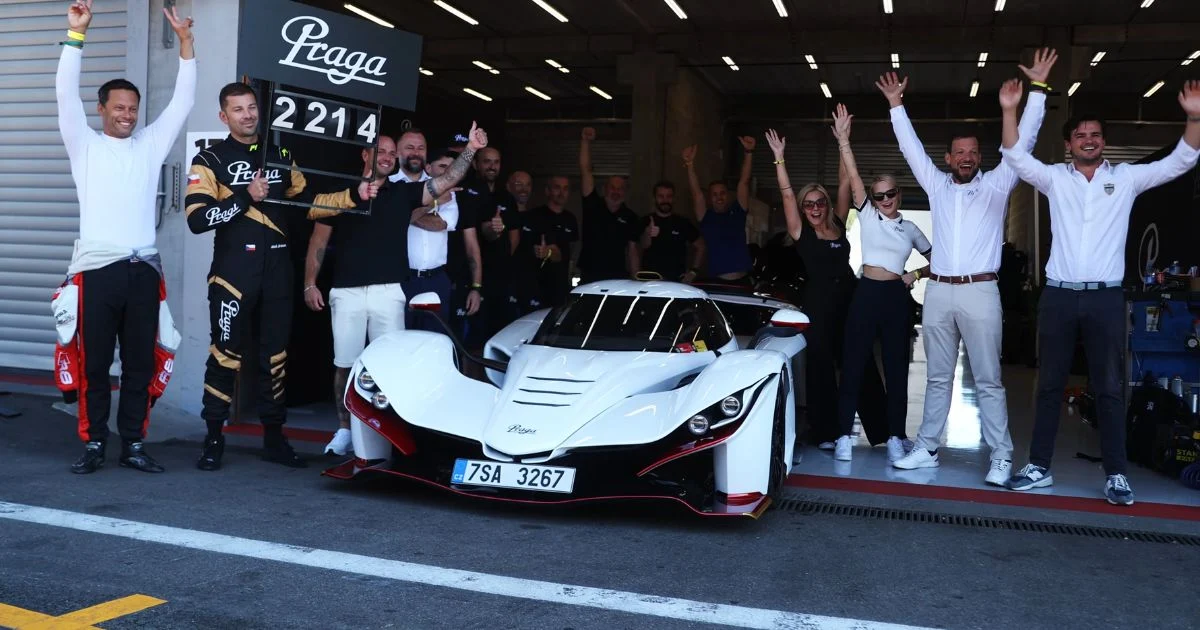
On August 12, 2026, during a Curbstone track day that mixed various prestige cars, the Praga Bohema covered Spa-Francorchamps’ 7 kilometers in 2:21.420, on its 100% street tires. The lap time is approximately 1.6 seconds faster than the Pagani Huayra Roadster BC’s 2:23.081 recorded on September 4, 2020, which Pagani had promoted at the time as a record for road-legal cars globally.
According to Praga, this lap wasn’t executed as part of a dedicated attempt, but rather occurred during a full client session, with traffic on track. Aleš Jirásek, the company’s development pilot who was behind the wheel that day, described the mindset: “We weren’t at Spa to chase a record,” Jirásek told Motor1. “We were there with clients to enjoy one of the world’s most beautiful tracks.” The pilot adds that the car “received no special preparation,” a detail that places this time in a very real-world context. At this stage, no independent timing sheet or official validation from Spa-Francorchamps or Curbstone has been published, leaving the 2:21.420 as a claimed time by the manufacturer, albeit backed by well-documented evidence.
Why the Praga Bohema Beats the Pagani Huayra Roadster BC at Spa
On paper, the Bohema doesn’t boast the raw horsepower of a Pagani, but it trades for a different advantage. Hidden beneath its carbon fiber bodywork lies a 3.8-liter twin-turbo V6 delivering 690 hp and 535 lb-ft (≈725 Nm) of torque, paired with a 6-speed sequential transmission. The curb weight stays under 2,200 lb (less than 1,000 kg), whereas a Pagani Huayra Roadster BC weighs in around 1,250 kg with a 6.0-liter twin-turbo V12 and 800 hp, plus about 1,050 Nm of torque. The power-to-weight advantage clearly favors the Praga, which shows up in every uphill pull—from Eau Rouge to Raidillon and into Kemmel—where it muscles ahead more easily. Zero-to-100 km/h comes in under 3 seconds and top speed is limited to roughly 317 km/h (about 197 mph), underscoring the car’s emphasis on efficiency per lap rather than raw top speed.
The other differentiator is aerodynamics. Praga quotes about 1,984 lb of downforce, roughly 900 kg, at 155 mph (about 250 km/h). In other words, at very high speeds the Bohema nearly generates its own weight in downforce, allowing it to carry more speed through Spa’s large, fast corners like Pouhon and Blanchimont, brake later, and remain stable where the circuit’s rhythm matters most. The Huayra Roadster BC, by contrast, aims for around 500 kg (about 1,100 lb) of downforce at 280 km/h (about 174 mph)—a high figure, but substantially lower in absolute terms. Result: this Czech, carbon monocoque hypercar—built with a GT3-like mindset and a road-legal plaque—turns a lap that feels more like a race car than a traditional supercar. The benchmarks speak for themselves:
- Praga Bohema: 2:21.420 (street tires, track day Curbstone)
- Pagani Huayra Roadster BC: 2:23.081
- Formula 4 at Spa: 2:22.522
- Radical Cup: 2:22.325
- Ferrari Challenge: 2:19.084
- McLaren Senna: around 2:24.82
This positioning highlights what that lap really represents: a street-registered car running on a circuit day at a pace closer to a purpose-built race car than to conventional hypercars. Praga plans to build only 89 Bohema units, with an asking price of €1.28 million before tax, and the first examples are already on public roads and in rallies. For the hobbyists who chase outright lap times, this 2:21.420 at Spa becomes a striking new benchmark that other hypercars will eventually have to chase on the same Ardennes tarmac.
Comparison Table
| Model | Lap Time (Spa) | Engine | Power (hp) | Torque (Nm) | Curb Weight (kg) | Downforce (kg @ high speed) | Top Speed (km/h) | 0-100 km/h | Price (excl. tax) |
|---|---|---|---|---|---|---|---|---|---|
| Praga Bohema | 2:21.420 | V6 3.8L Twin-Turbo | 690 | 725 | < 1000 | 900 (at 250 km/h) | 317 | < 3 s | €1.28 M |
| Pagani Huayra Roadster BC | 2:23.081 | V12 6.0L Twin-Turbo | 800 | 1 050 | 1 250 | 500 (at 280 km/h) | Not specified | Not specified | Not specified |
| Formula 4 | 2:22.522 | Not specified | Not specified | Not specified | Not specified | Not specified | Not specified | Not specified | Not specified |
| Radical Cup | 2:22.325 | Not specified | Not specified | Not specified | Not specified | Not specified | Not specified | Not specified | Not specified |
| Ferrari Challenge | 2:19.084 | Not specified | Not specified | Not specified | Not specified | Not specified | Not specified | Not specified | Not specified |
| McLaren Senna | 2:24.82 | Not specified | Not specified | Not specified | Not specified | Not specified | Not specified | Not specified | Not specified |
Key Takeaways
- The Praga Bohema set a new Spa lap record with a 2:21.420 during a track-day on August 12, 2026.
- This time beats the Pagani Huayra Roadster BC’s previous mark from 2020.
- The feat was achieved without any special preparation, in client conditions, and on street tires.
- The Bohema wins thanks to its light weight, strong aerodynamic downforce, and an excellent power-to-weight ratio.
- Its performance is closer to that of a race car while remaining road-legal.
- Production will be limited to 89 units, with a price tag of €1.28 million excluding tax.
FAQ
What time did the Praga Bohema set at Spa-Francorchamps?
The Praga Bohema posted a lap of 2:21.420 during a track-day at Spa-Francorchamps.
Why is this Praga Bohema record notable?
It was achieved during a standard track-day session, with street tires and no special preparation, reflecting real-world use.
How does the Praga Bohema compare to the Pagani Huayra Roadster BC?
The Bohema is lighter and benefits from greater aero downforce, despite lower power, enabling a faster Spa lap.
Has the Bohema’s lap time been officially validated?
As of now, no independent official validation has been published; the time remains claimed by the manufacturer.
How many Praga Bohemas will be produced?
Praga plans to build only 89 units of the Bohema.